The Pope Warned Us About AI. But We’re Missing the Spiritual Question.
Danielle A. Davis Canty / May 28, 2026Danielle A. Davis Canty is the senior advisor and director of technology policy at the Joint Center for Political and Economic Studies, host of The Miseducation of Technology Podcast, and a Public Voices Fellow on Technology in the Public Interest with The OpEd Project.
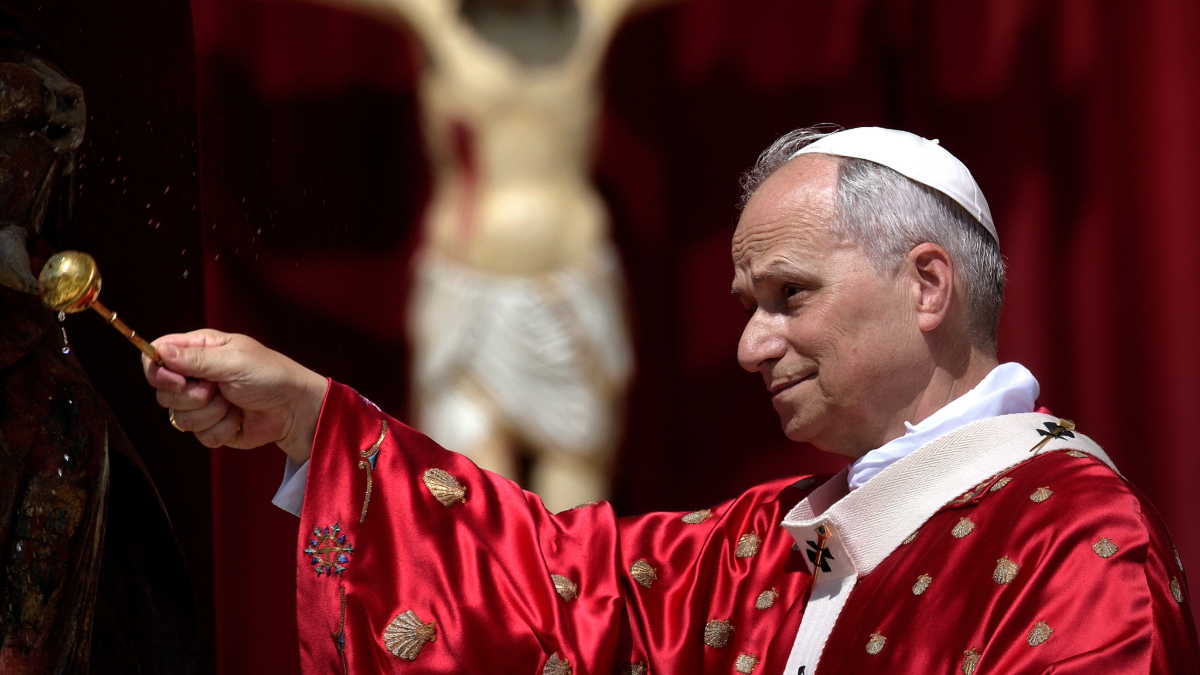
VATICAN CITY: On May 25th, the first encyclical of Pope Leo XIV, Magnifica Humanitas, will be presented at the Vatican. The photo is part of a collection of photos of Pope Leo XIV. Photo by: Stefano Spaziani/picture-alliance/dpa/AP Images
In Magnifica Humanitas, his recent encyclical on artificial intelligence and human dignity, Pope Leo XIV warns that AI poses profound risks to labor, truth, warfare, inequality, and human relationships. The document is a serious and necessary intervention into one of the defining debates of our time. But as I read it, I found myself returning to a different question—one that remains largely absent not only from the Vatican’s reflections, but from mainstream technology policy discourse more broadly:
What happens when artificial intelligence begins reshaping spiritual life itself?
The modern AI debate has become remarkably sophisticated when discussing material harms. Policymakers debate algorithmic bias, surveillance, labor displacement, privacy, misinformation, and intellectual property. Ethicists warn about autonomous weapons, synthetic media, and the concentration of technological power. Environmental advocates raise concerns about the immense energy demands of AI data centers.
Yet, comparatively little attention has been paid to the spiritual implications of artificial intelligence: what it means when machines increasingly mediate prayer, confession, grief, moral discernment, pastoral counseling, and even the search for meaning itself.
This omission matters more than many realize.
Artificial intelligence is no longer confined to productivity tools and search engines. AI systems are subtly entering spaces historically governed by trust, community, ritual, and spiritual authority. Faith-based chatbots now answer theological questions in the voice of Jesus or other prominent biblical figures. Generative AI tools draft sermons, devotional plans, prayers, and moral reflections. Individuals increasingly disclose intimate fears, emotional struggles, and spiritual doubts to conversational AI systems designed to simulate empathy and understanding.
In these interactions, something profound is occurring beneath the surface: deeply personal spiritual expression is becoming data.
Every prayer typed into an AI system, every confession offered to a chatbot companion, every vulnerable spiritual question entered into a machine-learning interface becomes part of a computational process built not around care or covenant, but around prediction, optimization, and extraction.
This is not merely a technological development. It is a transformation in spiritual authority.
For centuries, spiritual life has been mediated through institutional structures: clergy, congregations, sacred texts, communal traditions, and pastoral relationships. These structures were imperfect (often gravely so), but they were grounded in shared ethical obligations and human responsibility. Artificial intelligence systems, by contrast, are governed primarily by terms of service, engagement metrics, and proprietary models largely invisible to the public.
The question, then, is not simply whether AI can generate religious content. It is whether societies are prepared for a world in which algorithmic systems increasingly shape how human beings experience moral guidance, transcendence, comfort, confession, and spiritual belief.
This concern extends beyond any single faith tradition. Religious expression has always shaped broader cultural understandings of morality, community, dignity, and meaning. When spiritual practices become mediated through systems optimized for computational efficiency rather than human discernment, the effects are not isolated to houses of worship. They ripple outward into the social and ethical fabric of public life itself.
I have begun describing this emerging area of inquiry as “sacred data ethics,” a framework examining how artificial intelligence systems intersect with sacred expression, emotional vulnerability, religious authority, moral formation, and the law in the digital age.
At the center of this framework is the concept of “sacred data:” spiritually significant human expression that becomes extractable, analyzable, and reproducible within AI systems. This includes prayer requests, confessions, devotional reflections, moral struggles, grief, doubt, longing, and hope.
Historically, these experiences existed within relational and communal contexts that gave them meaning and protection. Today, they increasingly flow into systems capable of storing, modeling, and repurposing them at scale.
The implications are not merely theological. They are also legal, cultural, and political.
In the United States, artificial intelligence remains governed by a fragmented and still largely underdeveloped regulatory landscape at the federal level, particularly in areas involving data collection, behavioral profiling, surveillance practices, and generative AI systems. Within that vacuum, American privacy law currently does not provide a meaningful distinction between sacred expression and ordinary consumer data. A devotional journal entry entered into an AI chatbot may receive no greater protection than a shopping query or product review. Clergy-penitent privilege—long recognized as essential to protecting spiritual vulnerability—does not extend cleanly into interactions with AI systems increasingly positioned as emotional, relational, or even spiritual companions.
As these systems become more sophisticated, the distinction between tool and spiritual authority may also begin to blur. AI does not merely respond to spiritual expression; over time, it may subtly shape it. Systems trained on millions of interactions can begin reproducing patterns of belief, moral reasoning, and emotional response back to users in ways that influence future behavior and understanding.
This raises difficult questions that neither Silicon Valley nor many traditional institutions appear fully prepared to confront.
Who governs sacred data?
Who benefits from its extraction?
What happens when the language of faith becomes raw material for predictive systems?
And what becomes of human discernment when increasingly intimate dimensions of spiritual life are mediated through machines optimized for engagement rather than wisdom?
These questions are especially significant for Black faith communities, where spiritual institutions have historically served not only religious purposes, but cultural, political, and communal ones as well. For generations, Black churches have functioned as spaces of survival, resistance, dignity, and collective memory in the face of exclusion from traditional structures of power. To treat the spiritual expressions emerging from these communities as merely another source of behavioral data is to fundamentally misunderstand what is being extracted.
Artificial intelligence will continue evolving. And faith communities will continue adapting alongside it. Therefore, the issue is not whether technology should exist within spiritual life at all. The issue is whether society will develop ethical, legal, and cultural frameworks capable of protecting what is sacred before these systems become fully embedded into the intimate architecture of human belief.
The conversation about AI cannot remain limited to economics, labor, or misinformation alone. Those concerns are real, but they are incomplete.
The deeper challenge may ultimately be this: artificial intelligence is not only changing how we work or communicate. It is beginning to shape how human beings process what it means to seek comfort, spiritual authority, moral understanding, transcendence, and even worship itself. Yet, our legal and governance frameworks remain profoundly unequipped to confront these developments.
Once systems built for prediction begin mediating humanity’s most sacred forms of expression, the debate over artificial intelligence can no longer remain confined to material harms alone; we must also grapple with its spiritual implications.
I am currently developing this work through an emerging interdisciplinary framework I call “sacred data ethics,” exploring the intersection of artificial intelligence, faith, law, and human autonomy in the digital age. Readers interested in following this research can find more of my work through my forthcoming project, Sacred Data, Secular Algorithms.
Authors