The UK-US Tech Deal Exposes the Limits of Britain's AI Ambitions
Megan Kirkwood / Oct 27, 2026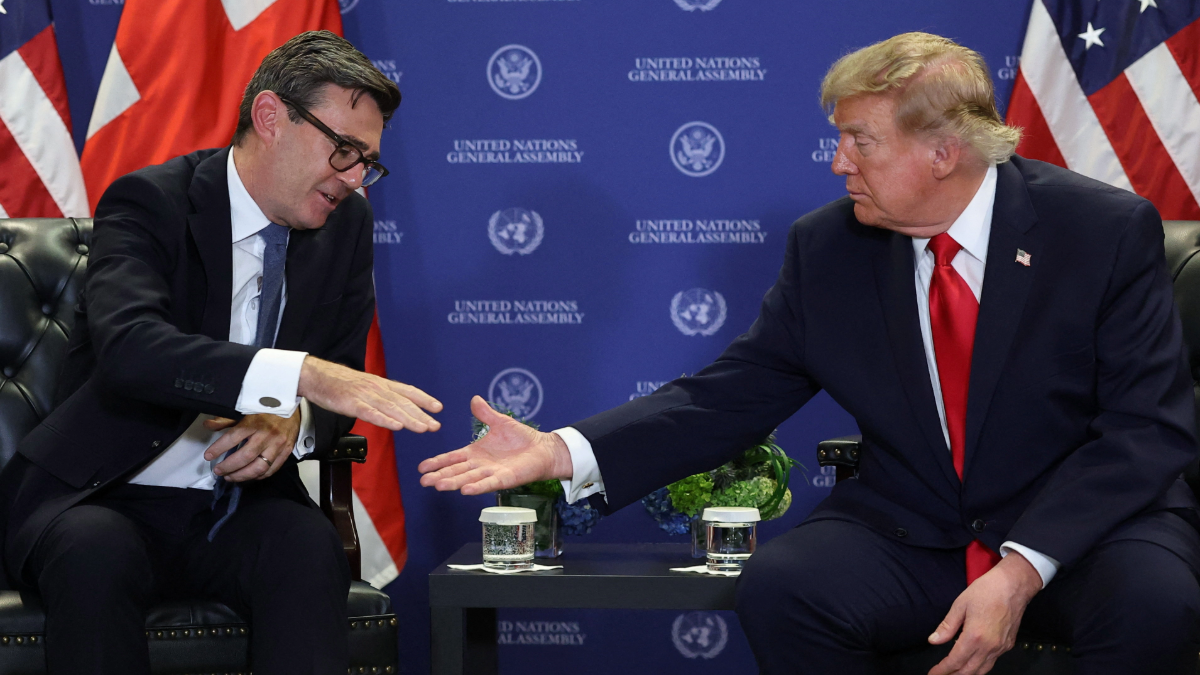
Prime Minister Andy Burnham (left) meets with US President Donald Trump during his visit to the US to attend the United Nations General Assembly on Sept. 22, 2026, in New York. Photo: Toby Melville/PA Wire POLITICS (Press Association via AP Images)
The UK-US Tech Prosperity Deal has tentatively returned to the negotiating table, but its revival remains partial. In February, the Financial Times reported that talks on the UK-US Tech Prosperity deal had restarted, though efforts to reach an agreement over the UK’s Digital Services Tax and online safety rules remain stalled. The US has also renewed its push to remove digital taxes by threatening 100% tariffs on countries introducing them.
The deal was originally based on an informal Memorandum of Understanding (MOU) establishing collaboration between the two nations on nuclear energy and quantum technologies, joint AI research initiatives, promoting exports of data centers and AI models, aligning policy and co-development of standards in AI. Alongside the deal, tech companies like Microsoft, Nvidia, OpenAI, Google and CoreWeave had announced a combined £31 billion of investment, mostly through building AI infrastructure.
The much-publicized deal, intended to bind the AI ambitions of the two nations, almost immediately fell through due to continued trade disagreements, particularly rules restricting American agricultural products, online safety regulations and digital taxes. One year on, and investment pledges linked to the deal have been abandoned while public sentiment largely opposes the very infrastructure buildout the deal hinges on.
The future of the UK-US Tech Prosperity Deal remains uncertain as renewed negotiations raise questions over whether the UK government will trade away digital regulatory powers in pursuit of closer ties with Washington, even as questions remain over what benefit the UK has to gain from such a deal.
Renewed talks raise questions over digital regulation and autonomy
Under the Starmer Labour government, the party had made it its mission to “mainline” AI into the veins of the nation, encouraging vast infrastructural buildout of data centers through “AI Growth Zones” and accepting a slew of deals and investments from private firms. His government was accused of jeopardizing regulation to appear pro-business, as well as prioritizing Big Tech perspectives when consulting on policy initiatives. Their vision was that AI was to boost economic growth, and largely pinned their hope on US investment dollars to achieve this.
The new Prime Minister, Andy Burnham, had indicated before taking office that his government would depart from the Starmer government on technology strategy, suggesting he would support stronger regulatory enforcement and abandon the “tech boosterism” that marked his predecessor’s reign. In practice, though, he has arguably taken a more “scattered” approach.
Signs suggest the Burnham government may be willing to make concessions to appease Trump and avoid further tariffs. In August, reports said the Burnham government is willing to “discuss” the UK’s Digital Services Tax with the US, though Politico reported that, rather than scrapping the tax entirely, it would be replaced by “a global solution” once it is in place. Civil society organizations have expressed concern at the possibility that the tax may be traded for a trade deal and have urged the government not to cave to pressure.
The Digital Services Tax is a 2% tax on revenues derived from UK users' use of services such as search engines, social media, and online marketplaces, though it applies only to firms with revenues exceeding £500 million globally and £25 million from UK users. Several European countries have similar taxes in place.
When the Digital Services Tax was first announced in 2020, the US administration under President Trump’s first term threatened tariff retaliation, arguing that it unfairly discriminated against US firms like Google and Amazon. The tax had been introduced due to “a misalignment between the place where profits are taxed and the place where value is created,” and was intended to “ensure the large multinational businesses in-scope make a fair contribution to supporting vital public services.” The UK almost cut the tax under the Starmer government in exchange for reduced tariffs, though ultimately it has stayed in place.
The second Trump administration has continued to double down on fighting digital taxes across the globe, releasing a Memorandum warning countries that taxes and regulations deemed to “discriminate” against US firms would be investigated and penalized through tariffs.
However, potentially even more contentious to the US are online safety rules. The UK’s Online Safety Act is a regulation enforced by Ofcom, the UK’s media and communications regulator, aimed at tackling illegal content on online platforms and protecting children from accessing harmful content. The Act takes a tiered approach, with the largest or most risky firms obligated to adhere to the strictest rules.
The US administration has expressed concern over the potential for the Online Safety Act to “censor” citizens, and also that it “disproportionately” affects large American firms. The EU, which has similarly come under fire for its own tech regulations, has defended its sovereign right to enforce its own laws, though there are signs that the EU may have stalled regulatory enforcement to avoid prompting unwelcome attention from the US President. Under Starmer, the Online Safety Act and digital competition rules were under discussion as part of trade talks with the US, but faced significant backlash and were walked back.
Meanwhile, the Trump administration has been criticized for its closeness to the tech industry. Following the massive spending from the tech industry to make good with Trump, including their willingness to back him on policy changes, the administration in turn has been ready to protect its interests both at home and abroad. Coupled with the fact that the second Trump administration has leaned on tech companies to coerce institutions and nations, creating a digital kill switch, there is increasing recognition from the EU and UK that they may not be able to trust the US, highlighting the need for greater technological sovereignty.
While the EU has implemented an official strategy on the matter, the UK has a murkier definition of what sovereignty means. The Starmer government was continually accused of maintaining a cozy relationship with US tech giants, with a rotating door of officials moving into the tech industry and previous tech executives moving into regulatory roles, and heavy involvement by the industry in shaping government policy. Indeed, the UK-US Tech Prosperity Deal itself appeared generally one-sided. Under that deal, the tech giants accrued much of the benefit, allowing them to build “private infrastructure that simply channels profits back to US headquarters.”
With increasing pressure from within the government and the general public to reduce reliance on US tech giants, Burnham’s government must consider the inherent imbalance of power between themselves and a US administration backed by Big Tech.
How a digital trade deal could constrain UK regulation
Concerns that the UK may continue to negotiate trade deals that favor Big Tech firms are explored in a report from Trade Justice Movement, a coalition of civil society organizations calling for trade “justice” which “tackles poverty and protects the environment.” Their report, The Price of the Deal, examines how digital trade rules promoted by the US could restrict the UK government's ability to introduce mandatory AI rules, constrain Ofcom's enforcement powers under the Online Safety Act, weaken enforcement of the Digital Markets, Competition and Consumers Act, and weaken protections for personal data.
The report analyzes trade agreements signed between the US and other countries to understand what terms the US is demanding in exchange for lower tariffs following the Trump administration’s imposition of global tariffs. The report points to “non-discrimination” for digital products and services, a policy that is intended to promote liberal free trade, which can be used to shield tech giants from regulation.
The authors point out that because digital markets are largely dominated by a handful of US firms, “almost any regulation aimed at market power, scale, or systemic risk will, in practice, fall most heavily on those firms.” Where legislation uses quantitative criteria like revenue thresholds or end user numbers to tier obligations so that smaller firms avoid over-regulation while large firms must have the highest regulatory burden, the largest firms are all likely to be based in the US, which may be characterized as de facto discrimination. The authors argue that “it is unclear whether the UK could resist US demands to include such a clause in a potential UK-US digital trade agreement,” illustrating that other agreements on reciprocal trade have included them.
Such an agreement, the authors argue, would immediately jeopardize regulations such as the Online Safety Act and the Digital Markets, Competition and Consumers Act, which both either directly target the largest firms, as is the case with the latter, or place the most obligations on the biggest firms, such as the tiered Online Safety Act. Both would be subject to non-discrimination rules were such an agreement signed. In addition, a Digital Services Tax would also likely be captured by non-discrimination rules, by virtue of the largest firms being US-based.
In general, the report warns that a digital trade agreement risks not only “a poor bargain on the substance,” but also “that the substance would not be settled by the bargain at all.” The US holds all the power in tech negotiations. The biggest firms are based in the US, and the US is the UK’s biggest export market. Meanwhile, the UK continues to tie itself to the US in tech, maintaining close ties with those firms, and relying on them to provide public services.
US tech giants' rhetoric continues to shape UK public policy, pushing for unpopular hyperscale data centers to be built, despite the fact that they are unlikely to benefit the local population. The UK already struggles to regulate the same giants it depends on for critical infrastructure, illustrating the need for the Burnham government to prioritize greater technological sovereignty. A renewed tech deal may trade away the government’s only tools to tame the tech giants.
Authors