Transcript: Senators Press FTC Members on Independence from Trump at Hearing
Cristiano Lima-Strong / Apr 16, 2026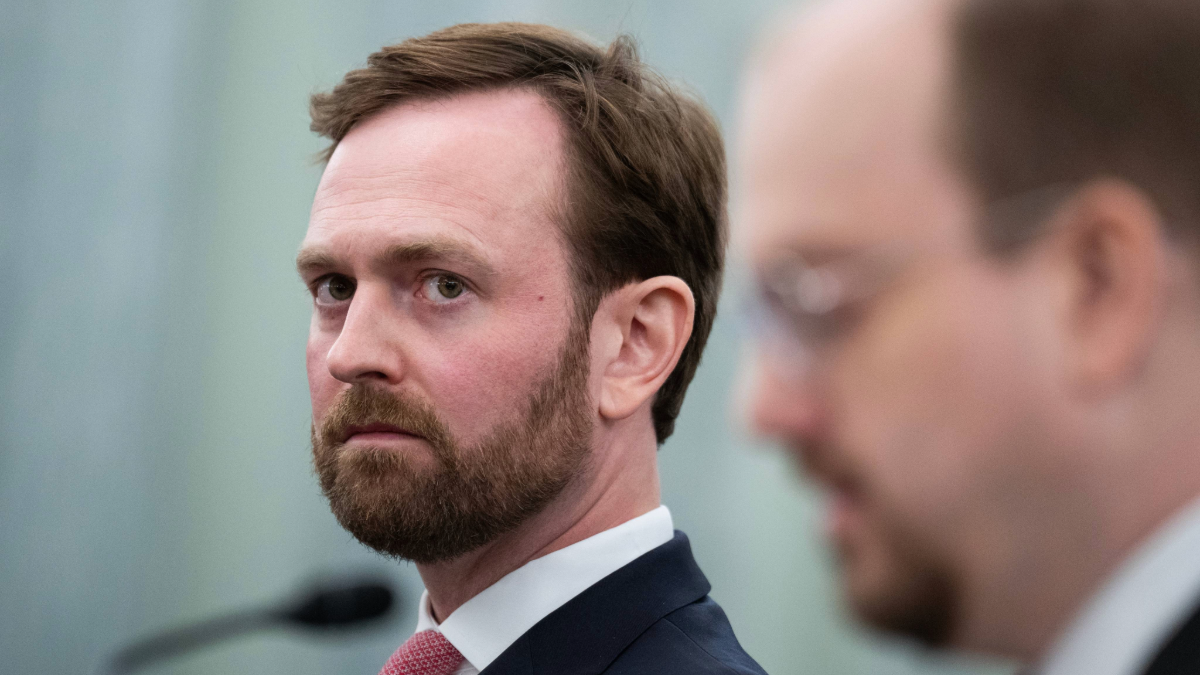
Federal Trade Commission Chairman Andrew Ferguson, left, and Commissioner Mark Meador testify during the Senate Commerce, Science and Transportation Committee hearing titled "Oversight of the Federal Trade Commission," in the Russell building on Wednesday, April 15, 2026. (Tom Williams/CQ Roll Call via AP Images)
The Senate Commerce Committee held an oversight hearing with members of the Federal Trade Commission (FTC) on Wednesday, a session that turned contentious at times as Democrats criticized President Donald Trump’s firing of the agency’s Democratic commissioners and questioned its Republican leaders about their commitment to independent enforcement.
The panel heard testimony from FTC Chairman Andrew Ferguson and Commissioner Mark Meador, the only two commissioners still serving on the five-member body after Trump’s firings last year of Democrats Rebecca Kelly Slaughter and Alvaro Bedoya and Republican Melissa Holyoak’s separate departure for a federal law enforcement role.
The Supreme Court is expected to soon weigh in on Trump’s firings of the two Democrats, a case that most legal experts expect the White House to win. That likely outcome, though, did not deter Democrats on the committee from pressing the agency’s existing leadership on whether they have faced any undue pressure from Trump or other White House officials.
Here are some of the key moments:
- Democrats kicked off the hearing by highlighting the absence of Rebecca Kelly Slaughter and Alvaro Bedoya, who President Donald Trump fired from the commission. Sen. Maria Cantwell (D-Wash.), the panel’s ranking member, said the Trump administration was “neutering the FTC” with firings that “eviscerated” its independence. Senate Commerce Chairman Ted Cruz (R-Texas), reportedly under consideration for a future Supreme Court vacancy, said he believed Trump had the authority to fire them and that the high court will uphold the moves.
- Ferguson was repeatedly pressed to say whether the president or his staff had sought to influence the agency’s enforcement action. Asked by Sen. Andy Kim (D-N.J.) if White House officials had asked him to take up or turn away cases, or to rule in cases any particular way, Ferguson said no. Ferguson did later say in an exchange with Sen. Ben Ray Luján (D-N.M.) that he had “discussed policy questions that are in front of the FTC with the relevant advisors within the White House,” but he declined to comment on any discussions with Trump.
- Pressed by Luján on whether they would hypothetically accept an order by a future Democratic president firing them, both Ferguson and Meador said that they would.
- In a few moments of bipartisanship, both Ferguson and Meador stressed the importance of enforcing the TAKE IT DOWN Act, a recently signed law criminalizing the distribution of non-consensual intimate imagery and requiring platforms to remove such material. Ferguson said the agency is “working assiduously to prepare for robust enforcement” of it. “It’s fantastic and critical that we have this tool … and that’s why it’s such a high priority,” Meador added.
- Ferguson expressed agreement with Cruz that the agency ought not overstep its enforcement mandate when it comes to AI harms. “Comprehensive, early-stage, generalized regulation of AI, as the AI Act does in the European Union, is a recipe for killing innovation,” Ferguson said, later adding that the FTC must “not become the general all-purpose AI regulator.”
Below is a lightly edited transcript of the hearing, “Oversight of the Federal Trade Commission.” Please refer to the official audio when quoting.
Sen. Ted Cruz (R-Texas):
Good morning. The Senate Committee on Commerce Science and Transportation will come to order. I appreciate everyone being flexible with the time. I know we were going to gavel in at 10:00, but there was a Senate Foreign Relations Committee markup that was also at 10:00. So part of the joys of this job is trying to be two places at once. So thank you for everyone for the flexibility in shifting this a little bit later. I want to welcome Federal Trade Commission Chairman Andrew Ferguson and Commissioner Mark Meador. Thank you both for being here today. Let me begin by congratulating Chairman Ferguson. In just one year, the FTC has returned more than $3.2 billion in ill-gotten gains to consumers. More than the commission returned during the entire Biden administration, more in one year than the Biden administration did in four. And just this morning, the FTC is filing a settlement with major advertising firms that had effectively colluded to boycott conservative news sites.
Whether advancing free speech or preparing to enforce the Landmark Take It Down Act, which holds big tech accountable for deep fake revenge porn or stopping deceptive ticketing practices, it's clear you've been busy. It's a job well done, and I look forward to hearing more about the FTC's recent successes. In 1914, Congress created the FTC in line with President Woodrow Wilson's vision of an expert, independent, and impartial agency that would supposedly put politics aside. Congress delegated broad authority to protect consumers from unfair or deceptive acts or practices and unfair methods of competition. It intentionally did not define or articulate these terms, believing that a flexible, adaptable FTC could use its expertise to develop them through case by case enforcement with courts serving as the check. But President Wilson's fever dream of an omnipotent bureaucracy, precisely weighing benefits and costs free from grubby politics has not come to pass.
At times, the FTC has stretched its powers far beyond Congress's mandate, inserting itself in nearly every sector of the economy in ways unaccountable to the public. Rather than rely on Article III courts, the supposed backstop, the FTC has used its administrative courts. Rather than prove its case in court, the FTC is too often sued to swiftly settle. Imposing detailed, forward-looking obligations and consent orders that read more like legislation than case-specific remedies. Given the FTC's broad investigative powers, businesses that dispute allegations of wrongdoing often have no choice but to comply rather than risk the reputational harm that can stem from a public fight. There have been times when the FTC has exercised such tools judiciously. There's no doubt the FTC's antitrust and consumer protection missions remain critical. I saw firsthand when I headed the FTC's Office of Policy Planning, working alongside skilled staff on complex issues of technology, competition, and consumer protection.
But when Congress delegates broad powers to an agency without guardrails or limits and without conducting consistent oversight, that agency inevitably will test and expand its authority. It's why during the Biden administration, FTC Chairwoman Lina Khan went well outside the agency's legal authority and instead pursued a weaponized political agenda. It was hardly the first time the FTC unlawfully expanded its authority. Notably, in the 1960s and '70s, amid a period of FTC massive overreach and rulemaking binges, even the Washington Post dubbed the agency the "national nanny." How did Congress respond then? It exercised its own authority and refused to fund a rogue agency until the agency instituted reforms. That history is instructive. In light of the Supreme Court's decision in EPA versus West Virginia and in Loper Bright as well, Congress has a clear responsibility to review the authorities of each agency, including the FTC, to more carefully define and limit them.
That's how we keep agencies accountable to the American people. It's shocking then that it's been nearly six years. The entirety of the Biden administration and the Democrat controlled Senate since the FTC commissioners appeared before this committee for an oversight hearing. Instead of asking hard questions of the FTC, Congress has treated it like a regulatory genie. Whenever a problem merges, particularly one involving new or rapidly evolving technology, we make a wish and say, let the FTC handle it. For example, Congress has considered legislation to have the FTC regulate the totality of the internet through sweeping data privacy rules. AI, setting up the FTC as the national speech police, and college sports replacing the role of universities in the NCAA. When Congress does give FTC new authorities or responsibilities, it never seems to revisit the existing broad powers the FTC has misused in the past. The last time Congress meaningfully acted to restore accountability at the FTC was 1996.
30 years is long enough for Congress to go without seriously considering FTC reform. One clear area of need is consent decree reform. Time and again, the commission has saddled companies and their workers with multi-decade orders that go far beyond correcting for any alleged misdeed. Done right, consent decree reform has the potential to eliminate red tape on small businesses, lower prices for consumers, increase investment, create jobs, grow the economy, prevent censorship of American speech, and hold bureaucrats accountable. I'm hopeful that my colleagues and I might be willing to work together on this. I will say there are other areas where the FTC can and should do more within its core areas of expertise. This committee has already acted by passing the Take It Down Act, and many of my colleagues on both sides of the dais have put forward thoughtful, practical bills to crack down on deceptive and hidden fees, address bots in the ticketing market, and better protect Americans from frauds and scams.
As I noted during the Biden administration, this committee did not conduct a single oversight hearing into the FTC. Even though this is the Trump administration and it will present an opportunity for senators of the opposing party to ask hostile questions, this committee believes oversight is a responsibility. It's why we've had already an FCC oversight hearing and why we're having this FTC hearing, because the Senate is going to do its job. I will say today, I look forward to hearing from Chairman Ferguson and Commissioner Meador on how they are working to rebuild the FTC's morale and legitimacy. One of the saddest legacies of Chairwoman Khan was the FTC, an agency with professionals, with lawyers and economists who loved their work. The morale plummeted. And when the agency lost sight of its statutory mission and instead became a partisan attack dog, that understandably had a negative effect on the professionals who work there. So I look forward to hearing how the FTC is now focused on faithfully enforcing those laws that Congress has enacted rather than stretching beyond them. Ranking Member Cantwell.
Sen. Maria Cantwell (D-Wash.):
Thank you, Mr. Chairman. And good morning to the witnesses here today. Obviously, the FTC is our primary agency for continuing to protect consumers, promote competition, and to stop unfair and deceptive practices. So neutering the FTC, as this administration has done, should have gotten a response and outcry by everyone for the fact that this should be a bipartisan organization nominated by whoever is president at that time. I would like to begin by noting who's not here today. Commissioner Rebecca Slaughter, former Commissioner Bedoya. They're not here because President Trump legally fired them without cause in direct violation of the Federal Trade Commission Act and the Supreme Court president. The FTC, which our predecessors on the Senate Committee on Interstate Commerce helped draft, say that the commissioners can only be fired for inefficiency, neglective duty, or malfeasance in office, and yet the president fired Commissioner Slaughter and Bedoya for no reason at all.
Congress designed the FTC to be an independent agency so that it would serve the public good, not the president's allies or donors or special interests. Congress rightly understood that impartial decision making was critical to the credibility and effectiveness of the FTC. It also recognized that bipartisan perspectives would contribute to better outcomes. That is why Congress required that no more than three of the five commissioners come from one party, and commissioners were given staggered seven-year terms to ensure that they had enough time to learn the issues and promote continuity at the FTC. Despite Congress clear direction, President Trump has eviscerated the FDC's independence and eliminated the voices of dissent, and that means for over a year there have been no Democrats on the commission. That's not much of a bipartisan commission. And yes, Mr. Chairman, we did have oversight over the FTC. In fact, we conducted meaningful oversight.
One example is when in April 2021, a hearing on the full slate of FTC commissioners to oversee how the commission was combating pandemic fraud during COVID. Afterwards, the FCC took actions based on the information and returned tens of millions of dollars to taxpayers in September. We held a hearing on two Republican nominees, also when the president's illegal firing. So yes, we have had oversight. I want to make a statement for Commissioner Slaughter and explain that the commissioners are critical to "pushing the commission to be more effective", and to "provide transparency and accountability in the agency's end". I am concerned that one critical question Commissioner Slaughter raised in her statement, the FTC's decision to settle with a dating website, Service Match, and OkCupid without restitution or civil penalties. These companies deceived consumers and violated their privacy, but instead of putting consumers first and insisting on restitution and penalties as part of the settlement, the FTC simply ordered Match and OkCupid not to be deceptive in the future.
The FTC should be vigorous in protecting consumer privacy, the laws and on deception. The FTC slap on the risk settlement failed on both fronts. So I want to thank Commissioner Slaughter for attention to that issue. And I want to be clear, the problem here is not just that Commissioner Slaughter and Bedoya were illegally removed. The problem is that instead of being a consumer watchdog, the FTC is now turned into the president's lapdog and every agency with jurisdiction should be laser focused on the affordability crisis. Grocery prices are up 30% since January 2020, outpacing both wage, growth and overall inflation. In my state, a family of four now pays an average of $1,200 a month for groceries if they can afford it. And over the last 30 years, we've seen grocery industry become more and more consolidated and grocery chains have used anti-competitive practices to keep competing grocery stores out of their local community.
For example, Albertsons in Bellingham closed in 2016. It created a food desert in Birchwood neighborhood. Albertsons then included a land restriction when it sold its property to prevent another grocery store from actually moving in. Albertsons ultimately removed their restrictions after the Washington Attorney General opened an investigation about whether they had violated our state antitrust laws. And earlier this year, Washington State became the first state to ban restrictive covenants that ultimately raid food prices by decreasing competition in local markets. But instead of combating grocery retail prices that can raise food prices or protecting consumers from surveillance pricing, the FTC instead voluntarily dismissed a suit against Pepsi for allegedly concluding with Walmart to raise its wholesale prices for other grocery retailers.
Tellingly, this dismissal came shortly after Pepsi made a major contribution to the President of the United States. What American consumers really want is the FTC to make sure that bad actors are not exploiting things, including oil prices today. And I will in the future reintroduce my legislation that gives the FTC even more authority in going after oil markets. American consumers for the commissioners who are here, the Northwest and most of the West Coast is an isolated market, which means anytime you have a shortage, we pay extra prices. There's no relief coming. So in that isolated market, it's easier to have manipulation. And while the scams have grown expensively over the last five years, the FTC has been operating without its so called 13B authority to get money back for defrauded consumers.
For more than 40 years, this was used as the FTC's return funds that were illegally taken from consumers. Between 2016 and 2020, the FTC returned more than $11 billion to consumers when they had this authority, but when the Supreme Court struck down that authority, they've returned just $2 billion to consumers. So I will be asking questions about that and continue to focus on what we can do to get the consumer protections, particularly in a market of inflation, how we can get empowered the FTC to be even more aggressive. Thank you, Mr. Chairman.
Sen. Ted Cruz (R-Texas):
Thank you to ranking Member Cantwell.
Sen. Maria Cantwell (D-Wash.):
And I would just like to add a statement for Commissioner Slaughter to the record.
Sen. Ted Cruz (R-Texas):
Without objection, it'll be added to the record. I will note also for the record that this hearing includes all of the currently serving commissioners on the FTC. On March 18th, 2025, President Trump fired the two Democrat commissioners, FTC Commissioner Rebecca Slaughter and Alvaro Bedoya. In doing so, immediately prompted litigation, which the president knew that it would. Since that time, Commissioner Bedoya has formally resigned and taken another job. So I cannot imagine any universe in which a former commissioner no longer serving and working elsewhere would be included in a hearing. And Commissioner Slaughter brought litigation challenging the firing. That litigation was initially successful. She prevailed in the US District Court for DC and she also prevailed in the DC Circuit, but the DC Circuit is not the final voice. And in September 2025, Chief Justice Roberts put a stay on the DC Circuit's decision, which allowed President Trump's firing to stand.
Supreme Court heard oral arguments in December of 2025 and Trump versus Slaughter, and a decision is expected in the next couple of months. I believe the court is likely to uphold the firing, and in particular, that the case of Humphrey's executor is going to be overturned. I think it should be overturned as I read Article II of the Constitution. All executive power is vested in one President of the United States, and I think Humphrey's executor was a mistake the court made that I believe this court is going to correct, but the bottom line is neither Commissioner Bedoya nor Slaughter are current commissioners of the court. They have both been terminated and the Supreme Court has stayed any order to the contrary. With that, I want to introduce our witnesses-
Sen. Maria Cantwell (D-Wash.):
Mr. Chairman, if I could, Mr. Chairman, do you believe in a bipartisan commission and do you believe in the nominations of presidents or do you think in the future we're just going to continue this process and prosecute individual commissioners so that you can have a commission controlled by one party?
Sen. Ted Cruz (R-Texas):
I don't know what subsequent presidents are going to do, either Republicans or Democrats. I don't know if they will appoint bipartisan commissions or not. What I do believe is the president had the authority to make the determination to fire those executive branch employees, just like the president, I believe, has the authority to fire any other executive branch employee. And I think the court is going to overrule Humphrey's executor and come to that conclusion.
Sen. Maria Cantwell (D-Wash.):
Well, just so I could, and we'll get to our commissioners. Yeah, I'm against a lot of the presidents firing of various people, including thousands of scientists that could be providing us better information today. So yes, no doubt I disagree with the president on firings. Thank you.
Sen. Ted Cruz (R-Texas):
That is fully clarified for the record. Our first witness is Mr. Andrew Ferguson, Chairman of the Federal Trade Commission. He was designated as Chairman on January 20th, 2025 by President Trump, and he has served on the commission since 2024. Our second witness is Mr. Mark Meador, commissioner at the FTC. He was nominated by President Trump on January 20th, 2025 and confirmed by the Senate on April 10th, 2025. Chairman Ferguson, you're recognized for your opening statement.
Chairman Andrew Ferguson:
Thank you, Mr. Chairman. Chairman Cruz, Ranking Member Cantwell and members of the committee. Thank you for the invitation to testify about the Federal Trade Commission's contributions to the Trump-Vance Administration's many achievements in protecting consumers and promoting a competitive economy. I am particularly pleased to testify alongside my colleague and friend, Commissioner Mark Meador. His extensive experience as an antitrust lawyer in the federal government and the private sector has been a valuable tool to the commission as it executes on its mission to protect the American economy, and I'm grateful that this committee and the Senate swiftly confirmed him. Since the very first day of President Trump's second term, the commission has carried out its mission to protect the public from deceptive or unfair business practices and from unfair methods of competition by aggressively wielding the power bestowed upon us by the American people through their elected representatives in Congress.
Our antitrust and consumer protection laws established the limits of acceptable conduct in business, and Congress has charged us with ensuring no business, no matter how powerful or large, transgresses those limits. In just one year, the FTC under President Trump returned more than $3.2 billion to American consumers. That's more relief provided to consumers in one year than the Biden administration provided in four. Our enforcement actions have rooted out illegal business practices that affect Americans of every stripe, whether renting a home, buying a car, subscribing to a service online, or purchasing tickets for live entertainment. Mindful of our congressional mandate, we have successfully prosecuted several business for COPA violations, ensuring greater safety for our children and their data online, and we are litigating two groundbreaking cases under the Bots Act, the first time the commission has ever litigated cases under that important law. And we are working assiduously to prepare for robust enforcement of one of President Trump's and this Congress's greatest legislative achievements, the Take It Down Act.
Under President Trump's leadership, the FTC has also taken an aggressive approach to enforcing the law against anti-competitive mergers and conduct. In the past year, we've challenged anti-competitive mergers and conduct that would've adversely affected competition in healthcare, housing and home construction, assisted living facilities, the oil and gas markets, military and commercial aircraft and semiconductors. We sued Redfin and Zillow for an illegal combination that could raise rental prices across the country. We're litigating against John Deere for preventing farmers from preparing their own tractors, and we are litigating against two major pesticide manufacturers for maintaining illegal agreements that have increased the price of pesticides for American farmers. We forced America's truck manufacturers to abandon an anti-competitive agreement that would've increased the cost of shipping across the country, and we are continuing the monopolization case against Meta that President Trump brought in his first term. In sharp contrast to the previous administration, which expressed hostility towards structural remedies in merger enforcement, we've had great success in securing major settlements with scores of companies that will ensure their mergers don't injure competition.
Negotiating hard for structural remedies that fully mitigate potential anti-competitive harms maximizes the return on Congress's investment in the FTC's mission by freeing up resources to pursue still more anti-competitive mergers and conduct. In keeping with President Trump's directive to make healthcare more competitive, innovative, affordable, and higher quality, we've made a special effort to target illegal business practices in healthcare, including the creation of a healthcare task force charged with expanding our enforcement capacity and partnerships with other government agencies and law enforcement. Just a few months ago, we negotiated a landmark competition and consumer protection settlement against one of the largest pharmacy benefits managers in the country that will save Americans billions of dollars on prescription drugs, impose radical new pricing and transparency requirements, and protect thousands of community pharmacists-
Chairman Andrew Ferguson:
... transparency requirements and protect thousands of community pharmacists from abusive reimbursement practices. We also brought two major merger challenges in healthcare markets, recently scoring a victory in federal court that blocked a proposed merger that would've eliminated competitive prices in the market for lifesaving medical devices that treat severe heart disease for Americans. And we have focused on protecting America's workers. One of my first actions as Chairman was to launch an FTC-wide labor task force that would help us identify and prosecute deceptive, unfair, and anti-competitive labor market practices. In this past year, we returned hundreds of millions of dollars to workers who were cheated out of their hard-earned pay by false or misleading terms of employment or business opportunities. We've secured settlements permanently banning certain businesses from marketing deceptive business opportunities, and imposed the largest ever penalty for a violation of the commission's rule to protect franchisees. And we have freed tens of thousands of American workers from unlawful non-compete and no hire agreements, protecting their wages, mobility, and freedom to open competing businesses.
The substantial accomplishments of the FTC under President Trump would not have been possible without the incredible work of our staff. Day in and day out, these noble civil servants work tirelessly to keep our markets fair and free by enforcing our nation's antitrust and consumer protection laws. The FTC boasts some of the most talented litigators, investigators, economists, statisticians, and paralegals in the entire federal government. I consider it an honor to lead them in our common calling of protecting our fellow Americans from monopolies and fraud. Thank you again for your invitation, and I look forward to your questions.
Sen. Ted Cruz (R-Texas):
Thank you, Commissioner Meador. You're recognized for your opening statement.
Hon. Mark Meador:
Thank you, Chairman Cruz, Ranking Member Cantwell, and members of the committee. I appreciate the opportunity to appear before you today. I'm deeply grateful to President Trump for his leadership and the opportunity to serve as a commissioner on the Federal Trade Commission, the agency where I began my career as a staff attorney in the healthcare division. It is truly the honor of a lifetime to serve our country and the American people in this role. I also want to recognize and thank the talented and dedicated staff at the FTC. Every day, they work tirelessly to protect consumers and to promote free, fair, and open competition. Their commitment to public service is unmatched, and I'm proud to work alongside them. I'm also, of course, proud to work alongside Chairman Ferguson. I'm grateful for his leadership and for charting the right course for the FTC even before I joined the commission.
I look forward to continuing our collaboration and service of the American people. The FTC has a dual mission to protect consumers from unfair and deceptive practices and to promote competition across the economy. This mission puts the FTC in a unique position as a law enforcement agency. At a time when markets are evolving rapidly and new technologies are emerging, the FTC remains guided by its mandate to protect the interests of American consumers. A key focus of our work has been prioritizing and tackling affordability issues. We've pursued corporate misconduct that drives up costs for Americans and essential sectors like healthcare, energy, housing, and food. Because when markets are not functioning properly, American families pay the price. And we have already seen meaningful results in just the first year of this administration. Through our merger enforcement program, the FTC has successfully blocked unlawful transactions and caused parties to abandon anti-competitive deals that have threatened to raise prices, including in markets for critical medical devices.
We have also secured settlements that preserve robust competition across a range of industries, including retail goods, healthcare services, defense, and semiconductors. At the same time, the commission is delivering significant consumer protection wins. We have taken action against companies employing deceptive user interface designs, unfair and misleading ticketing practices, and other forms of misconduct that distort consumer choice and impose hidden costs on Americans. Of course, the FTC's effectiveness rises and falls with the quality of our enforcement tools, and Congress has provided us with many important authorities that enable our work on behalf of the American people. With that said, it would make an enormous and immediate difference for Congress to authorize the FTC to obtain equitable monetary relief for consumers under section 13B of the FTC Act. For decades, the commission relied on this provision to return money to consumers cheated and harmed by illegal conduct. However, the Supreme Court, correctly, in my view, made clear in its 2021 AMG decision that section 13B in its current form does not authorize the commission to obtain monetary redress for consumers.
That decision has had far-reaching consequences. For example, in a recent case involving Aylo Group, formerly known as MindGeek, the operator of Pornhub and other pornography websites, the commission along with state partner Utah charged that defendants engaged in egregious misconduct involving the distribution of child sexual abuse material and non-consensual sexual material. While we were able to secure strong injunctive relief to prevent future misconduct, we were unable to obtain what would have been millions of dollars in compensation for exploited victims. As I noted at the time, the commission currently lacks the power to obtain appropriate financial relief for those victimized by such conduct. Since I joined the commission in April, I have come to learn that this example is not an outlier. Across a wide range of cases, billions of dollars remain in the pockets of wrongdoers instead of being returned to injured consumers. This dynamic also affects what investigations and enforcement actions the FTC devotes its resources to pursue.
To be clear, our staff has worked creatively and diligently to utilize the authorities that continue to permit recovery of consumer's money wherever possible, and in many cases, they have succeeded. But those authorities do not always apply and they are often less efficient and less effective. Restoring the ability to seek equitable monetary relief pursuant to section 13B would be one of the highest returns on investments Congress could make. Historically, for every dollar Congress appropriates to the FTC, the agency has returned many multiples of that amount to consumers. There are very few areas of government where the return on investment is so clear and direct. Without a legislative fix, we are operating with one hand tied behind our back. Bad actors know this and in some cases are able to retain ill-gotten gains simply because we lack the authority to force them to return them. A bipartisan fixed to 13B would restore a critical enforcement tool and ensure that bad actors face the full consequences when undertaking illegal conduct.
In the meantime, we will continue to use every tool within our existing authority to protect the American people, but unless and until Congress acts, we cannot fully deliver justice for American consumers. We urgently need your help. Thank you again for the opportunity to appear before you today. I look forward to your questions.
Sen. Ted Cruz (R-Texas):
Thank you to both of the witnesses. All right. I want to start on the topic of sports. We've been having a lot of discussions in Congress on how to fix the wild west of college sports. College sports as we've known it for decade. One of the very few cultural unifiers we have right now is in deep peril. Basic rules on student athlete eligibility, transfers, tampering, and other NCAA standards to stop cheating are right now unenforceable due to constant antitrust litigation. The current system is unsustainable. Without a legislative fix, I fully expect major division one schools to begin canceling non-revenue programs and begin cutting athletic scholarships. We're seeing that happen week after week after week. Now, some of my colleagues that suggest that the answer is the federal government should take on the role of overseer of college sports. They'd have the FTC oversee or execute many of the duties that universities and the NCAA has traditionally managed prior to recent court cases.
Let's play this out a bit. Imagine the FTC taking a vote on whether to enforce a student athlete's eligibility to play, or to file a lawsuit regarding an athlete's decision to enter the transfer portal. Or for instance, maybe the commissioners open an investigation into the decisions of which teams are to play in the college football playoffs. By the way, I still think Texas should have.
Mr. Chairman, in your judgment, would expanding the role of the FTC Chairman to be the new commissioner of college sports, make college sports more politicized or less?
Chairman Andrew Ferguson:
I have a strong preference not to be the commissioner of college sports, whatever you all are planning on. Look, the FTC is really good at the stuff within its core century long competence, competition and traditional consumer protection, fraud and unfairness. I think that over the course of time, the FTC has developed a reputation in some parts of Congress as the place to put a grab bag of miscellanea. And I think the further that that miscellanea gets from our core competence, the less skilled and adept and expert the FTC is. I think HISA, for example, a law, totally understand why Congress passed it, understand why they put it in the FTC, but pretty far removed from the type of thing the FTC is really good at. We've gotten good at it, but it's not our core competence. And so I think placing general regulatory authority over college sports, which has very little to do with competition and traditional consumer protection in the FTC would not play to our strengths and would not be a particularly good use of the FTC.
Sen. Ted Cruz (R-Texas):
So look, I agree with you that that is not within the core competency of the FTC, and would be a foolish policy decision that would be bad for the FTC and bad for college sports. Let's turn to a different topic. AI. During the Biden administration, the FTC pursued a notice of proposed rulemaking relating to AI and algorithmic pricing. Although the proposal was never published, the FTC's analysis is very relevant for today's debate about AI regulation, particularly since the FTC's proposed rules bore many similarities to state laws like Colorado, and even foreign laws like the EU AI Act. Based on the FTC's assumptions and research, what did the FTC economist estimate the cost of complying with the proposed FTC rule would be effectively functioning as a fee or tax on the use of AI?
Chairman Andrew Ferguson:
Mr. Chairman, my staff has enjoyed very much working with your staff on this issue. The precise analysis of our economist is protected by deliberative process privileges as my staff has discussed with yours. But I am able to say that the preliminary economic analysis is that the costs were staggering. And I can also say from having worked with my foreign counterparts and learned a lot from their attempted implementation of the AI Act, that comprehensive early stage generalized regulation of AI, as the AI Act does in the European Union, is a recipe for killing innovation. Yes, we need a national framework as the president has articulated to protect children, communities, and creators as we promote AI innovation, but the approach of the AI Act in the European Union has been nothing short of a disaster for fomenting innovation in the EU.
Sen. Ted Cruz (R-Texas):
Well, I agree with you there as well. I would note the FTC's expert opinion, and when I was at the commission, there were 75 PhD economists at the agency. I assume it's a comparable number today.
Chairman Andrew Ferguson:
I believe it's a little higher than that, but a comparable number.
Sen. Ted Cruz (R-Texas):
The FTC's expert analysis is that imposing the rule that the Biden administration wanted to impose would have imposed, I think the term you just used was staggering costs. Yesterday in my office, you used a different term, you called the cost astronomical. In either level, there has been been reporting that the costs were estimated at more than $65 billion in regulatory costs over 10 years, $65 billion that would be inflicted on consumers that would drive up costs and that would stifle innovation. Thank you, Mr. Chairman, Commissioner Meador. Ranking Member Cantwell, you're recognized.
Sen. Maria Cantwell (D-Wash.):
Thank you, Mr. Chairman. Just to follow up quickly, I have some very critical issues here on pricing for sure. But I am sure you would agree that this agent issue of people going out and recruiting athletes with no reference of skill or representation that could be a deceptive practice. And that the FTC in its normal efforts could be looking at deceptive practices by individuals who are misrepresenting themselves.
Chairman Andrew Ferguson:
Yeah. And Congress has passed a law that addresses this issue, the SPARTA, and we issued warning letters to a bunch of major colleges and universities on those lines.
Sen. Maria Cantwell (D-Wash.):
My colleagues here, Senator Blackburn and Cornyn and myself have follow-on legislation to that. So we feel like the problem continues. Trust me, a lot of young men and women being taken advantage of. But let's turn to this grocery price issue, which I think is really plaguing America. I brought up that instance in my state for both of you and Mr. Meador about covenants and the fact that people were using restrictive covenants as a way to restrict competition. Do you consider restrictive covenants that keep competitor grocery stores or pharmacies from opening as an unfair method of competition? Either of you, yeah. I like to get both of you on the record. Whoever wants to jump in first.
Chairman Andrew Ferguson:
I actually was not aware of this issue until I became a commissioner and learned that this is also an issue that has arisen in some of our partner states, as in foreign countries. And so I can't comment on the existence or specifics of FTC investigations, but this is an issue that I do think warrants careful attention about whether land covenants or other deed obligations can be used to restrict robust competition in any industry, but particularly a real estate heavy industry like groceries.
Sen. Maria Cantwell (D-Wash.):
Well, we appreciate it. We had people right onto camera basically said they raised prices because they could and that lack of competition because people would have to drive further. So we were definitely outraged. So take a look at Washington's law. And Mr. Meador, did you have a comment about that?
Hon. Mark Meador:
I was just going to echo that and say that these sorts of kitchen table issues are a top priority for the commission. And so anytime you raise concerns about the ability of competing grocery stores to enter or expand, that's important to us and we'd be happy to take a look at it.
Sen. Maria Cantwell (D-Wash.):
Well, and what about surveillance pricing? I think you guys have looked at a study, but then somebody, it's now been a year since the release of those research summaries. When do you expect a final report on the 6B investigation on surveillance pricing?
Chairman Andrew Ferguson:
So generally can't talk about ongoing content of 6B studies. I can say this. On the question of personalized pricing, a couple things. When we learned about the alleged personalized pricing experiment being conducted at Instacart without consumer's knowledge, we opened an investigation. And shortly thereafter, they publicly announced that they were canceling the experiment. And so I take the issue of personalized pricing seriously. I have instructed staff to begin exploring whether the commission needs a policy statement on whether certain disclosures ought to be required if someone is using highly personalized pricing to set individualized prices. And again, because the issue is new, because we remain uncertain about-
Sen. Maria Cantwell (D-Wash.):
But sometimes theft and crime can be new. So I'm asking when do you expect a final report on that investigation, which would then lead you to these policies?
Chairman Andrew Ferguson:
So I can't give an answer to that because I don't know, but I will say that in the rulemaking that we announced yesterday, and the ANPRM, if you go on grocery delivery fee transparency that we announced yesterday. A lot of the questions that we have asked the public and industry to comment on that will inform how we decide to proceed with the rulemaking relates to personalized pricing in grocery and food delivery apps. This is an issue that we are taking seriously.
Sen. Maria Cantwell (D-Wash.):
Mr. Meador.
Hon. Mark Meador:
No, I agree with that approach. I look forward to seeing the report that staff prepares and can echo Chairman Ferguson's comments that this is a top priority for us.
Sen. Maria Cantwell (D-Wash.):
Well, it needs to be a robust investigation, because on top of everything else, when people are admitting that they are raising the prices, and then in this particular case, that it doesn't mean whether it's an airline seat or a grocery store price, the public is frustrated. Do you agree that we need to restore the 13B authority as soon as possible?
Hon. Mark Meador:
Absolutely. As I stated in my open remarks, this is an imperative thing for the commission.
Chairman Andrew Ferguson:
Yes, I have been imploring the Senate and the House to do this since my confirmation hearing in 2023. In statement after statement in cases that we have brought, settled or litigated, I have noted that we could do more for American consumers in all sorts of cases, including one that you mentioned in your statement or opening statement Ranking Member that we are unable to do because Congress has not given us this important authority.
Sen. Maria Cantwell (D-Wash.):
Well, Mr. Chairman, if I could, just if the FTC no longer brings section 5 claims before the ALJ, that means that we no longer able to get cease and desist orders effectively blocking off one of the last remaining statutory authorities. So hear loud and clear from me that consumer pricing issues and consumer cost issues and refunds as a tool must be a very big priority to get this resolved. So thank you. Thank you, Mr. Chairman.
Sen. Ted Cruz (R-Texas):
Thank you. Senator Curtis.
Sen. John Curtis (R-Utah):
Thank you, Mr. Chairman. Gentlemen, I regularly hear from constituents about what they describe as predatory practices in the timeshare industry, like high pressure sales tactics and misleading claims about cost and resell value. The Better Business Bureau reports receiving thousands of complaints against timeshare companies each year, representing millions of dollars in consumer losses. How is the commission tracking these deceptive and unfair practices in the timeshare market? What trends are you seeing? And based upon what you're seeing, do these patterns rise to the level of concern that warrants additional enforcement or scrutiny? Mr. Chairman.
Chairman Andrew Ferguson:
Senator Curtis, we are aware of these concerns. The FTC operates the nation's premier consumer complaint apparatus into which law enforcement agencies from coast to coast tap in to open law enforcement investigations and to examine trends. We have examined this exact question. Over the last several years, we have not seen an increase in the number of reports relating to timeshares, but the alleged loss for each of those reports has gone up substantially. So I don't know if the number of alleged timeshare deception is going up, but the rate at which people are allegedly losing money to them has gone up. We are aware of this issue, we are taking it seriously, and we agree with you, this is something the commission needs to look at.
Sen. John Curtis (R-Utah):
Thank you. I would welcome any follow-up with my office in keeping us posted on that.
Chairman Andrew Ferguson:
More than happy to work with you, Senator Curtis.
Sen. John Curtis (R-Utah):
In the whining days of the Biden administration, Lina Kahn's FTC rushed out two proposed rulemaking makings related to earnings claims. These proposed rules disproportionately target the direct selling industry, which represents a substantial part of the Utah's economy. A recent independent study by the Phoenix Center has identified significant flaws in the proposed rules cost benefit analysis, including overstated benefits and a failure to fully account for key assumptions. Your FTC has demonstrated just this week that it already has authority to take enforcement action against bad actors, further proving the irrelevancy of the proposed rules. So my question is, why hasn't the FTC withdrawn these Biden era rules?
Chairman Andrew Ferguson:
Senator Curtis, as you pointed out this week, we brought several enforcement actions involving what I'll call bad apples in the direct selling industry. Lots of honest workers, business owners in the direct selling industry, and it is important that we root out the bad apples. But as my colleague, Commissioner Meador, very eloquently explained in his opening statement, "The fact that I can't pursue consumer redress for Section 5 violations in the absence of a rule by and large means that in cases involving bad apples in the direct seller industry, which is all that we're worried about is just the bad apples, I can't put money back in wronged consumer's pockets with Section 5. With a rule I could." And so what we are doing at this point as we have undertaken our lawful enforcement regime regarding bad apples in the direct seller industry is continue to examine is the absence of the ability to put money back into consumer's pockets, handicapping our ability to enforce our consumer protection laws in this industry.
And if the answer is yes, I think the possibility of a rulemaking needs to be on the table. Now, the rulemaking would be lawful. We would check every procedural box, which my predecessor routinely failed to do, but it is important as we have continued to bring forth lawful Section 5 claims in this industry that we assure ourselves that Section 5 without the ability to put money back in consumer's pockets is sufficient. And if it's not, I think a rulemaking needs to be part of the discussion.
Sen. John Curtis (R-Utah):
In regards to this report, let me raise concerns about the underlying analysis, whether the benefits of this proposed rule justify the costs, particularly for legitimate actors. And I encourage you to withdraw it. I'd like to, Mr. Chairman, ask unanimous consent to enter the Phoenix Center study into the hearing record.
Sen. Ted Cruz (R-Texas):
Without objection.
Sen. John Curtis (R-Utah):
And let me just ask you to balance. I understand the point that you make, but I hear over and over again, and it's not just in this industry, that clear rules of the road don't shift dramatically, that people know what to expect. And by having these underlying rules out there, so that you can take advantage when you need to of the bad actors severely limits the good actors' ability to plan and prepare and have stability in their businesses. So I would really ask you to think about that delicate balance of... Imagine if you had a business and there was a big hammer out there that somebody could choose to whack you on the head just because they need the ability to wack bad actors on the head. And how that impacts your whole business, your employees, your business model, and everything else.
Chairman Andrew Ferguson:
I totally agree with you. The balancing is not only prudent, it's required by the laws Congress has established governing our rulemaking authority. And on that point, if the commission were ever, and I'm not saying we are, consider picking up those rules again and beginning the rulemaking process again, we would be aiming at one issue and one issue only, fraud. These would not be to regulate the direct seller industry. It would be to weed out the fraudulent bad actors and put money back in people's pockets. But that's what this would be about, not regulation, fraud prevention, and only fraud prevention.
Sen. John Curtis (R-Utah):
Understand that. And I'll only use just a few seconds to make my point, but imagine what that does to the good actors so that you can have the ability to hammer the bad actors, right? To just know that maybe not everybody is always going to exercise that with as much restraint as you, and they have to take into consideration any Chairman or any situation where somebody can pull that rule out and use that hammer to whack them on the head.
Chairman Andrew Ferguson:
Totally understand. I agree with you that we would have to be mindful that we won't always have people here, like Commissioner Meador and I, to make sure that we follow the rules of the road, and if we ever undertook a rulemaking, that would be accounted for.
Sen. John Curtis (R-Utah):
All right. Let me just end with me once again urging you to withdraw the rule. Thank you very much.
Sen. Ted Cruz (R-Texas):
Thank you. Senator Klobuchar.
Sen. Amy Klobuchar (D-Minn.):
Thank you very much. I have a lot of good questions. I'll start with you, Commissioner Meador. President signed my bill with Chair Cruz, the Take It Down Act that he's been leading and we worked on very hard, got it done. The DOJ just announced its first conviction under the law, pretty bad guy. And your testimony calls enforcement of the Take It Down Act a high priority. Talk about quickly why it's so vital to work on that enforcement.
Hon. Mark Meador:
This really gets to protecting some of the most vulnerable people in our country. I applaud your and Chairman Cruz's leadership and the president's leadership, as well as the First Lady's on this essential issue. As a father of young children, I hope they never make any decisions that put them in a situation where they could have inappropriate pictures taken, but we've seen today that now you can use AI to create these even if someone's unwilling. And so I think it's fantastic and critical that we have this tool to remove that material when it does pop up. And that's why it's such a high priority. Again, we're really, at the FTC, focused on protecting families, and this is one of the most important ways we can do that.
Sen. Amy Klobuchar (D-Minn.):
Thank you. In a recent paper, you said Congress should consider appropriating drastically more resources for antitrust enforcement. I agree. That's why Senator Grassley and I did the Merger Filing Fee Modernization Act. Could you talk about why this is important, how it can be a net gain for money and for consumers?
Hon. Mark Meador:
Of course. As I remarked in my opening comments, I've really seen this when I've come back to the FTC, how every dollar that Congress appropriates in the agency translates into multiple dollars that we can put back into the pockets of consumers on both the consumer protection side and on the competition side, where we stop anti-competitive mergers and anti-competitive conduct that maintains free markets, which is really the foundation of our economy.
Sen. Amy Klobuchar (D-Minn.):
Last year, the FTC and a bipartisan coalition of state AGs sued Live Nation Ticketmaster for intentionally failing to enforce ticket purchase limits, so that Ticketmaster could profit off the resale of those tickets on its platform. The Justice Department, as you know, settled the case less than a month after ousting the head of the antitrust division, the major case, amidst warnings Live Nation was circumventing antitrust enforcers to cut a deal, and there has been significant reporting that the president was eager to settle the case. I'm not asking you to comment on that. Will you commit to seeing the FTC parts of this case through both of you to ensure the best outcome for consumers?
Hon. Mark Meador:
I am absolutely committed to ensuring we reach the best possible outcome for consumers.
Sen. Amy Klobuchar (D-Minn.):
Okay. Mr. Chair?
Chairman Andrew Ferguson:
Senator Klobuchar, I am the first Chairman to have brought a litigated BOTS Act case. This is extremely important to me. I know it has been important to this committee. I heard, for example, in a hearing about a year and a half ago, very loud and clear from Senator Blackburn that the FTC's to date, at that time, unwillingness to bring cases was a problem. And we have brought two major cases and are litigating them. I am unequivocally committed to fighting tooth and nail to right the wrongs in the ticketing industry.
Sen. Amy Klobuchar (D-Minn.):
Okay. Thank you. Of course, I disagreed with that settlement, but I only have two minutes left and that was not out of the FTC. Do you agree that the commission works best? I know you've said this before, that it's helpful for markets, for courts, for litigants, to have people and the other party pointing out different points. This commission in the past has worked together across party lines. Do you still believe that the commission works best when it has a full bipartisan slate of commissioners?
Chairman Andrew Ferguson:
I think that if a majority on the commission is departing from the law and running amuck, it's helpful to have dissenting voices. The commission under President Trump has not had that problem, and ultimately the composition of the commission and the identity of any particular commissioners is a question for the president and for Congress, and not for me. My job as Chairman alongside Commissioner Meador is to maximize how much protection we can provide to American consumers with the resources this Congress appropriates, and that's what we do every day.
Sen. Amy Klobuchar (D-Minn.):
The FTC has brought a number of landmark antitrust cases across administrations of both parties, including the Facebook case. I appreciate that you've continued to push many of these cases forward, but how about new monopolization cases? We all know that this is a continuing problem for the economy. How many cases has the FTC brought in the last year to block a merger valued over $1 billion? Are there things in the works? You don't have to reveal what they are.
Chairman Andrew Ferguson:
We brought multiple enforcement actions last year to enforce anti-trust laws against mergers valued between $1 billion and $30 billion. Several of them resulted in major landmark divestitures and other forms of settlement, including in the aerospace and military defense industry, semiconductors, oil and gas. Look, the size of the merger at the end of the day is basically irrelevant to the job Commissioner Meador and I do, but our job at the end of the day is to take each merger that comes through the agency's doors and apply the antitrust laws to the facts. Small, big, medium size, doesn't matter. That's how we thought about our job. But we have brought enforcement actions, both litigated and ultimately settled for mergers raging between half a billion and $30 billion.
Sen. Amy Klobuchar (D-Minn.):
Appreciate you being here today and we miss Gail Slater very much over at the DOJ and hope you're going to continue this important work and certainly hope the DOJ antitrust department continues to rise to this occasion. I'm very concerned about that. Thank you.
Sen. Ted Cruz (R-Texas):
Thank you, Senator Moreno.
Sen. Bernie Moreno (R-Ohio):
Chairman Ferguson, Commissioner Meador, thank you for being here. Thank you for your great testimony and thank you for your hard work on behalf of American Consumers. Just start with generally, if you're a business person watching this hearing and you're somebody that's in a competitive market, what would be the one thing, Commissioner, that you'd want business owners to know when it comes to the rules of the road for the FTC, just generally speaking, without getting granular?
Hon. Mark Meador:
I think it would be that we value early and good faith engagement. We want to hear from the business community. We want to work constructively with them. Our statutory mandate is to enforce the law against bad actors and that's always our primary focus, but in the process of doing that, it's helpful for us to hear from the...
Hon. Mark Meador:
... focus, but in the process of doing that, it's helpful for us to hear from the business community, from industry about the concerns that they're facing, both with respect to competition or perhaps other bad actors in the industry. But also, how we could do a better job. And we welcome that feedback and engagement.
Sen. Bernie Moreno (R-Ohio):
Commissioner?
Chairman Andrew Ferguson:
I agree with my colleague. The other thing that I think it's important to remember is that the FTC is not a general economic regulator. We are law enforcers. We are here to make sure that the economy remains competitive, which is good for business and for consumers.
And on the consumer protection side, we are here to weed out the bad apples and make sure that they don't get to inflict harm. That's not just good for consumers, it's good for business because the more that consumers feel like they can trust American businesses, the more likely they are to engage in economic activity that grows businesses, that grows the economy. It lets people lift them up by their bootstraps and achieve the American dream. And that I think is a critical departure from the previous administration. I am not here to regulate. I'm here to enforce the laws against the bad actors, and we will enforce vigorously. And without fear, but that is who we're after.
Sen. Bernie Moreno (R-Ohio):
Right. And I couldn't agree more. I think it's extremely important for actually all businesses. I was in the car business. For you to continue to weed out the fraud that exists with the small percentage of bad actors left in the automobile business, I think that business has transformed dramatically over the last 30 or 40 years. I applaud your work. I thank you for working with the National Automobile Dealers Association and making sure that you have clear rules of the road. And I hope that you'll continue to engage with them in a positive way.
So, speaking of automobiles, they currently have all kinds of data collection devices on cars. It's not like it used to be maybe when 30 or 40 years ago, these cars have cameras, they collect enormous amounts of data connected to our infrastructure. Do you think the DFTC has the capabilities to police what people are doing with that data and protect consumers from misuse of that data?
Chairman Andrew Ferguson:
The answer is, yes. We have tools available. We settled a major case against General Motors for having collected personal data from car owners without their car owner's knowledge or consent. That's part of our larger Section 5 data enforcement regime that has applied to all industries that collect data. But I'm not going to sit here and pretend like the absence of specific federal privacy legislation is a good thing.
I think that what we have seen in America in the absence of a national framework governing privacy collection, storage, use, sale, et cetera, has been a combination of a Balkanized state by state approach or the worst case scenario, I think, which is that California ends up writing the rules for the whole country rather than the nation's representatives gathered in Washington.
So, we have done a lot of privacy work with Section 5. But Section 5 is a general consumer protection statute written in the mid-1930s that is not aimed at the modern data economy. And I do think that at the end of the day, the best way to ensure that we have clarity for people who collect and use data and consumers who turn over those data is that Congress creates a national framework governing data privacy rather than everyone have to figure it out state by state or California getting to fill the breach.
Sen. Bernie Moreno (R-Ohio):
That's great. And I could not agree with you more. How do you see the threat of bad malign actors from foreign adversaries, like for example, China bringing their vehicles into the United States, collecting that data and sending it back to the CCP?
Chairman Andrew Ferguson:
I think that this is a huge issue and it's not just with cars, it's with all sorts of potential devices. I mean, this was a major concern during the fights over Huawei about a decade ago that I think the United States ultimately did a very good job protecting itself from allowing China to run a lot of our infrastructure. Europe, I think a lot less successfully. But this is an issue that we are concerned of, but also Congress is concerned about.
They've passed a series of laws like PADFA that we enforce and have enforced that are designed to make sure that companies are not transmitting data back to our adversaries, which is bad both for the United States generally. It's a national security problem, but it also exposes citizens to the risk of blackmail and other forms of influence by foreign actors. And we've taken that concern very seriously just as Congress has with its own legislation.
Sen. Bernie Moreno (R-Ohio):
Thank you. Thank you, Mr. Chairman.
Sen. Ted Cruz (R-Texas):
Thank you. Senator Baldwin.
Sen. Tammy Baldwin (D-Wis.):
Thank you, Mr. Chairman. Mr. Chairman, you started your questioning out with a topic of sports. You talked about college sports. I want to talk about professional sports. There are few things that bring Americans together the way sports do. And another thing that's sadly bringing Americans together is the evolving digital landscape involved in watching sports. It has become costly and complex and a subscription nightmare.
Fans pay hundreds, if not thousands of dollars for subscription services each year, only to then encounter block out restrictions that block them from watching the games on a service they've already paid for. Chair Ferguson to me and fans across the country, this sounds like an unfair and deceptive business practice. That's why today, I introduced the "For the Fans" Act. Under my bill, the FTC would be charged with prohibiting league-owned streaming services from charging fans subscription fees only to turn around and block out certain games from that platform.
Chair Ferguson, if this legislation becomes law, do you commit to enforcing it and ensuring consumers have access to every game on a league-owned streaming service?
Chairman Andrew Ferguson:
Yes. The FTC under President Trump has taken fee transparency for subscription services very seriously. We brought a series of cases, including against Uber and LA Fitness on this front. We, of course, settled the Amazon case that was related to this issue for $2.5 billion, including the largest civil penalty for a rule violation in FTC history. And we have promulgated to ANPRMs addressed at a rule to promote price transparency in markets where this really bothers people.
So, it's very important to me. I also think as a general matter, without commenting on the particular legislational, we're happy to provide technical assistance. That it is a good thing when Congress defines with particularity what they believe an unfair or deceptive practices rather than the commission having a general law, not using it in a way that Congress wanted them to use, and then me coming into a hearing and being told, "Why aren't you using it this way?" My response is, "I've got all sorts of priorities we're using this for." But as is the case with CAPA or ROSCA, when Congress defines with particularity and clarity deceptive and unfair practices, I think that's good for consumers and for businesses.
Sen. Tammy Baldwin (D-Wis.):
I think you will be pleased with the specificity in this bill. To a new topic, I am a strong supporter of our Made in America economy. It is a priority that this administration shares. I was pleased to see the administration issue an executive order on ensuring truthful advertising of products claiming to be made in America. People need to know that they can trust when a product claims to be made here, so that they can make informed decisions about how to spend their hard-earned dollars. Chair Ferguson, can you elaborate on how the FTC intends to promote voluntary country of origin labeling? What incentivizes sellers and manufacturers to disclose this information voluntarily?
Chairman Andrew Ferguson:
Sure, Senator Baldwin. You are absolutely correct. This is a huge administration priority. The president has issued EOs on this topic. We brought three major Made in USA enforcement actions just this week, and the president's pending nominee to join us at the commission has been one of the most tireless public advocates for US manufacturing in the country.
So, I totally agree with you. In terms of incenting voluntary country of origin labeling, there is a lot of data that Americans both want, A, to know where their products are coming from. I mean, I routinely will go on Amazon and type into the AI thing, "Where is this product made?" on almost everything I buy. And that they're willing to pay more for products that are made in the United States because they know they're supporting their friends, families, and neighbors and American business, which is why we brought these major made in USA cases yesterday.
I think that one of the areas we've been asked to explore is big online retail platforms. What role do they have in policing, enforcing, incenting third-party sellers on their platforms to do honest and true country of origin labeling?
Sen. Tammy Baldwin (D-Wis.):
I want to cut you off only because I have a follow-on question related to this very topic and I want to have time for it. I appreciate that insight. I have a bill, the Country of Origin Labeling Online Act, COOL Online, that would require products sold online to disclose where they are made, just like you would see in a brick-and-mortar store. We could turn the saucer over and see where it was made.
When I first introduced the bill, Vice President then Senator Vance was my co-lead on the bill. And I look forward to working with the administration on this shared goal and invite my colleagues on this committee and others to co-sponsor the bill. But Chair Ferguson, how would codifying the requirement for online marketplaces to disclose the country of origin for their products impact the FTCs efforts to enforce made in America labeling?
Chairman Andrew Ferguson:
So, obviously, I can't speak for the president on any particular piece of legislation. And ultimately, whether the administration supports one piece or another is up to the president. But I will say that when a business fails to provide a label at all, it's one thing when they're very dishonest and we brought enforcement actions on that front, but when they fail to provide a label at all, our power is about material omissions. Those are more difficult cases than material affirmative misrepresentations.
And so, an affirmative requirement that they provide a country of label origin would make, A, the obligation clearer, but also make the FTCs ability to enforce failure to do so much clearer. Whereas, today, we're relying on our general anti-material omissions authority.
Sen. Tammy Baldwin (D-Wis.):
I appreciate it. Thank you, Mr. Chairman.
Sen. Ted Cruz (R-Texas):
Thank you. Senator Blackburn.
Sen. Marsha Blackburn (R-Tenn.):
Thank you, Mr. Chairman. And thank you for being before us today. We appreciate this. I want to talk a little bit about AI, and I know that you all have taken some meaningful action to begin to get in around this. And at the president's direction, I worked with the group, and I thank you all for the input to do an AI act discussion draft that we have put out there. The White House has put something out. And, of course, that's going to come to our committee under the leadership of Chairman Cruz.
And this is something that the American people are wanting to get across the finish line. And I know that in the framework, we embodied what I call the four Cs, which the president had had in his executive order. Let's protect children. And, of course, that's the Kids Online Safety Act. Let's protect our creators and copyright and patent holders. And then, protect communities from high electric rates and job laws and protect against censorship.
And I think that putting these things in the bill, the Kids Online Safety Act, the Guard Act, all of that protecting children and no fakes, which protects all of our creators is vitally important. So, Mr. Chairman, I come to you first. I'd like for you to talk for a moment about how this FTC, the Trump FTC, is going to approach protecting consumers from these harmful effects of AI and still embolden that innovative sector that we need to be the global leader.
Chairman Andrew Ferguson:
Senator Blackburn, it's a great question. Couple of things. We are insistent on whatever we do, whether it's AI or any other industry on staying comfortably within the boundaries of the law that Congress articulated in establishing the FTC.
So, we have brought major cases under the Child Online Privacy Protection Act just this year, including a major case against Disney involving how it was labeling videos on YouTube, and then using children's data acquired from those. And we continue to make CAPA enforcement one of our principal priorities. We also are enforcing the consumer protection laws in the AI space, but not against AI qua AI. What we are focusing on is making sure that AI does not become a tool for fraud, and that also AI companies in the application layer of the AI system are not making fraudulent misrepresentations or material omissions about what their products can do.
And particularly for products at the incipiency of a new technology, there is a real risk and we've seen it and we brought enforcement actions on it about like trying to beguile consumers into buying a product by promising the moon and that product not being able to deliver, particularly when AI seems to be able to do a lot. So, we have brought those cases and will continue to do so, but it is very important to me, and I won't speak for Commissioner Meador, but I bet he agrees with me that the FTC not become the general all-purpose AI regulator.
It is not what our laws allow. It is not consistent with the president's priorities, nor is it consistent with the framework that the president articulated in his EO a couple weeks ago, nor do I think it'd be consistent with the bill that you proposed where we would just set the rules for the road and hope that it works out. Congress has to set the rules for the road, and we stand ready to assist Congress in doing that. We stand ready to enforce whatever Congress gives us. But for now, our job is to take the tools that we lawfully have, not exceed them, and protect children, creators, communities, and resist censorship with those lawful tools.
Sen. Marsha Blackburn (R-Tenn.):
And talk to me for just a minute about how the decisions in New Mexico and California inform your work when it comes to looking at safety by design for the virtual space.
Chairman Andrew Ferguson:
So, we obviously are aware of them and it looks closely. I think it is important that, one, not assume from decisions reached by juries or courts applying unique state laws, that it would be the same under the FTC Act. Look, obviously, we care about making sure that children, for example, are not being sucked into a world online without their knowledge.
Commissioner Meador and I launched a landmark 6B study into AI chatbots and their effects on children, which is ongoing. We're receiving data and documents on that right now, and we will eventually release a report on it. But I think it is particularly important to me that at the outset of this new technology, rather than basically taking the European approach and rushing headlong with major enforcement, that we study, determine what's actually going on, and then use what we learn from the study to inform prudent enforcement that promotes innovation while protecting the four Cs, just like you described.
Sen. Marsha Blackburn (R-Tenn.):
And I want to bring up the BOTS Act, of course. And where are you on enforcement with the BOTS Act?
Chairman Andrew Ferguson:
Senator Blackburn, I sat in a hearing a little over a year ago that wasn't about the FTC, but you berated the FTC for its failure to bring BOTS Act cases. You were heard loud and clear. We are litigating two BOTS Act cases, one against a ticket broker, one Gargantuan BOTS Act case against Ticketmaster. This is the first Federal Trade Commission ever to litigate cases under the BOTS Act.
It was a mistake for the commission not to have made this a priority, but I heard you loud and clear last year. We have made it a priority that is also consistent with the president's own executive order on ticketing. The president said very early on, "People are getting ripped off by all sorts of practices that is making it very difficult to take your family to a baseball game, to participate in America's pastimes." We heard you loud and clear. We heard the president loud and clear, and we have moved swiftly and decisively to do that.
And not just on the BOTS Act, we brought the first enforcement action under the deceptive fees rule governing ticket prices and required StubHub within months of their first violation involving sales for NFL opening day to return every single dollar they took in violation of the deceptive fees rule back to American consumers. The President has made this a priority and we are acting on it.
Sen. Marsha Blackburn (R-Tenn.):
And I thank you so much. Thank you, Mr. Chairman.
Sen. Andy Kim (D-N.J.):
Thank you. We're going to recognize Senator Luján.
Sen. Ben Ray Luján (D-N.M.):
Thank you, Mr. Chairman. Chairman Ferguson, following President Trump's firing of Commissioner Slaughter and Bedoya, you stated, "President Donald J. Trump is the head of the executive branch and is vested with all the executive power in our government. I have no doubts about his constitutional authority to remove commissioners, which is necessary to ensure democratic accountability for our government." Chairman Ferguson, it's a yes or no question. If in 2029 a Democratic president fires you, will you accept the decision to go quietly?
Chairman Andrew Ferguson:
Yes. Commissioner, same question. If a Democratic president fires you in 2029, will you accept the decision to go quietly?
Hon. Mark Meador:
Yes.
Sen. Ben Ray Luján (D-N.M.):
Commissioner Meador, when you appeared before this committee for your confirmation, you may recall you and I discuss Humphrey Executor. At that time, you refused to answer the question saying that it would not be appropriate for you to weigh in. Because at that time, you were just a nominee. Well, you're before us as a commissioner. Now, that you're in this position, should the Supreme Court overturn Humphrey's Executor?
Hon. Mark Meador:
I agree entirely with the position laid out by the United States government before the Supreme Court.
Sen. Ben Ray Luján (D-N.M.):
Do you think the Supreme Court should overturn it?
Hon. Mark Meador:
Yes.
Sen. Ben Ray Luján (D-N.M.):
Do you agree with Chair Ferguson's statement that the president has the authority to remove FTC commissioners?
Hon. Mark Meador:
100%.
Sen. Ben Ray Luján (D-N.M.):
Now, on my follow-up question, Mr. Ferguson, is in response to higher fuel prices and supply chain disruptions caused by President Trump's unnecessary war in Iran. US companies are increasing prices and fees at a time when most Americans already fill the pinch from food costs, healthcare costs, utility costs. I think you and I would both agree that they're all too expensive. I would argue President Trump's actions are making things worse. My question to you is, if companies do not roll back their price increases and fees that they're attributing to President Trump's war with Iran, once their costs return to pre-war levels, will you prosecute those companies for misleading consumers about the reason for those higher prices?
Chairman Andrew Ferguson:
Senator Luján, I'm not answering hypothetical law enforcement questions. What I can commit to you is, as is true in all areas of our economy, if businesses are violating Section 5 by lying to consumers in order to induce them into entering transactions, they will hear from the FTC. I also categorically resist your premise that the president's military operation in Iran is unnecessary, that's neither here nor there. I am committed to enforcing Section 5 everywhere that Section 5 is violated to the full extent of whatever Congress appropriates me, no matter what. But I'm not answering hypothetical questions about future statements.
Sen. Ben Ray Luján (D-N.M.):
Are fuel prices higher as a result of the Iran war?
Chairman Andrew Ferguson:
I think fuel prices are higher because Iran is threatening tankers trying to enter the Straits of Hormuz and interfering with free navigation. That is definitely true.
Sen. Ben Ray Luján (D-N.M.):
So, your answer is yes.
Chairman Andrew Ferguson:
My answer is that Iran has...
Sen. Ben Ray Luján (D-N.M.):
You can explain it all you want, but the answer is yes.
Chairman Andrew Ferguson:
That's not what I said, Senator. What I said is that Iran has blocked free navigation in the Straits of Hormuz, and that has contributed to an increase in oil prices across the war.
Sen. Ben Ray Luján (D-N.M.):
Was the Strait blocked before the war?
Chairman Andrew Ferguson:
I don't think so.
Sen. Ben Ray Luján (D-N.M.):
Okay. Well, the answer is yes.
Chairman Andrew Ferguson:
No, the answer is not yes, Senator. It's not what I said.
Sen. Ben Ray Luján (D-N.M.):
I'll say the answer is yes. I'll say yes. Can we agree on that?
Chairman Andrew Ferguson:
I agree you said, yes.
Sen. Ben Ray Luján (D-N.M.):
Thank you. Yes. Okay. Chair Ferguson, Americans are paying higher prices for fuel due to President Trump's war in Iran. I said yes to that. Utility costs have been increasing as well and Americans are filling the pain and paying higher prices to keep the lights on. You have the authority to prosecute price gouging and energy markets. How many of those actions have you brought?
Chairman Andrew Ferguson:
Which statute gives me the authority to prosecute price gouging?
Sen. Ben Ray Luján (D-N.M.):
You're the lawyer, man. I'm just a farmer.
Chairman Andrew Ferguson:
You said it. Well, tell me which law you're talking about Senator. I'm happy to...
Sen. Ben Ray Luján (D-N.M.):
I have that authority, Mr. Chairman.
Chairman Andrew Ferguson:
I have the authority to resist...
Sen. Ben Ray Luján (D-N.M.):
Mr. Chairman, does the Federal Trade Commission have authority to go after people for price gouging when it comes to electricity markets? You're a smart man.
Chairman Andrew Ferguson:
Yeah. You said that I do. Which law? I just want to talk about which law.
Sen. Ben Ray Luján (D-N.M.):
I'm asking you, do you?
Chairman Andrew Ferguson:
I have authority to go after anti-competitive acts and practices and actually not for utilities, so you are incorrect about that.
Sen. Ben Ray Luján (D-N.M.):
Do you have the authority to go after price gouging, Mr. Chairman?
Chairman Andrew Ferguson:
What do you think price gouging is? I have the authority to go after anti-competitive acts...
Sen. Ben Ray Luján (D-N.M.):
No. Well, Mr. Chairman, the Problem with your leadership here, price gouging is the American people getting screwed by people charging them too much money. I don't care if you're a conservative or a liberal, you should agree with that. I mean, people getting price gouged are people getting screwed and they're hurting across America, Mr. Chairman.
Chairman Andrew Ferguson:
Yes. And we have brought actions to keep prices at competitive levels.
Sen. Ben Ray Luján (D-N.M.):
Okay, Mr. Chairman, you go and tell my constituents that they're paying competitive levels for the price of electricity, for the price of food, for the price of all the other nonsense getting more expensive. And at a time that the Straight is now blocked with all the plastic industry, depending on those for tools and all the other tools, let's see if Donald Trump is going to be responsible like the Grinch for screwing Christmas as well, because we're seeing all of the manufacturing supposed to be placed now. Price gouging is taking place. All that I'm asking you is something simple, something very simple, not a gotcha. Will we go after price gouging once we see these prices change if this war in Iran ends?
Chairman Andrew Ferguson:
I will go after anti-competitive and deceptive acts that make people pay more money as I have for the last 15 months.
Sen. Ben Ray Luján (D-N.M.):
Well, Mr. I disagree that you have been, but I appreciate that response. I yield back, Mr. Chairman.
Sen. Andy Kim (D-N.J.):
Thank you. I'm going to take up my questions here. Chairman, I'll start with you. I read through your testimony and it really struck me that you kept referring to the FTC as the Trump-Vance FTC. So, I just wanted to ask you if you think Trump is your boss.
Chairman Andrew Ferguson:
The American people are my boss as they are President Trump's boss.
Sen. Andy Kim (D-N.J.):
So, in the response to a question that you had QFR that you gave to a colleague of mine, you said, "The FTC is proud to carry out the president's agenda. I am appointed by the president. I am removable by the president, and that's what democracy requires." And I was really struck by that. You said, "It's what is required." So, I guess I wanted to ask you, who originally appointed you?
Chairman Andrew Ferguson:
President Biden.
Sen. Andy Kim (D-N.J.):
And he had the right to remove you in your opinion?
Chairman Andrew Ferguson:
He absolutely did.
Sen. Andy Kim (D-N.J.):
So, then were you proud to carry out President Biden's agenda?
Chairman Andrew Ferguson:
I was proud to carry out the law, which is what I did in dozens of dissenting statements.
Sen. Andy Kim (D-N.J.):
Well, look, as you said in your statement that democracy requires that you fulfill what the president's agenda is, and that was the statement that you said.
Chairman Andrew Ferguson:
Democracy requires ultimately that I obey the law. Now, the president, as we are part of the executive branch, gets to set the priorities of the executive branch. That's the point of our presidential elections. So, yes, I am proud to carry out President Trump's agenda consistent with the law, which is what he's asked me to do.
Sen. Andy Kim (D-N.J.):
Has President Trump or anyone in his administration asked you to take up or not take up any particular cases?
Chairman Andrew Ferguson:
No.
Sen. Andy Kim (D-N.J.):
Has anyone asked you to rule in any particular way on any cases?
Chairman Andrew Ferguson:
Anyone in the world?
Sen. Andy Kim (D-N.J.):
Anyone is the president or anyone in the administration asked you to rule in any particular way?
Chairman Andrew Ferguson:
No.
Sen. Andy Kim (D-N.J.):
If the president did ask you to rule in a particular way, would you follow that order?
Chairman Andrew Ferguson:
I follow lawful orders of the President of the United States, which I am compelled to do as an officer.
Sen. Andy Kim (D-N.J.):
But why are you referring to it as the Trump-Vance FTC?
Chairman Andrew Ferguson:
Because President Trump is the President of the United States after the 2024 election, and we are part of the executive branch of which he is the elected head.
Sen. Andy Kim (D-N.J.):
You have gone through over and over again that the president has a right to fire any commissioner, but you also talked about your role in being the center during the Biden administration. So, I guess I wanted to ask you, I mean, are we just at a point now where the FTC that any future president could very well just have three commissioners of their party and getting rid of the dissent?
Chairman Andrew Ferguson:
The FTC had three Democrat commissioners under President Biden for more than a year. So, the answer was yes before President Trump became president.
Sen. Andy Kim (D-N.J.):
Yeah, but you think that that's good for the FTC?
Chairman Andrew Ferguson:
I have no position on whether it's good or bad for the FTC. I do think having three Democrat commissioners, the three particular ones we had was not good for the FTC.
Sen. Andy Kim (D-N.J.):
Commissioner Meador, when I was talking to you during your nomination, you said, "My experience both as an attorney at the FTC and as a practitioner appearing before it, that the consensus building that took place at the FTC always made its enforcement action stronger." Do you still stand by that?
Hon. Mark Meador:
Yeah, I think there's lots of discussion that goes on at the FTC, both between my office and Chairman Ferguson and with staff and all of that's part of the consensus building that we continue to engage in.
Sen. Andy Kim (D-N.J.):
Does the lack of bipartisanship right now, is that detrimental to the FTC's work?
Hon. Mark Meador:
No, you can look at the work that we've done over the last year and see that the FTC is thriving and continuing to vigorously enforce the law.
Sen. Andy Kim (D-N.J.):
I think the challenge that I'm seeing here is just that we absolutely have to reassure the American people that the decisions that are being made at the FCC, that the enforcement that is being done comes from that place of rules and laws consistently. And I know you have said that, but I'll be honest with you, when we see what has been unfolding in this administration, when we see how the president has been operating, there's real concern amongst the American people.
And I want to pass that along to you from my constituents. And it's something that I hope all of us can stand up towards in terms of understanding that yes, the American people are the boss and that they are the ones that we are focused on. And when you refer to it as a Trump-Vance FTC, it gives me great pause. It really concerns me about how you are seeing your work and who you think you are ultimately responding to.
So, I just wanted to make that point clear. Mr. Meador, I did want to focus on one particular issue that was raised up, which is about AI when it comes to bots, when it comes to the work that we're trying to do on chatbots in particular. And I guess, I just wanted to ask you, where do you see the gaps in the FTCs authority when it comes to protecting children online? I'm trying to get a sense of what else do we need to be doing from Congress to be able to give power, to be able to take this on?
Hon. Mark Meador:
I think it's difficult to state categorically what all the gaps might be. I think the way that Chairman Ferguson and I both approach this is we take the law that we've been given by Congress, and then we see how it can be enforced to address the problems that arise before us.
So, that's the purpose really of the 6B study that we've undertaken is to allow us to get a better view of the market, to understand how the industry is functioning, how these companies are operating, the effect on children in particular, and that in turn will give us a better understanding of the marketplace to identify potential harm, and then we can see what we can do about it with the authorities that we have. And, of course, we want that to be a constructive conversation with Congress so we can alert you to any gaps that we learn of at that point.
Sen. Andy Kim (D-N.J.):
Well, that's the end of my time, so I'm going to recognize...
Sen. Ben Ray Luján (D-N.M.):
Mr. Chairman, can I be recognized for unanimous consent?
Sen. Andy Kim (D-N.J.):
Yes.
Sen. Ben Ray Luján (D-N.M.):
I'd like unanimous consent to enter into the record the Energy Independence and Security Act of 2007, which authorized the FTC to issue a rule prohibiting the use of deceptive and manipulative practices for energy markets. And also, a unanimous consent to enter into the record. The FTC issued a rule from 2009, the prohibition of energy market manipulation, implementing section 811 and 812. I'd be happy to also support an FTC bootcamp appropriation to help these guys learn what they do. Thank you, Mr. Chairman.
Sen. Andy Kim (D-N.J.):
Thank you. I recognize that unanimous consent. Senator Markey, I wanted to turn it over to you.
Sen. Ed Markey (D-Mass.):
Okay. Thank you, Mr. Chairman. Chairman Ferguson, this administration has brought unparalleled corruption and political interference into every corner of the federal government. President Trump has directed the Justice Department to prosecute his political enemies and drop cases against his friends, even today. And he has punished law firms for representing the wrong clients and fired Inspectors General in the middle of the night.
Just this morning, he threatened to fire Fed Chairman Jerome Powell based on an entirely baseless criminal investigation. So, Chairman Ferguson, I want to get a better understanding about the White House's influence on your work at the Federal Trade Commission. It's very troubling to me. I have your schedule here for January. It is heavily redacted. Have you ever discussed a specific Federal Trade Commission...
PART 4 OF 5 ENDS [02:04:04]
Sen. Ed Markey (D-Mass.):
... discussed a specific Federal Trade Commission investigation, civil investigation demand, a merger review, or enforcement decision with anyone at the White House?
Chairman Andrew Ferguson:
I don't discuss outside of the Oval Office anything that I discuss with the President, but I have discussed policy questions that are in front of the FTC with the relevant advisors within the White House, as I am obligated to do as part of the executive branch.
Sen. Ed Markey (D-Mass.):
So you've never had a conversation with someone in the White House on a pending investigation or a civil investigative demand or a merger review?
Chairman Andrew Ferguson:
I have discussed policy questions in front of the commission with the relevant advisors at the White House, as I am obligated to do as part of the executive branch.
Sen. Ed Markey (D-Mass.):
Well, as FTC Chairman, these are critical issues that affect the public interest. And you have a heavily redacted schedule; very difficult to know who you're meeting with in the White House at all. So you're frequently visiting the White House, actively discussing pending Federal Trade Commission matters with the White House officials. And shockingly, in action after action, your Federal Trade Commission has used its investigatory and enforcement powers to target the political enemies of Trump and his MAGA allies. And it's clear what is happening here. Trump tells you who his enemies are, and you open an investigation. You are functioning as the president's political enforcer with a federal badge, because the overlap is incredible.
And here's how I know it, Chairman Ferguson. Let's turn to a different issue in terms of what your priorities are. Every year, the Federal Trade Commission releases a report on the top consumer complaints filed with the Federal Trade Commission or other consumer protection and law enforcement agencies. And I have the most recent report right here. And it compiled and analyzed over six million consumer complaints from 2024. How many times, Mr. Chairman, is gender-affirming care mentioned in that report as a consumer complaint from the American people?
Chairman Andrew Ferguson:
I don't know, but I can tell you that in response to our request for information, we received thousands of complaints about alleged deception involving pediatric gender dysphoria care.
Sen. Ed Markey (D-Mass.):
What about you, Commissioner Meador? Do you know how many times it was mentioned in this report?
Hon. Mark Meador:
No, I have the same answer as Chairman Ferguson. I don't know about that report, but I can tell you-
Sen. Ed Markey (D-Mass.):
The answer is zero.
Hon. Mark Meador:
... we received thousands of comments.
Sen. Ed Markey (D-Mass.):
The answer is zero, zero complaints. Okay? Zero. That-
Hon. Mark Meador:
Should we then disregard the thousands of complaints that we did receive?
Sen. Ed Markey (D-Mass.):
Well-
Hon. Mark Meador:
We have received ...
Sen. Ed Markey (D-Mass.):
... FTC has chosen to attack the [inaudible 02:08:16] ... human [inaudible 02:08:29] ...
Sen. John Hickenlooper (D-Colo.):
... clone a voice of a loved one, or someone relevant to that person, who is calling in distress, needs money, needs help. In 2024, FTC started taking action through its Voice Cloning Challenge and issued a new impersonation rule to help better protect consumers from these harmful scams, these deceptive scams. So I guess what I'd ask, Chairman, if you can give us an update on how the FTC is succeeding in this, fighting against these impersonation scams.
Chairman Andrew Ferguson:
Senator Hickenlooper, we brought action to enforce the impersonation rule. And you are right, the rate of scams are going up. I think there's a couple things to bear in mind about that. And the first is, yes, AI is definitely contributing to it. It is increasing both the sophistication of the actual mechanisms by which the scams are accomplished, but it's also making it easier for scammers to choose their targets. And that is a huge problem. We cannot overstate how big an overseas problem this is for us, how many of these scams are lobbed in by foreigners in call centers and other operations in parts of the world where they don't bat an eye at the risk of civil enforcement from the FTC.
So we are working extremely hard and working with our law enforcement partners throughout the federal government, including the FCC, which has taken this foreign scammer issue very seriously. But you are right, AI is part of the problem here. The deluge of foreign scams is almost incredible. And because a lot of these scams involve ... The easiest way to stop these scams would be to sort of do something about them passing over the wires, which we don't regulate. And the FCC has taken real action to confront this, and I'm proud to work with them on that. But AI plus foreign scams is what is driving this surge.
Sen. John Hickenlooper (D-Colo.):
Right. And I've been led to believe that we're doing a better job of being able to identify who the highest probability targets are, just like the scammers are doing. And is there any way, has anyone looked at how do we make sure that, or see if it's possible, to alert them and warn them before they are our targeted ... I mean, if this targeting process is as efficient as we think, we should be able to mimic it.
Chairman Andrew Ferguson:
So I think one of the actions the federal government has taken, and it's at the FCC, which is the only one with the regulatory authority to confront it, is adopting regulations, or proposing at this point regulations, that would require basically the telephone companies, the common carriers, to identify when a call is coming in from overseas. Because what ends up happening is calls come in from India or Cambodia or Eastern Europe or wherever, and they're masked to appear to be a domestic number.
And I have taken to not answering phone calls from numbers I don't recognize, but for a lot of people, that isn't their practice. So if it looks like a US number, you're likely to pick it up. And if they get someone on the phone, particularly from a vulnerable population, a lot of the work has already been done. If it's clear that this number is coming from abroad, that will reduce the rate at which members of vulnerable populations pick up the phone. So I think that the FCC, and we've worked with them on this, but the FCC has got the tool to try to confront that problem directly.
But you're also right that one of the most important ways to identify when AI is involved in a scam is other AI tools. That was what the Voice Cloning Challenge was in part designed, was not just to find who could clone best, but that same technology can be used to help identify when voice cloning is happening. But a lot of this work will have to be done either with the companies that the transmissions are passing over, which Congress, for good reason, has excluded the FTC from having direct regulatory authority over.
Sen. John Hickenlooper (D-Colo.):
Right. But you're working together well with the FCC. You don't need legislative action to facilitate that. That's [inaudible 02:14:57]-
Chairman Andrew Ferguson:
So we are definitely working well with Chairman Carr and with the other commissioners. Whether we need additional action, I'd like to put a pin in that. We are trying to figure out what all we can do within the confines of Section 5 and the other authority that Congress has granted us. And if we conclude we need more to try to stop the deluge of foreign scams, I absolutely will be coming back to this committee, and happy to work with you directly to figure out what that legislation would be. So yes, great relationship with the FCC. Whether we need more, I think we're still trying to figure out what that would look like.
Sen. John Hickenlooper (D-Colo.):
I chair the Subcommittee on Consumer Protection, Data Privacy, and Technology, and that is right in the sweet spot there. And certainly anything we can do that would give you more support, we would do that happily.
In the latest report to Congress, FTC's latest report to Congress, it described four major enforcement actions against companies that did not comply with the reasonable data, security measures that expose consumer data to fraud. The FTC's report also highlighted ransomware and data breach attacks, as you described originating from China, from Russia, from North Korea.
So in terms of protecting American consumers, especially in terms of the data breach attacks, what else can you do to protect ... I hear that this is a little bit redundant for what we just discussed. And I'm all about making sure the FCC ... figure out how we can make sure that those are identified as overseas calls. What else?
Chairman Andrew Ferguson:
So one of the tools that the agency has used for a long time and that we've gotten really good at is educating, basically outreach missions to vulnerable communities to educate them on what scams look like. I mean, you may not have seen it and it's probably good for you, but Commissioner Meador and I, and one of our former colleague who's now the US Attorney in Utah, have been doing promotional videos, basically giving quick introductions to what particular types of scams look like, and then giving them the website to go to. And not just for potential victims of scams, but for the family members of those potential victims to help them try to identify that.
So our education mission, which dates back basically to the foundation of the commission, we have spent a lot of resources to make sure we're getting out to as many populations as possible and explaining to them what frauds look like, what can you do to protect yourself? What are the hallmark of frauds that are disguised as otherwise lawful transactions? And then try to bring as many of these cases as we can.
And one thing we've done is, particularly for widespread fraud committed abroad over the payment system within the United States, where it wouldn't be efficient for us to try to figure out which foreign scammer committed which particular small scams, but where payment processors are on notice that the scams are taking place and they are not complying with their Section 5 obligations to defend against fraud, we've brought enforcement actions in that context.
Now, we don't want to be a financial regulator. That's not what I'm saying. But in order to confront the foreign scam problem, many of which involve credit cards, the payment processing system is one area where we can lawfully, carefully and prudently bring enforcement actions to protect Americans from scams without having to chase down scammers in Vietnam, Cambodia, India, East Europe, wherever they may be.
Sen. John Hickenlooper (D-Colo.):
Right. And that's almost an impossibility. No, I appreciate that. Also, I know that there's some efforts trying to incentivize companies to harden their defenses against ransomware. What type of incentives? And can we help make more incentives?
Chairman Andrew Ferguson:
So the commission is not a generalized privacy regulator. We enforce the consumer protection laws, which require companies not to make affirmative misrepresentations, including about their security policies and infrastructure, and not material emissions on the same topic. We've been doing that since the mid 2000s. We're continuing to do that today. And then the test for the security systems has always been, have you been sort of conducting yourself reasonably? And whether a particular misrepresentation or mission violates the sort of reasonable principle depends on available technologies and costs and stuff like that.
But I'll be honest with you, like I was saying to Senator Moreno earlier, Section 5 is a useful tool to protect privacy, but it was written in the mid-1930s and it is not sort of the ideally suited tool to address the panoply of privacy problems that confront America today. And I recognize that a sort of national privacy framework will involve difficult trade-offs, difficult political decisions, all sorts of balancing. I do think Congress is the one that needs to take that up rather than asking the FTC to become a general privacy regulator with a law written in 1935.
Sen. John Hickenlooper (D-Colo.):
Got it. I appreciate that. Senator Rosen?
Sen. Jacky Rosen (D-Nev.):
Thank you, Mr. Chairman. I appreciate that. And thank you for your questioning, and thank you for the witnesses for being here to testify. I'm sorry that we don't have a full board of the FTC, but I want to follow up on what Senator Kim and Senator Klobuchar called out earlier.
It is unacceptable, again, that we only have two members of the FTC here today instead of a full bipartisan commission, as it is supposed to be, as you would want it in any administration, a bipartisan commission. It's an abject failure of this administration. It's an assault on the independence of the commission to have a nearly empty commission before us today because the president illegally fired Commissioner Bedoya and Commissioner Slaughter. It really makes no sense.
But for the two of you here today, I want to focus on what I feel one of the number one issues facing families in Nevada and across the country today as regards to rising costs, and for some, certainly rising more than others, because I want to talk about surveillance prices. Under the former FTC Chair Lina Khan, the FTC issued a request for information regarding retailers' use of surveillance pricing and the impact on consumer prices and competition. However, under your FTC, Chair Ferguson, the commission closed the comment period three months early.
In response to a letter I sent you asking for an explanation why this critical opportunity for the public to weigh in was closed, you asserted that the outgoing chair published materials that went beyond the scope of the commission's original 6B study on pricing. In that letter, you assured me and the commission ... that the commission, excuse me, quote, "will not hesitate to use its law enforcement authority to deter unfair or deceptive acts or practices and unfair methods of competition, including markets for or relating to algorithmic pricing."
With everything from grocery to gas prices skyrocketing under this administration's tariffs and other misguided policies, I believe consumers need price transparency more than ever to make decisions to stretch their dollars as much as they can. Consumers should not ever be profiled and charged different prices based on that profile. It is an abusive and unfair practice that uses consumer data against them.
I was a computer programmer. I understand how this data is collected and how it's used. And when people go to shop, if I go to the grocery store, there should be one price for broccoli for all of us, not some of us pay more and some of us ... no one will pay less. I guarantee you on that one. And that is unfair. If I want to barter, I'll go to, I don't know, some of those ... I don't want to name any sites. They're barter sites on the internet, garage sales. I'll go do that. But I don't want to go to my department store, my home goods store, and certainly not my grocery store or gas station to say what they think I should pay based on some profile they make somewhere from someplace that may or may not be accurate.
And so, Chair Ferguson, can you confirm today that the FTC under your leadership remains committed to enforcing the law and ensuring that companies are not using consumer's data to unfairly charge customers higher prices for the same product? Yes or no, please.
Chairman Andrew Ferguson:
I definitely can say that we are committed to enforcing the law. And I will point out that Instacart very publicly was discovered to have launched an experiment on personalized pricing. We opened an investigation into that, and they shut it down shortly after our investigation.
Sen. Jacky Rosen (D-Nev.):
I thank you for that.
Chairman Andrew Ferguson:
That is the first law enforcement action that the FTC, including under the previous administration, took on this issue at all.
Sen. Jacky Rosen (D-Nev.):
I just want to be clear. When I think about having a full commission, when I think about these things for consumers, I do not think of it as Democrat or Republican. I think of it as American. I am not just a senator. I'm also a consumer. I'm a shopper, just like you are. You're not just a chairperson. You also are a consumer, as are your friends and family and community. So these are things that protect the regular people from deceptive practices. So Chair Ferguson, would you agree that, just generally, if a customer does not know their prices are being set on their own data, that would be a deceptive practice?
Chairman Andrew Ferguson:
I can't answer hypotheticals about law enforcement questions. I will point out that this week, we released an ANPRM on a proposed rule to promote price transparency for online delivery apps, groceries and regular food. And among the questions we have asked industry and the public to address are, is highly personalized pricing happening? How is it affecting prices? Are there safeguards in place? What does it look like? And we will absolutely be accounting for that fact in any proposed rule on price transparency for delivery prices.
Sen. Jacky Rosen (D-Nev.):
I look forward to seeing that rule. Thank you. And as you said, you're going to be working on the rulemaking, but I do know in February of this year, 15 consumer protection and privacy data groups filed a petition urging you obviously to initiate a rulemaking to require companies to notify consumers if the surveillance pricing's being used. I know I feel for me, and I think many others, feel this is a bare minimum. So understanding where your personal data is being used to set prices, it's really essential for every day not just Nevadans, but for all of us as shoppers and consumers. We want to make informed choices. And if my husband goes on to shop, I go on to shop, we're going to pay a different price; that just doesn't seem right.
So I know you responded from a question from Ranking Member Kent while on this topic. I just want to confirm just what you just said. Will you commit to moving forward to rulemaking or other FTC action to be sure that requires notice to consumers when companies are using this, so they can make a choice whether or not to use that company?
Chairman Andrew Ferguson:
So in order to avoid some of the procedural missteps of the previous administration on rules, I don't want to commit to any particular rulemaking, because we have to see what evidence we acquire. And I will follow the evidence where it leads.
On the disclosure question, one of the things that I have instructed staff to do is to explore whether the commission needs to issue a policy statement on whether and under what circumstances disclosure of the use of personalized data to set prices is a Section 5 issue, and we are reviewing that right now.
Sen. Jacky Rosen (D-Nev.):
Thank you. I look forward to following up with you on that, because I do think it's important for people to understand how their data, writ large, is being used either for or against them in any particular way, and that transparency. Sometimes you sign this consent, it's 500,000 pages long, you couldn't possibly read it, and there's some line in there and you said, "Well, you've agreed to it." That's not necessarily correct, but we'll look forward to following up.
And since I'm going to close up the hearing, I'm going to ask one last question about food prices, because they're on top of everybody's mind. Everyone eats. I don't care who you are, what party you are, what place you live, it's really important. And so their mergers have been driving up food prices. And in 2024, I advocated for the FTC to sue to block the Kroger-Albertsons mega merger; would have eliminated good paying jobs, led to even higher food prices, of course, in my state of Nevada and across the country. Consolidation up and down the grocery food supply chain has often left us to higher prices and fewer choices for hardworking families being squeezed in every direction.
So Commissioner Meador, in your confirmation hearing, I asked whether you would support actions by the FTC to block mergers in the food industry that raise prices for Nevadans. You committed to doing everything you can to ensure the FCTC is enforcing competition up and down the grocery supply chain. And so today I want to just discuss another threat, a threat to competition prices in the food industry, because Sysco is seeking a $30 billion merger that could hurt independent restaurants' ability to compare prices and have meaningful food choices between food distributors. So this isn't the grocery store, this is where your restaurant gets their food.
So would you support the FTC blocking Sysco's acquisition of Restaurant Depot if it was shown that the merger would force small businesses or small local restaurants that we all love to go to in our neighborhood to pay higher prices and limit them from working with independent suppliers?
Hon. Mark Meador:
Thank you for that question. So of course I can't comment on any specific pending transaction, but I can reiterate Chairman Ferguson's comments and the comments that I've made previously that these kinds of affordability issues, these kitchen table issues, are top of mind for the Federal Trade Commission, and are one of the areas I think we spend the most time thinking about and worrying about. As a father of seven kids with a very large grocery bill, I pay a lot of attention to these matters. And so it's top of mind for us.
Sen. Jacky Rosen (D-Nev.):
And I want also add just the last thing about restaurants before I close this out is that our local restaurants, they really are a huge backbone of small businesses all around our country. Oftentimes you like to go to a small town, you eat at the coffee shop, cafe, the brew pub, whatever they are. This is a really big driver of small businesses across our country. And so to put them behind the eight ball where they can't be competitive and ready at very tough market, I just think hurts our small business community and our local communities in so many ways that get to bring that, I will say because it's restaurants, that flavor of the area, the special food they have or whatever that is, whether it's tourists or the locals alike. So thank you for looking into that.
And with that, I'm the last one here for questions. So I will thank you both for your testimony here today. And I will say this, senators will have until the close of business on April 22nd to submit questions for the record. The witnesses will have until the close of business on May 6th to respond to those questions. This then concludes today's hearing. The committee stands adjourned.
Authors