Trump Signs Executive Order To Combat State AI Regulation
Justin Hendrix / Dec 12, 2025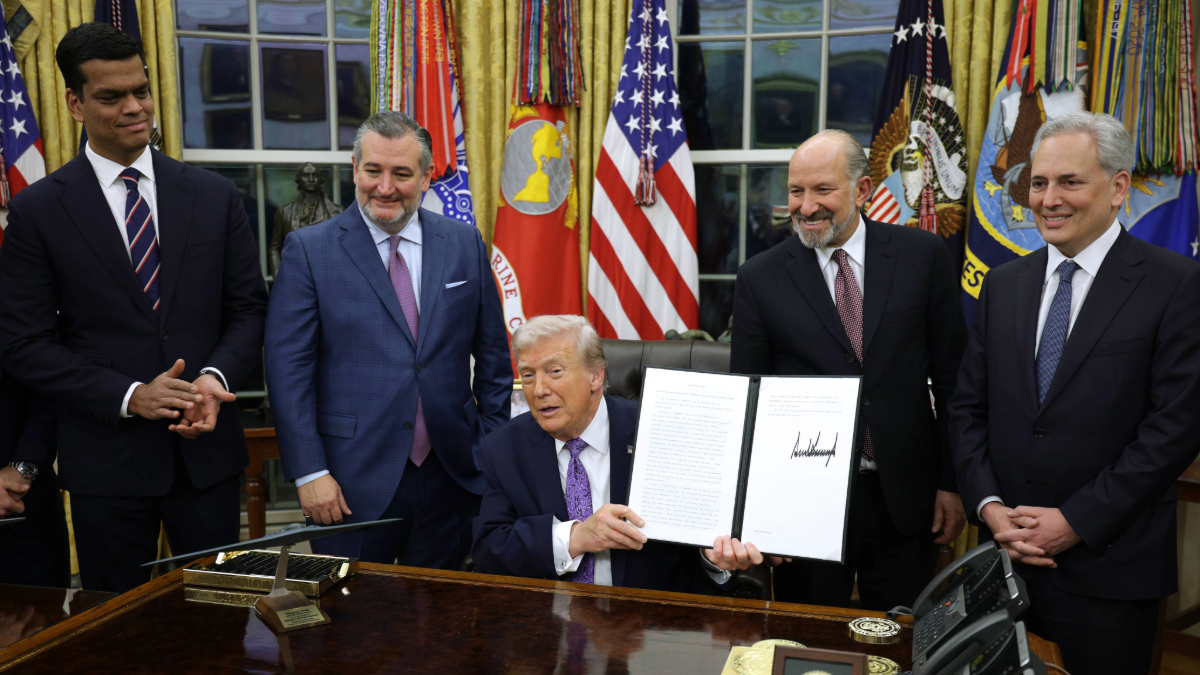
US President Donald Trump displays a signed executive order as (L-R) Sen. Ted Cruz (R-TX), Commerce Secretary Howard Lutnick and White House artificial intelligence (AI) and crypto czar David Sacks look on in the Oval Office of the White House on December 11, 2025 in Washington, DC. (Photo by Alex Wong/Getty Images)
President Donald Trump signed an executive order on Thursday intended to limit state regulation of artificial intelligence. In a ceremony in the Oval Office, Trump said AI is a strategic priority for the United States, and that there must be “a central source of approval” for developers.
“When they need approvals on things, they have to come to one source, they can’t go to California, New York, and various other places, like Illinois, with [Illinois Governor] Pritzker, you know, a totally unreasonable person,” he said. “But if they had to get 50 different approvals from 50 different states, you could forget it, because it’s not possible to do.”
The White House circulated a version of the executive order last month. The signed version is similar to the draft, giving various responsibilities to agencies including the Department of Justice, the Department of Commerce, the Federal Communications Commission, the Federal Trade Commission, and the President’s Special Advisor for AI and Crypto, working in concert with various other parts of the executive branch that are concerned with AI policy.
But the final version does contain some key differences, including a carve-out for state child safety laws, certain laws relating to data centers, and state procurement and use of AI.
Key components of the order include:
- Department of Justice: The order calls on the Attorney General to create an “AI Litigation Task Force” to challenge state AI laws, “including on grounds that such laws unconstitutionally regulate interstate commerce, are preempted by existing Federal regulations, or are otherwise unlawful in the Attorney General’s judgment.”
- Department of Commerce: The order calls on the Secretary of Commerce to work with other White House officials to develop a hit list of “onerous” state laws “that conflict” with the pursuit of AI supremacy. Of particular concern are laws that “require AI models to alter their truthful outputs, or that may compel AI developers or deployers to disclose or report information in a manner that would violate the First Amendment or any other provision of the Constitution.” The final version of the order also stipulates that the review of state AI laws “may additionally identify State laws that promote AI innovation” in addition to those seen to restrict it. The order also calls on the Secretary of Commerce to issue a policy notice tying the deployment of Broadband Equity Access and Deployment (BEAD) program funds to an evaluation of the “regulatory landscape” in states. The order calls on other agencies to do similar evaluations of their discretionary grant programs.
- Federal Communications Commission: The order calls on the FCC Chair to “initiate a proceeding to determine whether to adopt a Federal reporting and disclosure standard for AI models that preempts conflicting State laws.”
- Federal Trade Commission: The FTC Chair is required to issue a policy statement to “explain the circumstances under which State laws that require alterations to the truthful outputs of AI models are preempted by the Federal Trade Commission Act’s prohibition on engaging in deceptive acts or practices affecting commerce.”
- Special Advisor for AI and Crypto: The special advisor is directed to develop “a legislative recommendation establishing a uniform Federal policy framework for AI that preempts state AI laws that conflict with the policy set forth in this order.” The final signed version says the legislative recommendation “shall not propose preempting otherwise lawful state AI laws” that relate to “child safety protections,” “AI compute and data center infrastructure, other than generally applicable permitting reforms,” “state government procurement and use of AI,” and “other topics as shall be determined.”
The draft mentioned the much repeated but disputed claim that “state legislatures have introduced over 1,000 AI bills that threaten to undermine" innovation, referencing specific examples in California and Colorado. The final version does not contain the same references, but David Sacks, the White House AI and crypto czar, did repeat the claim at the signing ceremony. The final version also adds the claim that a patchwork of state AI regulations makes compliance challenging, “particularly for start-ups.”
“We have over 1,000 bills going through state legislatures to regulate AI,” said Sacks. “Over 100 of them have already passed. 25% of them are in California, New York and Illinois. You’ve got 50 states running in 50 different directions, it just doesn’t make sense. We’re creating a confusing patchwork of regulation.”
Sacks made specific reference to the fact that child safety laws would not be targeted under the executive order. “This EO gives your administration tools to push back on the most onerous and excessive state regulations,” he said. “We’re not going to push back on all of them, for example, kids safety, we’re going to protect, we’re not pushing back on that.”
Tech firms and industry-backed groups indicated support for the executive order, while many legal experts, civil rights, and consumer protection groups denounced it.
"President Trump’s executive order doubles down on a dangerous policy that the Republican-led Congress has rejected not once, but twice: displacing states from their critical role in ensuring that AI is safe, trustworthy, and nondiscriminatory," said Cody Venzke, senior policy counsel with the American Civil Liberties Union, in a statement.
“With today’s executive order on artificial intelligence, Donald Trump is doing his best to take care of his Big Tech buddies and donors," said Robert Weissman, co-president of Public Citizen. "This reward to Big Tech is a disgraceful invitation to reckless behavior by the world’s largest corporations and a complete override of the federalist principles that Trump and MAGA claim to venerate."
During the signing ceremony, Trump noted that he would not have preferred the term “artificial intelligence.”
“I always thought it should be the 'SI,' Supreme Intelligence,” he said, “but, I guess somewhere along the line they decided to put the word artificial, that’s okay with me, it’s up to them. It’s a massive industry.”
Authors