We Need Google Trends for AI
Oliver Marsh / Sep 23, 2026
The rise of AI for information-seeking has prompted a parallel rise in concerns about related risks. Such risks can be highly individual, such as psychological or medical impacts or malicious use by bad actors. But there are also concerns about societal risks if systemic problems compound: for instance, if political leanings or source selection in AI answers mediate how citizens receive news or political information en masse.
Such risks have also led to a rise in auditing of chatbot responses. By the standards of technical research, the basics are relatively straightforward. A user can prompt an AI tool and assess its answers on various axes (inaccuracies, bias, sources used, etc.). There are various methods for scaling up both the prompting and analysis, with advantages and disadvantages: for instance, automating answers via official APIs may not be fully reflective of answers chatbots give when used normally, but “unofficial” automating is often blocked by companies. Nonetheless, general barriers to entry for this sort of research are relatively low, and we have seen a proliferation of such audits.
However, auditing answers to prompts gives only limited insight into societal risks. Even if some sets of prompts gave potentially harmful answers, this would have limited impact if no real person was likely to ever make those prompts. On the other hand, prompts which give potentially harmful answers one percent of the time could be high-risk if made by millions of people.
Understanding the societal risks of AI requires up-to-date data on how people really use AI tools to seek information, in enough detail to quantify trends while also preserving user privacy. There is already a well-established model for this: Google Trends. I shall unpack the problem of why we need particular kinds of data first, before moving on to my proposal of a Google Trends for AI.
External researchers have limited insight into LLM use
The question of societal risk must be seen through data on how much AI tools are actually used, and for what. A study produced with OpenAI claims that by July 2025 the ChatGPT consumer product had been "adopted by around 10 percent of the world’s adult population." In a Reuters survey of six countries (Argentina, Denmark, France, Japan, the UK, and the US), 34 percent of respondents said they use generative AI tools weekly, while Pew research from 2026 found roughly half of US adults have used chatbots and one-in-four use them daily. These and other studies report fast growth from previous years. To crudely summarize, chatbot use is not yet as substantial as search and social media, but is growing fast. And the rise of AI summaries means that people are increasingly exposed to AI answers even if they do not seek them out.
Understanding societal risks also involves understanding large-scale trends in how people interact with AI, both quantitatively and qualitatively. Numerous large AI companies have published reports and interactive dashboards based on datasets of how their tools are being used in everyday life. OpenAI publishes monthly updated Signals Data for ChatGPT, and Anthropic has an Economic Index. Google doesn't have an equivalent dashboard, but has published based on its internal ATLAS v1.0 dataset. These outputs keep control of the story and the framing in the hands of the companies. In particular, they are focused a lot on AI usage for work topics, and what that might say about the future shape of the economy. Even Anthropic CEO Dario Amodei advocates for evaluation by external parties brought into companies, noting that in safety reports published by companies such as his own “we are still the ones choosing what to include and omit.” However, even when external partners are brought in (such as OpenAI partnering with Harvard and Duke), there remain numerous concerns about “independence by permission,” learned from research partnerships with social media companies.
There have been external attempts at LLM usage datasets. SEO companies such as Semrush offer products like prompt research reports, which they describe as “keyword research for the AI era” with sources such as panel data. Some options even go as far as free access to conversation-level data, such as the more than three million donated ChatGPT conversations included in the WildChat dataset. But these are drastically limited in volume and representativeness compared to actual company data, and as such are limited in understanding the full realities of societal risks.
The case of the 2024 German regional elections
Extra details, such as popular keywords or common phrasings in prompts, can vitally inform the design of research into societal risks. For instance, during research with AlgorithmWatch on chatbot use during regional German elections in 2024, we repeatedly had to ask: do our prompts address the sorts of topics that potential voters really talk about with chatbots?
To facilitate our research, we requested that Microsoft, Google, and OpenAI provide us with breakdowns of how often certain German election-related terms were used in prompts to their proprietary chatbots. This request was modelled on Article 40.4 of the EU's Digital Services Act, which allows researchers to request internal company data under certain conditions. However, as the Article was not fully operational at the time, we had no regulatory backing and had to rely on the goodwill of companies (and appeals to the EU's Election Guidelines).
After discussions, Microsoft provided us with some data, though it was limited to very specific keywords and only broken down by month, with some additional data on 4-day windows around the elections. Even from this we could see that there were substantial increases in queries related to elections, from 2,000-4,000 prompts per state across August to over 6,000 per state across the election month of September. A subsequent similar request for the 2025 Federal Election showed that there were many more prompts mentioning the far-right Alternative für Deutschland (AfD) than for other parties. However we were still unable to see what people were actually asking about these topics, and the time windows were too coarse to fully understand election trends. Further, there was no room to refine and iterate our requests based on the emerging data. This was all still better than discussions with Google, which expressed interest in the idea but never gave data. OpenAI just tried to sell us their enterprise product.
Of course, with more detail comes more privacy concerns. As useful as full prompt-level data might be for researchers, this could expose highly sensitive information users may put into chatbots. Reports by the companies themselves are at pains to explain their privacy-preserving methods. Under certain conditions, such as Article 40.4 of the Digital Services Act, external researchers could be bound to follow similarly strong privacy-preserving methods as they mine prompt-level data. But this is not helpful for ensuring widespread low-barrier insights to a wider research community. What we need is an easily accessible interface which allows researchers to explore up-to-date and customizable trends in chatbot usage without going so far that researchers could reconstruct private behaviour.
How Google Trends works
To achieve this, we should learn from the past. Specifically, we need a Google Trends for AI use.
Google Trends is a free online service which has been offered in some form by Google for over 20 years. It provides insight into "trending" searches—i.e. topics and search terms which have suddenly increased in interest—on a daily basis. A user can also track the volume of searches for particular topics or an exact keyword, and see the most popular “related searches” for that topic or keyword. All this can be broken down by country, and sometimes even regions within countries. Time ranges can be set from “since 2004” right up to “past hour.”
For instance, I can look at searches in state of Sachsen-Anhalt on the date of its recent State Parliament election on Sept. 6. Top searches on that day clearly did relate to the election (see the first image below; “Wahl” is German for “election”). The far-right AfD party also features in the top searches; they were widely expected to perform very strongly in this election (and, indeed, won an extremely high 44 percent). Having seen this, I can then compare, over time, volumes of searches on topics related to the different parties in the region of Sachsen-Anhalt (see the second image). Again, the AfD was far outperforming everyone else, with a clear peak around election day.
I can zoom out wider too, and see that in the whole of Germany the top-trending searches on Sept. 6 were about the Sachsen-Anhalt elections. However, the data can also guard against overstatement of election interest: on Sept. 18, two days before elections in Berlin and Mecklenburg-Vorpommern, none of the top trending searches related to the votes (the top search was about a football match between Bayern Munich and Union Berlin).
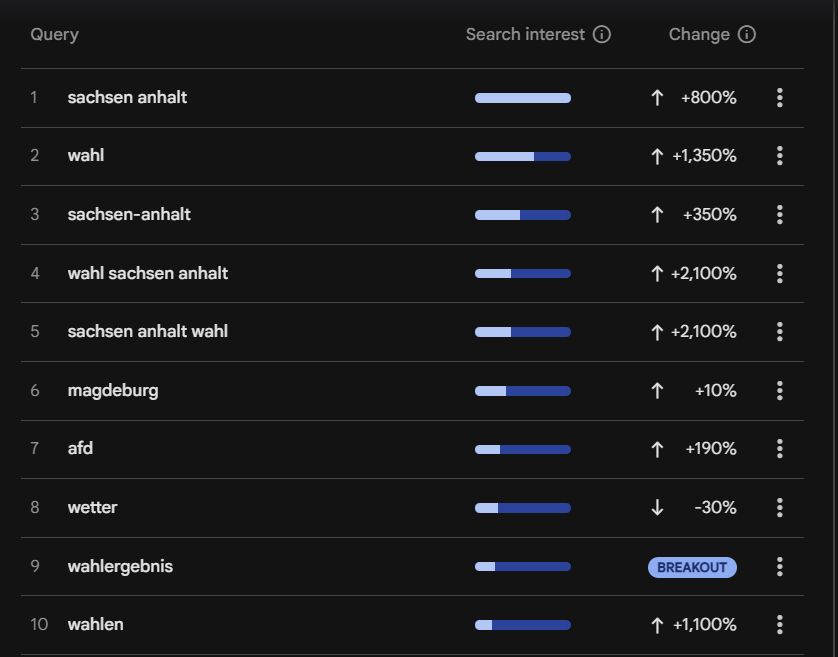
Figure 1. Google Trends results in Sachsen-Anhalt, Sept. 6, 2026.
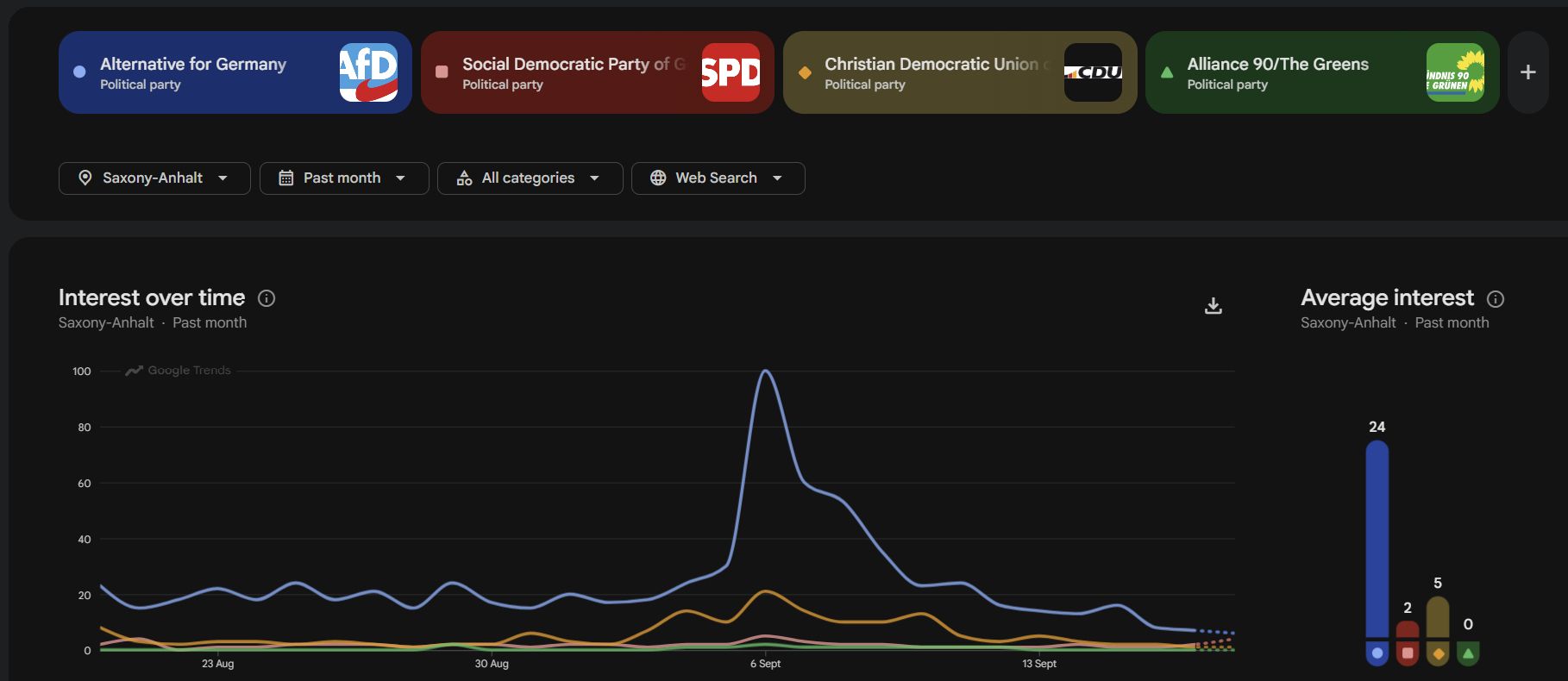
Figure 2. Google Trends results for searches in Sachsen-Anhalt for German political parties over time.
The data provided is not extremely detailed. A user sees relative values or broad ranges, rather than exact numbers, and only searches above a certain volume threshold are included (which limits privacy concerns). It is not clear how Google determines which searches are counted under a particular “topic”. But despite these limitations, the overall trends data is still valuable. In a previous role developing methodologies for analyzing online trends in the UK Prime Minister's office, I often found Google Trends more illustrative of public concerns than other online data. At the time we found that “viral” social media posts about the government might be shared thousands or tens of thousands of times. But a trending topic on Google could easily be receiving millions of searches. Search trends can be an indicator that a topic has (or has not) broken out of social media discourse and into wider public attention. Moreover, Googling often indicates that people want to know more about a subject, perhaps forming views on it—unlike social media, which often indicates set views. In addition to studying public opinion, Google Trends data has been used to forecast economic indicators and even epidemics.
Can we get a Google Trends for AI?
As AI tools begin to supplement or replace traditional search as a key information source, we need interfaces similar to Google Trends for widely used AI information-seeking tools (particularly chatbots and AI Overviews).
There would, of course, be questions and caveats. On top of the limitations already raised about Google Trends, there would need to be AI-specific considerations: for example, how to account for lengthier prompts and back-and-forth conversations. But even with these caveats, transparency and the ability for researchers to explore and iterate around real trends in uses of AI would be valuable.
The main problem: it is unclear how companies could be made to provide such data, if they would not do so voluntarily. Current laws seem limited in their opportunities. Even the recent designation of ChatGPT as a Very Large Online Search Engine under the EU’s Digital Services Act is highly unlikely to provide a Google Trends style service; the best we can hope for is an EU-data-only dashboard for a limited pool of researchers who make a successful Article 40.4 request for such data (and even this seems unlikely). But other data access laws will arise in the future; the UK and Canada are currently exploring possibilities, with Canada in particular explicitly including chatbots in its proposed Digital Safety Act. While the current US administration is mostly opposed to regulating technology, there continue to be attempts at platform transparency laws in the US. Advocates for data access should consider how a Google Trends for AI—or “access to aggregated near-real-time data of trends in AI-based information-seeking”—can be included in the scope of their proposals.
A more near-term approach could include such demands in voluntary and soft law proposals such as Codes of Practice for risk mitigations under the AI Act or the DSA; there is already lively debate around the transparency chapter of the AI Act’s General Purpose-AI Code of Practice.
Even this approach is probably optimistic, given the anti-transparency stance of many companies. But when CEOs such as Amodei are advocating for external evaluation, proposals such as Google Trends for AI can be used to stress-test that commitment. After all, AlgorithmWatch received (limited, though still useful) data from Microsoft with no hard regulatory backing. As discussed above, OpenAI and Anthropic already publish interactive dashboards of usage data, mediated through complex framings such as “work vs. non-work use” or “practical guidance vs. self-expression.” OpenAI even provides enterprise users with dashboards on how their staff use the tools, including analytics from within the last 24 hours. Google Trends shows that, with various caveats, the conversion of textual searches into near-real-time displays of keyword and topic trends has been possible for a long time, even at the scale of Google Search. Companies refusing to create such a system to allow external parties to explore trends relevant to their risk research would raise questions about commitments to risk mitigation.
However difficult achieving provision of a Google Trends for AI may be, there are still two lessons we should draw from the thought experiment. The first is that research into societal risks from AI must try and contextualize identified risks within data of how people are actually using AI. This will be particularly important as tools such as AI Overviews become default options, greatly increasing the range of people exposed (even unwillingly) to AI answers. Where such information is limited, researchers should caveat appropriately—and also shout about it publicly, to make the lack of transparency clear to governments and regulators.
The second lesson is that Google Trends is more than a methodological model. It meets a concrete, clearly feasible, clearly useful demand. A Google Trends for AI is an obvious need and not a substantial innovation. Failing to provide it would be further evidence of risks being worsened by corporate resistance to scrutiny.

Authors