What a Growing Telegram Disinformation Network Reveals About the DSA
Ognjen Karadzic, Daniela Alvarado Rincón / Jul 31, 2026
(Photo by Jakub Porzycki/NurPhoto via AP)
A multilingual network of Telegram channels offering local news does not appear to be what it seems. It seems there is no newsroom behind any of it. Independent researchers working separately, including us at Democracy Reporting International, have reached the same conclusion about this cluster of growing Telegram channels: They belong to a coordinated operation spreading disinformation and propaganda aligned with the Kremlin that shares the same script, pushes biased and unverified content, translated and timed to hit everywhere at once.
Our research reveals how easily a network can significantly grow across many languages in a way that is difficult to detect, which is why we argue that European authorities should reconsider their light regulatory approach to Telegram.
When size is a sign of inauthenticity
During social media monitoring of the Hungarian elections earlier this year, DRI identified seven of those previously uncovered channels, along with an additional twelve accounts that nobody had connected to this network. All 19 channels share the same signature of coordinated inauthentic behavior, and they never link or mention one another. Yet they all have similar names (translating roughly to "common sense"), and all but one share identical branding.
The "Common Sense network,” as we call it, shows two kinds of growth: vertical (rising subscriber counts within existing channels) and horizontal (new channels added over time). They tell different stories.
Subscriber numbers function as social proof. At its peak last winter, the network had over 220,000 subscribers; by early April it had dropped to 167,000, and it now sits under 100,000. We are confident the number will rise again, as it did last year, when each channel suddenly surpassed 10,000 subscribers almost overnight. The sudden spikes are consistent with purchased or otherwise inauthentic accounts. However, an unsuspecting German reader who does not spend time verifying a Telegram channel's legitimacy, and who encounters a channel "Die Stimme der Vernunft" which is posting regularly and has 40,000 subscribers, will likely conclude it is a serious channel. There is little to indicate that he or she has just walked into a network repeatedly linked to foreign information manipulation and interference (FIMI) operations.
Horizontal growth is a less ambiguous indicator. Nineteen channels across nineteen languages are themselves a significant footprint, and the more revealing insight is how the network came together. We reconstructed its horizontal expansion using data from the third-party service Telemetrio combined with systematic interval sampling of published messages via the Telegram API.
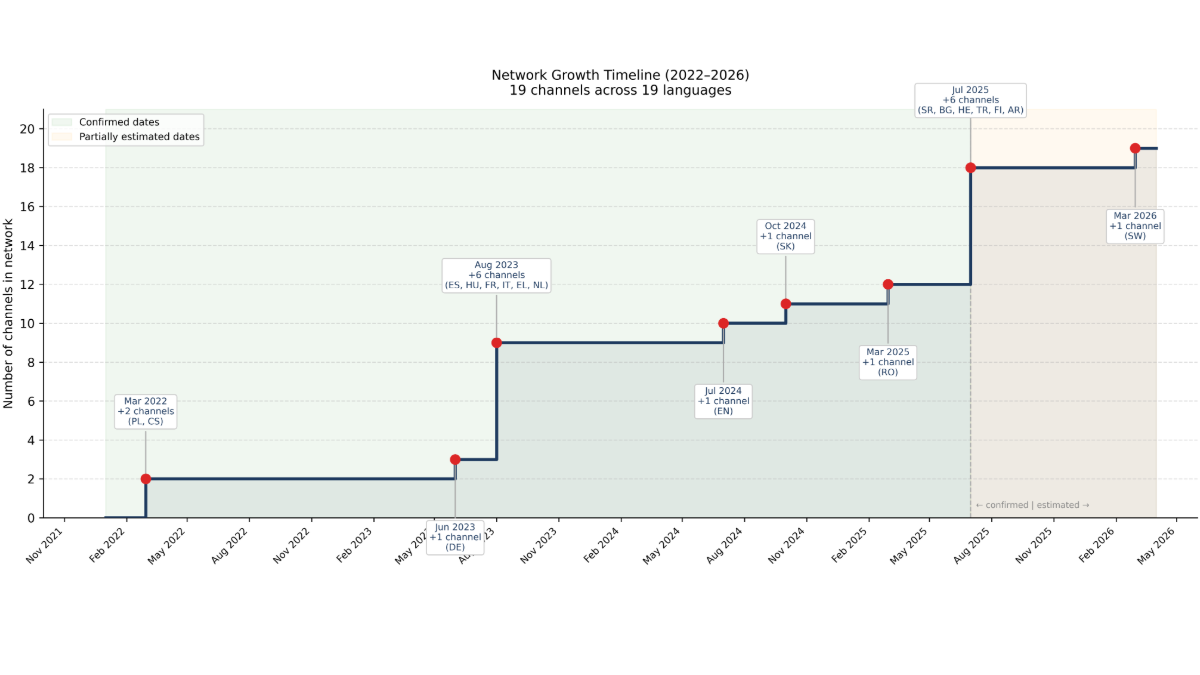
Reconstruction of the Common Sense network's horizontal growth (N=19). The network may include additional channels that went undetected. Creation dates for confirmed channels are known exactly; for estimated channels, dates are approximated to a two-week window.
None of this growth, in either direction, is likely to be noticed by Telegram. A network that can double its subscriber count overnight, or add six new language audiences within days (as it did in August 2023 or July 2025) operates without triggering any visible intervention by the platform.
The obvious question is why such a network can continue expanding despite repeated public exposure.
Telegram’s obligations under the DSA
The story with Telegram and EU regulation is also about numbers. Under the DSA, a platform becomes a Very-Large Online Platform (VLOP) if it has more than 45 million active monthly users. Telegram's latest report states they are still below that threshold. Its obligations are therefore largely limited to tackling illegal content: providing users with mechanisms to report it, acting on those reports, and protecting minors' privacy and safety. Very Large Online Platforms and Search Engines (VLOPSEs) obligations, such as identifying and mitigating systemic risks, do not apply.
The “common sense network” relies on purchased bots, fake engagement, and automated or semi-automated activity to artificially amplify certain content and create the false impression of broader public interest than it actually has. While the content is not illegal, such inauthentic “news channels” undermine the integrity of the public debate. If Telegram were designated a VLOP, it would have to assess and mitigate systemic risks associated with coordinated manipulation.
Nothing, however, prevents Telegram from moderating this type of behavior voluntarily. Reddit, another non-VLOP, already prohibits harassment, spam, disruptive behavior, impersonation, and other forms of coordinated abuse under its community rules. Telegram has instead chosen a far more hands-off approach, at times even resisting law enforcement requests.
Even where Telegram’s obligations are clear, its moderation record falls short of comparable platforms. On July 23, the DSA Statement of Reasons database showed that Telegram recorded around 12,000 moderation decisions over the past 180 days. A higher volume of moderation doesn't necessarily mean better protection for users. It can also reflect more user reporting or over-removal. Even so, the gap with its closest counterpart is significant: WhatsApp Channels, comparable in design and user base, recorded more than 194,000 over the same period -roughly sixteen times as many.
Nor can this gap be attributed to a lack of content requiring moderation. Civil society organizations have recently documented illegal content on Telegram, including financial scams, non-consensual intimate images (NCII), and child sexual abuse material (CSAM). Last year, the Belgian Institute for Postal Services and Telecommunications (BIPT) –the Digital Services Coordinator responsible for overseeing Telegram’s compliance with the DSA– separately identified hundreds of cases of terrorist content on the platform.
Taken together, these factors point to a gap: a platform with considerable reach and influence in the European Union is operating under a significantly lighter regulatory burden than its risk would warrant.
A path forward for stronger Telegram accountability
The most direct path is VLOP designation. Pressure is building on the European Commission to examine Telegram's status. In March 2025, a Member of the European Parliament asked the Commission to clarify the methodology behind Telegram's EU user count, pointing to independent research that suggests the real figure exceeds 45 million. The Commission's response was noncommittal: it said only that it was monitoring Telegram's figures, following market developments, and remaining in contact with relevant authorities.
Telegram's reported figures do raise legitimate questions. In February 2024, the company reported 41 million average monthly active recipients in the EU. Since then, it has offered only the claim of "less than 45 million," even as its global user base has grown beyond one billion. That the EU figure has stayed just under the threshold throughout this period merits closer examination, particularly since WhatsApp Channels, Telegram's closest equivalent in design and use, crossed the threshold and was designated a VLOP in February 2025.
Part of the problem is methodological. Article 24(2) of the DSA gives the Commission the power to adopt a delegated act detailing the methodology of how "active recipients" should be counted, but it has not yet exercised that power, relying instead on non-binding guidance. According to this guidance, an “active recipient” is anyone exposed to content disseminated through a platform's online interface. Public Telegram channels can be viewed, searched, indexed, and shared by anyone, whether or not they subscribe. If exposure to content is the relevant standard, as the DSA suggests, there are reasonable grounds to question whether Telegram's reported figures fully capture the reach of its public channels. Greater transparency about how the methodology should be to calculate those figures would help answer that question.
In the meantime, the European Commission and the Belgian regulator have tools available to strengthen Telegram’s accountability. The Belgian regulator could use its supervisory powers to examine Telegram’s compliance with its existing obligations on illegal content and child safety and open enforcement action where necessary. Research from civil society organizations and independent investigators is a crucial source of evidence to push for these efforts.
Our research also shows that content identified on Telegram circulates across VLOPs, including Facebook, X, Instagram, YouTube, and TikTok. While our analysis does not prove coordinated cross-posting, it suggests that disinformation networks operate across multiple platforms. The DSA already provides a systemic risk framework that encourages stronger cooperation between VLOPs, VLOSEs, and platforms such as Telegram to identify and disrupt campaigns that move across services.
Finally, the Commission's DSA Guidelines on mitigating systemic risks to electoral processes can serve as a useful benchmark for platforms such as Telegram. Although they cannot create new legal obligations for non-VLOPs, they can establish clearer expectations for addressing coordinated manipulation and other threats to electoral integrity.
Authors