What Digital Isolation and Censorship Evasion Look Like In Wartime Iran
Laura Scherling / Apr 1, 2026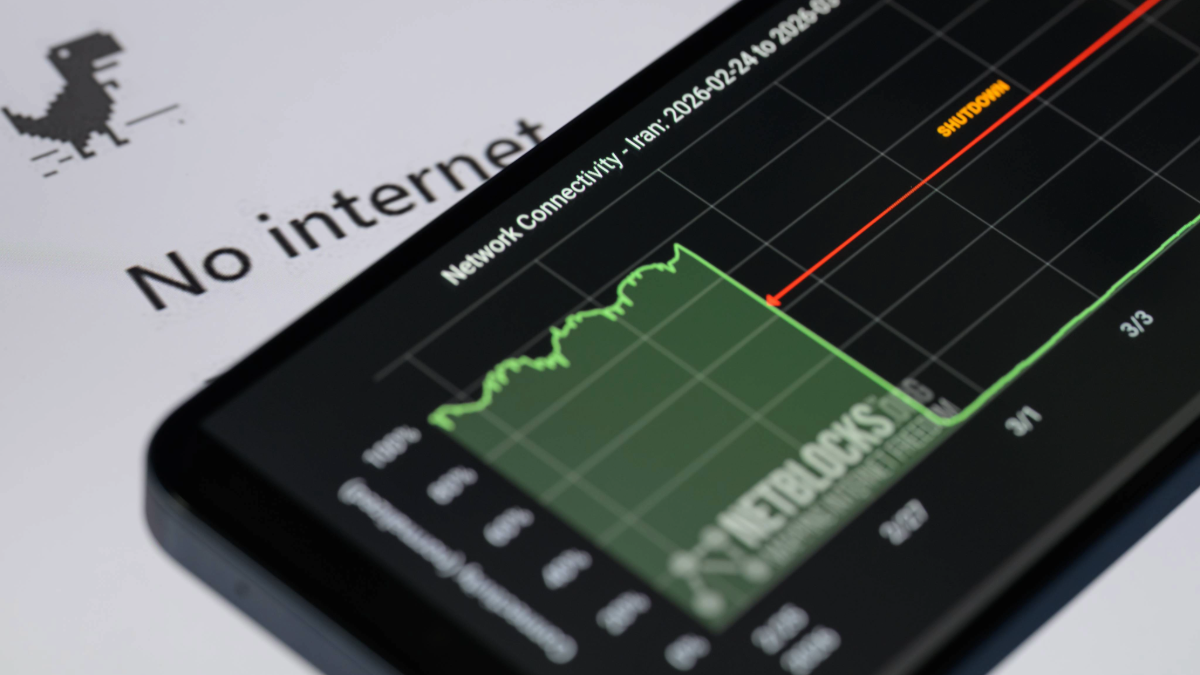
A NetBlocks graphic illustrates internet connectivity shutdowns in Iran on a smartphone screen in this photo illustration. (Photo by Jonathan Raa/NurPhoto via AP)
Four weeks into the war, Iran is plummeting toward total digital isolation with its internet blocked and communications heavily restricted and monitored.
The country’s government implemented a nationwide blackout shortly after the United States and Israel struck its cities and targeted political leadership on February 28.
While some people have since regained intermittent connections, internet monitoring service Filter Watch has observed “a volatile new phase” where Iranian authorities are also blocking those with privileged “White SIM card” connections that are typically exempted from crackdowns.
According to the site, prominent business and media professionals found themselves severed from the internet following a March 9 announcement by an Iranian spokesperson ensuring digital access for “state-sanctioned actors.” But even in a tightly controlled communications regime, NPR has reported that text messages likely from the government warning citizens not to join crowds that might turn into protests are still making it through to residents’ phones.
The International Organization Development Association (IODA), a Georgia Institute of Technology initiative that measures internet outages globally, has reported connectivity in Iran narrowing down to just a trickle of activity. IODA data indicates that Border Gateway Protocol (BGP) Visibility remains high, meaning a stealth internet blackout is taking place, where selective filtering allows some individuals to be “whitelisted” and gain digital access.
A group of Iranian researchers recorded a number of shutdown tactics used by Iranian authorities, including “DNS poisoning,” which can direct users to incorrect websites; “HTTP filtering,” which blocks site access and instead returns “403 Forbidden page” messages; and “TLS resets,” which abort connections. They also observed that “layered censorship” tactics can be challenging to circumvent, and found that Iranian people relying on traditional VPNs that might normally bypass restrictions are instead failing to work.
Shutdowns are disruptive in numerous ways. As Human Rights Watch has pointed out, internet shutdowns not only obfuscate possible “laws of war” violations, but also cut people off from sources of food and shelter and life-saving services. A United Nations declaration on freedom of expression has repudiated “kill switches” that shut down entire communication systems as “never … justified under human rights law.” The cybersecurity company Surfshark recorded 81 new internet restrictions in 2025 across 21 countries, pointing to evolving patterns of repression. Out of the 81 restrictions Surfshark tracked, 51 of these restrictive measures were taken in response to political situations.
By now, Iranians are familiar with digital blackouts, particularly in times of protest and civil unrest. Protests in 2019 led to a multi-day internet near-blackout. After the September 2022 death of Mahsa Amini, a Kurdish-Iranian woman who died at a hospital in Tehran under mysterious circumstances, the regime blocked the internet, social media and independent news sites. Following another wave of protests over soaring inflation beginning in December, internet access was cut and a deadly crackdown and “massacres of protesters” took place, as chronicled by Amnesty International.
An Iranian woman living in the US, who spoke on condition of anonymity out of safety concerns, said the crackdowns caused distress even to those afar. “In January when the internet was shut down, I was so worried about my brothers and my friends, I couldn’t sleep, eat or work. I would call their numbers, hoping they would pick up. ... My sister ended up in the hospital because of the stress” she said. The internet blackout after February 28 has persisted since then.
Some institutes like Chatham House have argued that Iran’s digital isolation strategies may signal a longer term strategy, where a “strict ‘White List’” is imposed and Iran might eventually move exclusively to their own “isolated domestic Internet” known as the National Information Network (NIN). Work on the NIN began around 2013 and Iran has invested at least $6 billion in it. The American Foreign Policy Council also noted that projects like these are not new: China launched the “Great Firewall” in the late 1990s and Russian began its efforts to isolate its own digital space in 2012.
Despite the latest near-total blackout, some Iranians have managed to periodically find a connection to the outside world, indicating there are small cracks in the system. During these short bursts of connectivity windows, privacy-preserving tools like the Lantern VPN have helped Iranians reach people outside the country. Lantern told me it has seen a “proliferation in different approaches” that have worked in connecting users, including open-source privacy-enhancing tech and the need for more internal peer-to-peer communication tools. The Tor Project said its Snowflake initiative is the “most used network traffic obfuscation tool” in Iran. Snowflake effectively masks Tor’s traffic, while also generating hundreds of short-lived proxies that do not last long enough for censors to identify and block it.
Still, some people in Iran are turning to expensive, often overpriced tools to reach their family members on the outside.
“My brother found a ‘package’ that he can activate on his phone to call us directly,” said the Iranian woman living in the US. “So he calls us every few days for a few minutes to tell us they are okay. It is very expensive for him to buy it.”
A second Iranian woman, who also spoke anonymously due to fears of retaliation, said that her family in Iran relies on a VPN but occasionally can get through to her on a landline phone. “But the landline is not always an option,” she added. “And when they use it, there’s the awareness that somebody is listening. So the calls are short. They get nervous.” Some of her relatives told her they are frightened to leave their home and spend a lot of time trapped inside. One of her relatives “walks laps inside their own home” just to keep their body moving, she said.
Using censorship circumvention tools to communicate with the outside world can be dangerous, even life-threatening, for Iranians. NPR reported that “security forces are checking phones,” and according to Forbes a new law makes the use of Starlink punishable by death. Forbes reported that Starlink still has “clandestine users” throughout Iran, and that camouflaged Starlink devices are being used to circumvent some of the “jamming attacks.” Despite the risk of their personal data being compromised, some people in Iran are taking the risk by using domestically built apps to communicate with people outside of the country.
The Iran war continues to be the most unpopular war among Americans in modern US history. According to Pew Research Center, 61% of Americans disapprove of President Donald Trump’s handling of the conflict. While Trump said he has had productive talks with Tehran, but Iran has reportedly disputed the account and resisted the administration’s proposed peace plan.
“Hope briefly emerged that the regime might collapse, but news of possible negotiations has plunged everyone back into anxiety and uncertainty,” the second woman said of her family.
Authors