Why New Mexico v. Meta Matters
Nathaniel Lubin / Aug 7, 2026Nathaniel Lubin served as an expert witness in State of New Mexico v. Meta Inc.
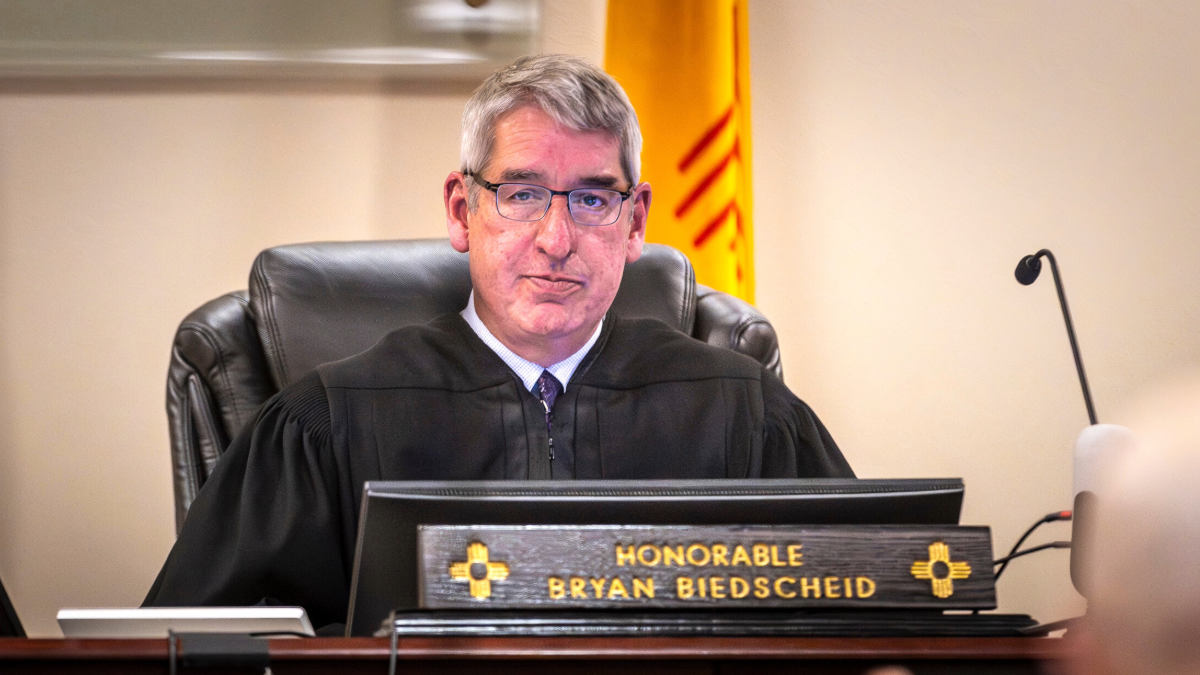
Chief District Judge Bryan Biedscheid delivers closing remarks after the jury reached a verdict against Meta at New Mexico's First Judicial District Court, Tuesday, March 24, 2026, in Santa Fe, N.M. (Nathan Burton/Santa Fe New Mexican via AP, Pool)
Yesterday’s ruling in the second phase of State of New Mexico v. Meta Platforms, Inc. should prove a landmark decision in the battle to make Big Tech accountable for its products' harms: for the first time, a social media platform was found to have caused a “public nuisance” due in part to the mental health epidemic among children on the platform. While headline fines ($942 million across the two phases) will drive attention, the most important aspect of the verdict is the finding that technology platforms may be held legally responsible for the effects of their products on critical populations of users.
A focus on these types of effects belies the popular narrative of social media as a persistent, small, drag on the productivity and wellbeing of all users. Instead, like prescription opioids, the trial revealed why this view of small effects on typical users is wrong and obscures platforms’ much more catastrophic effects on identifiable minorities of users, a reality that may well be echoed in future litigation.
As one of the state’s expert witnesses in the trial, one particular email exchange from 2017 illustrates the key dynamic. Amid a discussion among employees about internal research on excessive use of Instagram, the photo-sharing app that Facebook acquired in 2012, Head of Instagram Adam Mosseri, wrote: “1.3 percent of people in the US spending 30-plus hours a week [on Instagram] sounds like a lot.” The staff member who conducted the research responded with a remark saying that it was a judgment call as to whether that was a big enough group to justify a response.
It is hard to understand asking whether a million people is a big enough group to deserve help. Yet that’s just what the decision requires: that treatment of such issues receive more than a perfunctory response.
The government’s case was vindicated in March when jurors in the first phase of the trial found, on all counts, that the company had misrepresented the safety of its social-media products. This week’s ruling built on the jury’s finding by focusing on the “public nuisance” created by exposure to social media, similar to the legal responses to products like tobacco.
Judge Bryan Biedscheid’s decision is nuanced, and gives important procedural wins to Meta (which says it will appeal). But in establishing public nuisance for the first time – that “Meta’s platforms injure the public health, safety, and welfare in New Mexico” – he also ordered numerous binding requirements on Meta’s products and procedures. Specifically, in New Mexico he required that Meta:
- Maintain private by default settings for all under-18 users, including preventing underage users from showing up in search results unless identified by specific username;
- Prevent under-18 users from appearing in the recommendation algorithms of unconnected adults and prevent any unconnected adult from messaging an under-18 user;
- Enforce a 1-strike policy for adult users who engage in child sexual exploitation, including all accounts related to such a user, and preventing the creation of future accounts;
- Create a “clearly visible, forward-facing reporting mechanism” on every surface for unwanted sexual advances that receives a human review within 48 hours;
- Prohibit “romantic or sexualized” interactions between children and AI chatbots;
- Eliminate all push notifications for under-18 users during both nighttime and schooltime hours, except for messaging from connected users and for security;
- Hide like counts for all under-18 users;
- Implement mandatory time limits for under-18 users of not more than 90 hours cumulatively across Instagram and Facebook per month;
- Show a warning banner to all adults at least once a month and to all under-18s at least once a week, and show screens to all under-18s highlighting safety tools and features daily.
Besides their direct effects (if upheld on appeal), these requirements are important for numerous reasons. Above all, they demonstrate the need to assess companies’ decisions based on outcomes rather than inputs for the most affected users. The ruling publicly clarified that, for years, Meta’s relentless focus on maximizing product uptake came at the expense of users like the ones Mosseri referred to. And it offers a roadmap for both further litigation and future product design rules.
To date, critics of social media have overwhelmingly focused on the experience of typical users, especially typical teenagers. Questions like “Has social media caused mental health harms to young people?” matter, and the case offered direct evidence that the answer to that question is “yes.” Yet answering that question requires assessing a range of effects across very large groups of people. Especially because independent researchers have lacked access to platforms’ internal data, companies have been able to dispute findings and deflect criticism.
But assessing a putative average user is often misleading. In the real world, platform engagement is extraordinarily uneven, meaning that a small share of users racks up a disproportionate share of platform activity. As a consequence, the most severe harms from use are also highly concentrated. Other data presented at trial showed that this pattern persisted: between 2020 and 2024, the most active 1 percent of New Mexico teenagers still spent more than 30 hours a week on Facebook and Instagram.
What is true for time usage is also true for platforms’ more acute problems, such as harassment and crimes like the distribution of child sexual-abuse material and human trafficking. The evidence presented showed that these patterns were consistent and that the actions the company took in response often were weaker than other available options.
When companies like Meta acknowledge abuse, they tend to describe such harms as unavoidable. Sentiments boil down to “we’re trying; the problem is really hard,” particularly familiar from Mark Zuckerberg’s congressional testimony. Similar explanations were echoed in court. The executives’ arguments focus on procedural choices: look at all the accounts that were removed, they say, or see how we’re using machine-learning models to limit promotion of illegal activity.
Digital tools reproduce offline social problems, a challenging fact to manage. But the court heard tacit recognition that the measures supposed to control such problems were not scoped to solve them. For instance, the judge’s rule enforcing 1-strike policies may seem unnecessary given other descriptions of company behavior. Yet another internal email from 2020 read into evidence described the device-blocking policy:
Number one, perm block [is] actually just one year for terrorism, CEI [child exploitation imagery], CEI solicitation, revenge porn, content-based extortion, and sextortion. Temporary block [of] two weeks for nudity, bullying, NAZI, drug, gang, hate speech, cartel, graphic violence, and impersonation. Do not block for self-harm promotion, eating disorder promotion, copyright, trademark, counterfeit, spam, U13, sex offender, et cetera.
It turns out that enforcing 1-strike policies, including device blocking, may require an outside order.
While the enforcement set by the court will not solve every problem posed by social media in New Mexico, if scaled more broadly to other geographies and jurisdictions it will meaningfully change Meta’s management incentives. At the same time, the Judge’s decision not to engage with stronger rules related to issues like age assurance or features like recommendation algorithms, autoplay, and infinite scroll lend credence to the practical value for clarification by legislatures that such design rules are not protected by statute. (Though, notably, in other parts of his decision, the Judge forcefully makes the case that such rules related to content do not restrict abatement even as he subsequently declines to set restrictions on these features.) In Judge Biedscheid’s reading, COPPA is a particular obstacle to orders related to age assurance, despite an FTC policy statement from earlier this year on exactly this topic.
Given the radical way that machine learning is reconfiguring people’s lives, the public-interest case for influencing product incentives has never been more urgent. New technologies like large language models are black-box products far more complicated than social-media applications. And reasonable usage by average users, let alone by sophisticated engineers, is driving extraordinary payoffs and value. Yet, alongside these benefits, we must also anticipate abuse among a vulnerable minority of users. For instance, based on our knowledge of how social media operates, we can anticipate that people who spend the equivalent hours of a full-time job each week talking to chatbots are very likely to need extra protection, regardless of whether AI companies succeed in adding other safeguards.
More than 60 years ago in Silent Spring, Rachel Carson argued that a chemical company is responsible for misrepresenting the safety of a pesticide when it knows the risk for the small group of people repeatedly exposed.
State New Mexico v. Meta Inc. can be a similar turning point in how we understand technology products. While people and companies should be free to pursue their wants and wishes, we cannot ignore the at-risk outliers. We should focus on them: not as vulnerable victims in the making, but as the canaries in the coal mine who warn the rest of us when the environment is becoming toxic.
Authors