A Labor Day Prescription for Preserving Fair Employment in the Digital Age
Charlotte A. Burrows / Sep 2, 2026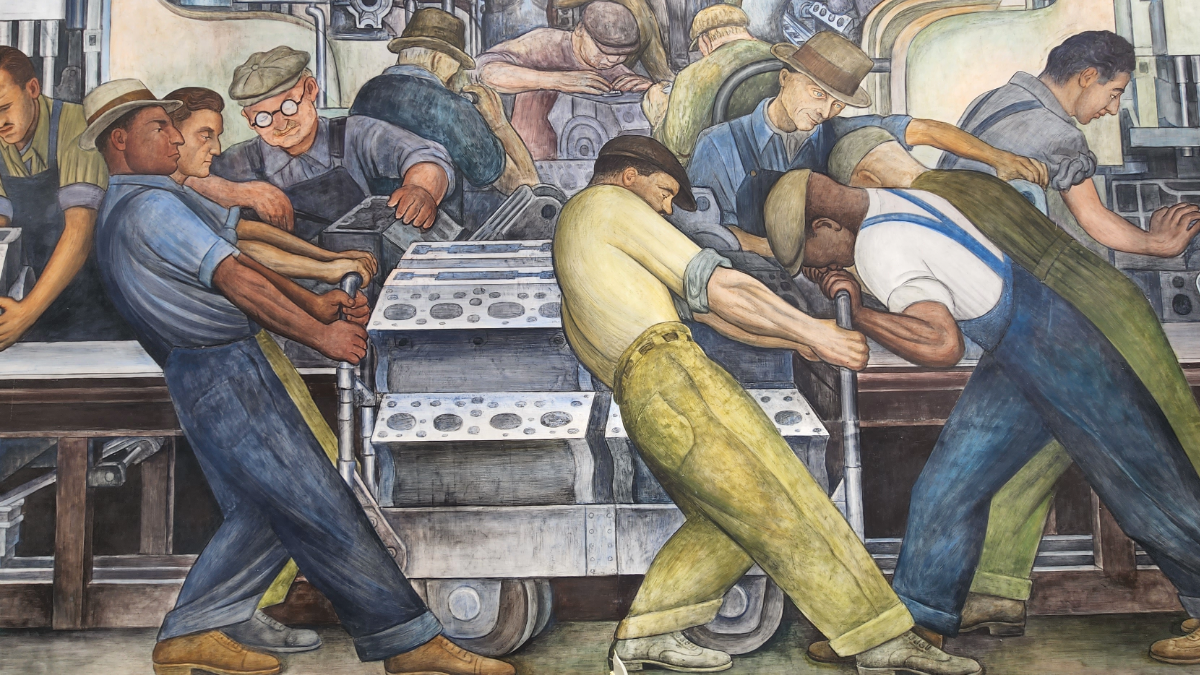
Photograph of a detail of a 1933 Diego Rivera fresco at the Detroit Institute of Arts. Justin Hendrix/Tech Policy Press
Labor Day 2026 comes amid rapid adoption of AI systems in American workplaces, with many workers now applying for jobs through AI screeners or finding their performance managed and judged by bossware. At the same time, the Trump administration is attacking a foundational civil rights protection that helps ensure employment screens actually reflect what the job requires. While AI technologies undoubtedly offer benefits, without guardrails, these systems can reject qualified people for reasons no one—including the employer—can adequately explain. And because these automated tools are designed using data that does not sufficiently reflect all workers, they can foreclose opportunities for qualified workers based on factors like race, sex, ethnicity, or disability.
We can’t let technological progress turn back the clock on civil rights. To give workers a fair shot in an AI-driven economy, the use of AI must reflect a national commitment to workplace equality. When I served as Chair of the Equal Employment Opportunity Commission, the agency had begun applying existing law to help ensure accountability when the use of technology violated workers’ civil rights. While the landmark 1964 Civil Rights Act was written before anyone imagined a résumé being scored by a machine, the question it asks of any screening device is evergreen: does it actually measure what the job requires? Until Congress enacts new laws to fully address all AI-related risks, traditional civil rights law remains one of the few existing tools to ensure accountability when automated employment systems violate workers’ rights.
Fortunately, the Civil Rights Act’s little-known, but crucial, disparate impact provisions protect qualified workers of all backgrounds from employment practices, including the use of AI, that create unfair barriers based on race, color, religion, sex, or national origin. This means that employers can’t impose unnecessary and irrelevant requirements that disadvantage workers because of a protected trait. As a unanimous Supreme Court explained in Griggs v. Duke Power, such practices discriminate because they operate as “built-in headwinds” to opportunity that are “unrelated to measuring job capability.” Reaffirmed by overwhelming majorities of both the House and Senate in 1991, the provision has led employers to re-examine workplace mandates like arbitrary height and weight restrictions or unnecessary degree requirements and replace them with criteria that reflect the actual knowledge, skills, and abilities needed for a particular job. That’s a win for everyone, because evaluating employees using fair, job-relevant, and merit-based criteria makes for a more qualified workforce.
Outside the AI context, the law against unfair disparate impact has proved invaluable. In 2021, the EEOC used it to secure relief for women who had been denied employment as truck drivers based solely on a test for which the company had no evidence it was related to the job. The women were qualified—indeed many had done the work successfully in the past—but were rejected by an assessment that did not measure job-relevant skills. Although this victory came in a case initially filed in Trump’s first term, the current administration has attacked this bedrock civil rights protection—threatening more than six decades of progress toward equal employment opportunity. This endangers the ability to challenge unfair employment practices of all kinds, but the implications are particularly far-reaching for the growing use of AI in employment decisions.
The attack threatens one of the few legal incentives for ensuring that automated employment systems actually work as advertised. That’s because civil rights compliance requires that AI used in employment be job-related and serve a legitimate business purpose. Ensuring that AI used in employment assesses job-related skills will benefit workers and employers—making the process fair and accurate for everyone by evaluating workers on what actually matters to the job. Given extensive evidence that these systems can hallucinate or produce authoritative-looking results based on irrelevant data, this is essential for both fairness and return on investment.
Yet a recent Justice Department opinion claimed—incorrectly and without evidence—that the law against unjustified disparate impact somehow forces employers to favor some groups over others. Federal law protects all workers, equally prohibiting employment discrimination, including unjustified disparate impact, against individuals of any race, religion, color, sex, or ethnic group. The law also forbids only unjustified disparate impact, allowing employers to evaluate workers using requirements that are truly job-related when there is no less discriminatory alternative.
The administration also erroneously relies on a recent voting rights case, Louisiana v. Callais, to support its effort to upend disparate impact law. The Supreme Court’s decision in Callais involved intentional, race-based redistricting to create a majority-minority electoral district—a context legally and factually distinct from the Civil Rights Act’s race-neutral employment provisions.
While the law against unjustified disparate impact is not a complete answer to discriminatory or otherwise poorly designed AI, it remains a powerful incentive for employers and AI developers to focus on fairness and to double-check conclusions that a particular AI model accurately predicts job performance. Given the intense economic pressures fueling the current market for AI in employment, such incentives are essential to protect workers and ensure job-related decisions. Ignoring workers’ civil rights as we develop emerging technologies means chasing short-term profits at the expense of long-term gains. Tools that cannot be shown to predict job performance screen out capable people quietly and at scale—at the expense of workers, employers, and the long-term future of responsible innovation.
The law against unjustified disparate impact has brought America closer to our shared value of equal employment opportunity. Rejecting the baseless efforts to narrow it will be crucial to America’s future moral, economic, and technological success.
Authors