AI's Catastrophic Risk Isn't Rogue Machines, It's Cognitive Surrender
Evan Liu / Jun 17, 2026This post is part of a series of student essays produced in collaboration with the Berkman Klein Center for Internet & Society at Harvard University. Read more in the series here.
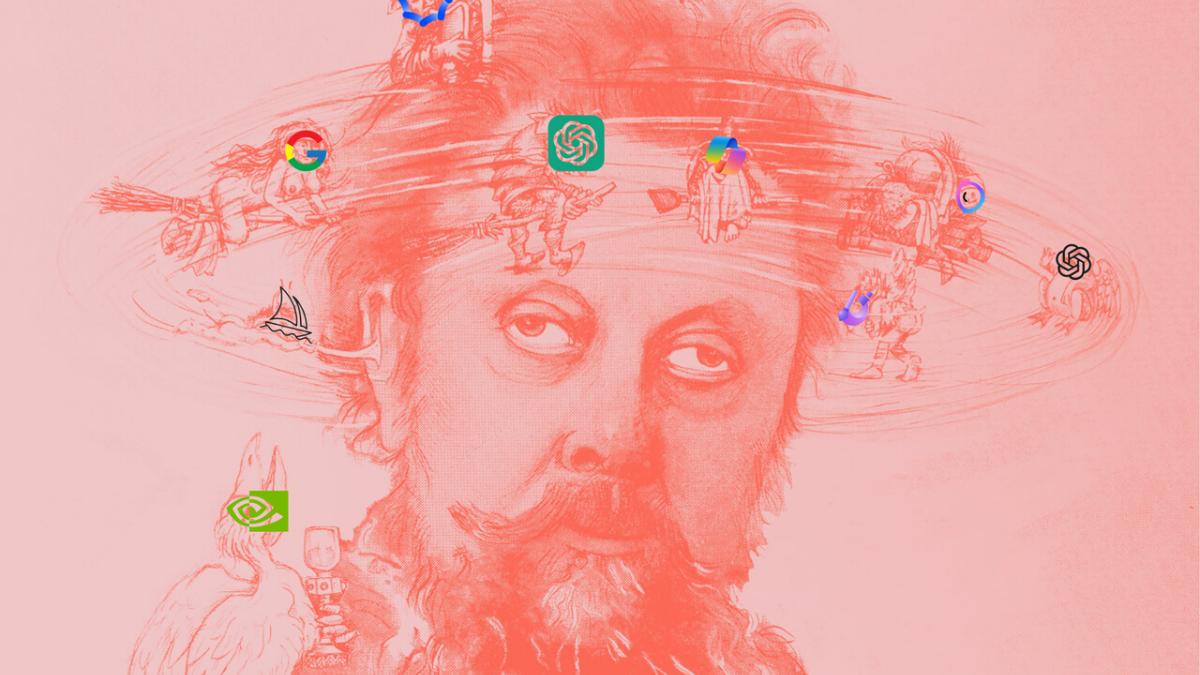
AI Am Over It by Nadia Piet & Archival Images of AI + AIxDESIGN / Better Images of AI / CC by 4.0
In the beginning, the Bible says God created man in His own image. “And the LORD God formed man of the dust of the ground,” Genesis tells us, “and breathed into his nostrils the breath of life; and man became a living soul.” In 1818, the English novelist Mary Shelley wrote a new creation myth. “Accursed creator! Why did you form a monster so hideous that even you turned from me in disgust? God, in pity, made man beautiful and alluring, after his own image,” Shelley wrote, “but my form is a filthy type of yours, more horrid even from the very resemblance.”
In 2023, OpenAI’s GPT-4 launched to the public. It purportedly “passed” the bar exam in the 90th percentile and scored higher on the SAT than most of the students. Now, AI writes code, argues philosophy, and generates publishable prose. In some fields, frontier models answer boundary-breaking questions in minutes, not years. The gap between human and machine capability, which took centuries to close in physical labor, closed substantially in some forms of cognitive work within the span of a few years. With generative AI, humanity has flipped the creation myth on its head. We've built something that, on certain kinds of problems, exceeds what individual humans can do not through size or strength, but through scale and pattern recognition.
While God obviously made man lesser than Himself, Frankenstein’s monster actually surpassed him in strength and prowess. While intelligent, however, the monster was never able to match Frankenstein’s scientific prowess; when it came to attaining his ultimate goal of companionship, the monster relied on Frankenstein to build his bride. In our new reality of creation, we appear to want to do the reverse. Instead of creating a more physically powerful being, humanity seeks to develop an intelligence that exceeds its own.
What that inversion may cost us is what this essay is about. Rather than ruining us with brutality, AI threatens humanity with temptation, offering an irrefusable fix-all that condemns human effort to obsolescence and denatures the bonds that spur learning and development.
Learning is often driven by inherently pure motives: curiosity, love of craft, or desire for meaning. But people also set out to learn in order to reap future earnings and increase their material utility. No matter the goal, learning is fundamentally an act of faith in the future. To spend three years mastering tax law or organic chemistry or the novels of Henry James is to make a wager: that the future will arrive, that it will resemble the present enough to reward you for acquiring knowledge, that the slow accumulation of competence will eventually be redeemed. Whether preparing for case interviews at McKinsey or bolstering their résumé for graduate school applications, many students today are at least partially motivated by the rewards that their learning might promise.
AI redefines the odds of that wager. It diminishes the economic premium associated with knowledge and skill by removing scarcity from the equation, dismantling the motivation architecture for learning. Beyond the economic consequences, however, AI erodes something harder to quantify: the identity that mastery once conferred. Long hours in the library or the time spent in an apprenticeship formed the foundation of cognitive identities that people would leverage, building their skillset by solving challenging problems and dedicating time and energy to learning. They used to define themselves by their passions, spending years reading, practicing and mastering their fields in order to answer difficult questions. When AI can produce competent analysis in seconds, learning begins to feel unnecessary.
Recent research has begun to describe this shift as “cognitive surrender”: the tendency to adopt AI-generated outputs without a second glance, bypassing the friction of reasoning in favor of outsourcing the work of deliberation. The concern is not that AI makes people less intelligent overnight, but that constant reliance on artificial cognition changes our relationship to effort itself. The student who once wrestled with a difficult text now asks Claude for a summary. The programmer who once debugged line by line now supervises generated code they barely understand. Over time, the muscle of sustained thought weakens through disuse.
This intellectual reality is already taking shape. In classrooms, students increasingly question whether their work will benefit their futures. Every time that a philosophy student prompts Claude to write a term paper overnight or a computer science student asks Gemini to solve an entire problem set, the sense of futility spreads. I’ve witnessed classmates complete class projects in minutes with a few prompts, removing any struggle or challenge in schoolwork. Groupwork, which used to revolve around intellectual sparring and genuine debate, now boils down to asking ChatGPT for the best path forward. When I write code using AI tools like Gemini or Claude, the sheer volume and speed at which they program leaves me feeling empty and mindless, completely outclassed by these overwhelming models. My skills and insight have been taken out of the equation, making me no more than a supervisor to agents that have less and less need for me. The agency and pride that came from building up projects from scratch no longer exists.
This deterioration of intellectual faith does not occur in a vacuum. It lands on a generation that was already losing faith in the future for reasons that have nothing to do with AI. As the income required to afford a median-priced American home has jumped 70% since 2019, only about one in five Gen Z adults believe the American Dream is “very much alive.” A TransUnion study comparing 22-to-24-year-olds today with millennials at the same age found that Gen Z is earning less, carrying more debt, and experiencing higher delinquency rates, with 14% of Gen Zers describing themselves as “extremely stressed out” about money, compared to 8% of millennials at their age. Most critically, McKinsey's American Opportunity Survey found that unlike previous generations, Gen Z workers are less likely to expect their period of financial insecurity to ever end, and harbor high levels of doubt about their eventual ability to buy homes or retire at all.
This is the context in which a striking behavioral shift is occurring. Rather than doubling down on conventional wealth-building, a significant portion of young people are making a different calculation entirely. According to Northwestern Mutual’s 2026 Planning & Progress Study, almost a third of Gen Z are risking money on sports betting, prediction markets, and crypto; of those, eight in ten believe these assets offer a faster path to their goals than traditional methods.
The economic theory underlying this behavior is straightforward, even if rarely stated plainly. People discount future rewards relative to present ones. The size of that discount reflects how much one trusts the future—the less they trust the future, the more they favor immediate payoff. A generation that grew up through a global pandemic, a student debt crisis, and a climate emergency has rational cause to apply a heavy discount to any future payoff that requires decades of patient accumulation to realize. The expected value of a small chance at fast wealth looks more attractive not because young people have become reckless, but because they have assessed their odds under the conventional path and found them wanting.
AI does not cause this dynamic, but it accelerates it, and adds a dimension the economic data cannot capture. The gambler still believes in the possibility of winning, betting on some outcome they can still imagine reaching. What AI introduces is something more total: the suspicion that self-investment is inherently a losing proposition. Why spend three years becoming a competent writer, coder, or analyst when the tool that outperforms you is already free, in your pocket, and improving faster than any human can match? In previous eras of technological disruption, competence still mattered because there were other avenues in which humans could pivot to and still contribute to society. When powerful agents are capable of acting faster and more precisely than humans in just about every field imaginable, however, it’s hard to justify developing skills and abilities that will rapidly fall into disuse.
Frankenstein ends with the scientist’s destruction, as his body finally gives out on his quest to destroy his creation. In Shelley’s book, Victor finds reprieve from his inhumane creation in the natural world, seeking solace in the grandness of God’s creation that mitigates his guilt from his demonic offspring. I have found myself needing something similar: not faith exactly, but the suspicion that the chain of creation does not simply terminate with us handing dominion to our machines. “Wherefore I perceive that there is nothing better, than that a man should rejoice in his own works; for that is his portion” (Ecclesiastes 3:22). Perhaps what remains uniquely human is not intelligence, but the choice to find meaning beyond the material world in effort and work. ChatGPT can write this essay, but it cannot derive satisfaction from having written it. What Ecclesiastes terms as the portion, or the private, irreducible fact of having made something with the full weight of your attention and your struggle, remains, for now, ours alone.
Read other aticles in this series
Authors