Big Tech’s Affordability Fight is Finally Here
Issie Lapowsky / Mar 4, 2026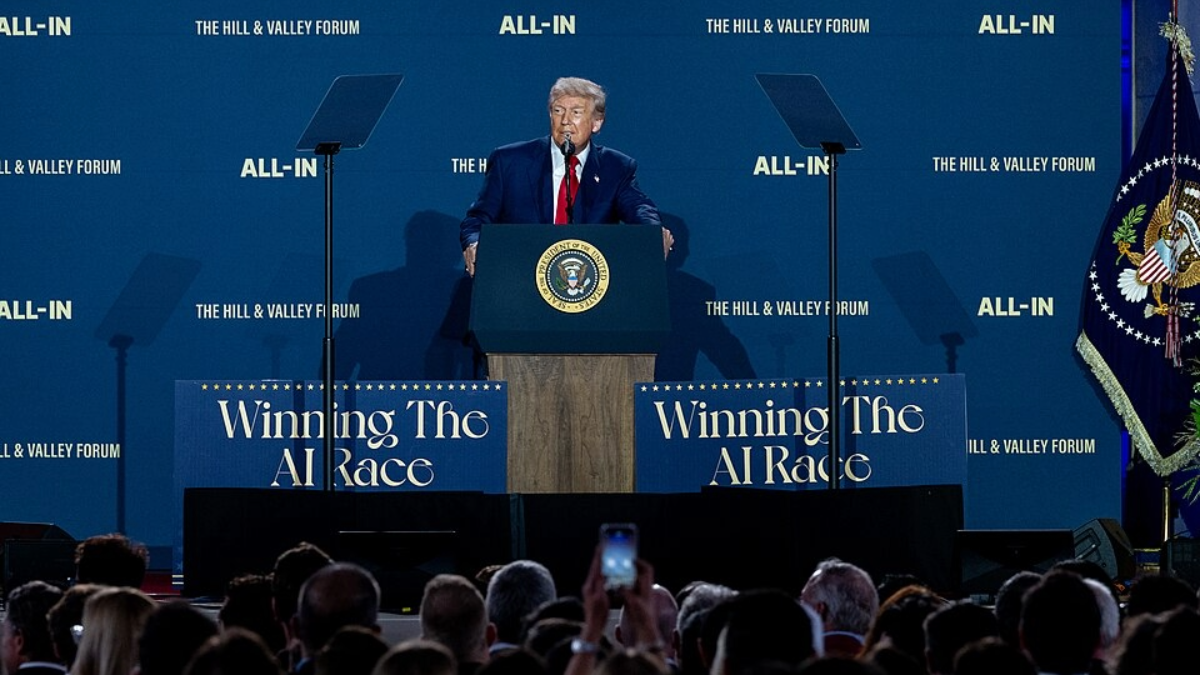
President Donald Trump delivers remarks at the White House AI Summit in Washington, DC, on July 23. (Official White House Photo by Joyce N. Boghosian)
As tech companies came under withering scrutiny at the height of the techlash, one defense giants like Google and Meta deployed to beat back claims of harm was that their most widely used products didn’t cost people a dime.
These behemoths still found ways to make their fortunes, but they largely did so on the back of free services billions of people used. And when these companies got in trouble politically — for antitrust and privacy concerns — they pointed to their cost-free services as a foil.
Google prominently featured the free nature of its ubiquitous search engine while fending off federal antitrust lawsuits in the United States. Facebook pushed back on criticisms that its data collection practices were too invasive by making policymakers question whether the world would be better off if it charged people for access. Personalized advertising, the company wrote in a blog post as it stared down new regulatory guardrails in Europe, “will always be the cornerstone of a free and inclusive internet.”
Information wants to be free, tech executives defiantly argued in the lexicon of the internet age, and they had ensured it was. For years, that helped make the topic of affordability one of Big Tech’s most effective shields.
In the artificial intelligence era, it’s becoming an Achilles heel.
On Wednesday, President Donald Trump is expected to meet with executives from a range of AI hyperscalers to sign a pledge vowing to supply their own power for data centers, an arrangement he announced with sparse detail during his State of the Union address last month. The White House confirmed to Tech Policy Press that the list of companies expected to attend includes Amazon, Google, Meta, Microsoft, xAI, Oracle and OpenAI.
The heightened attention from the White House is a clear sign that Big Tech officially has a new fight on its hands, one in which it will be asked to answer not just for the social and emotional toll of its technology, but for its economic cost, too.
“This issue has all the makings of a decisive electoral challenge,” Sen. Richard Blumenthal (D-Conn.), who co-sponsored a bipartisan bill targeting data centers’ rising utility costs, told Tech Policy Press. “The data centers are highly visible, electricity prices are a hot button issue and consumers are looking for accountability.”
‘A huge transfer of wealth’
Information may want to be free, but it turns out infrastructure is expensive, now more so than ever. This year alone, just four companies — Alphabet, Meta, Microsoft and Amazon — project they will spend some $650 billion on data centers. But the true long-term cost of building, cooling and powering these colossal energy-guzzlers extends far beyond tech companies’ own capital expenditures.
It’s also currently being passed on to consumers in the form of rising utility bills and corporate tax breaks that are depleting some states’ coffers. One recent analysis by the Union of Concerned Scientists found that in 2024 alone, utilities in seven states passed $4.3 billion in costs on to consumers.
The data center industry often argues that it brings real economic benefits to the state and local governments where its data centers are located. That includes creating hundreds of thousands of jobs — mainly construction jobs — and contributing substantially to the local tax base, which can be used to fund schools, roads and other public projects.
And yet, research suggests the tax picture is more complicated. While these companies do often contribute property and employment taxes, 36 states across the country now have sales tax exemptions for data centers, according to the nonprofit Good Jobs First, which studies economic development incentives. Designed to lure the industry in, those exemptions were mostly put in place before the recent expansion of more costly AI-specific data centers, which are larger and filled with more specialized equipment than the cloud computing data centers that came before. Now, according to the group, at least 10 states are losing $100 million or more in tax revenue annually thanks to those tax breaks. In Texas, those tax losses amounted to roughly $1 billion in 2025.
Good Jobs First executive director Greg LeRoy said these numbers have made it increasingly clear that data centers are not always the valuable economic drivers that tech giants and the political leaders promoting them have sold them to be. If anything, he argued, they risk draining state budgets at a time when states are already struggling to make up the shortfall from cuts to federal funding. “There's a huge transfer of wealth from taxpayers to shareholders,” LeRoy said.
Complicating matters further for Silicon Valley: unlike search engines or social media, the cost of using certain advanced AI tools keeps going up, meaning consumers face the prospect of paying for AI access on both the front and back ends.
All of these costs are raising public awareness of the actual price of AI at a time when affordability has become the salient political issue of the day — and voters are connecting the dots.
One Morning Consult poll in November found that 58% of voters believe data centers play some part in increasing electricity costs, up from 54% in October. In February, a Marquette poll found that 70% of voters believe data centers’ costs are greater than their benefits, up from 55% in October. While Democrats were more likely to agree with that statement than Republicans, the majority of both parties agreed.
Growing backlash
The public pushback is making the data center issue a potentially potent one heading into the November US midterms.
Carol Obando-Derstine, a Democratic congressional candidate in Pennsylvania’s 7th district, said she hears questions about data centers at every public appearance she makes.
“[Voters are] hearing about the strain on the grid. They keep seeing it in the media and want to know more about it,” she said.
Obando-Derstine is running in part on her record as a former regional director for a local electric utility, arguing it would bring much needed expertise to Congress at a time of so much strain on the grid. There’s precedent for this wonky platform: fellow Democrats Mikie Sherrill in New Jersey and Abigail Spanberger in Virginia promised to help check data center expansion en route to clinching their gubernatorial races last year.
Meanwhile, legislatures from bright red Oklahoma to deep blue New York have proposed bills that would impose all-out moratoriums on data center construction. According to Tech Policy Press’s last count, at least 300 data center bills tackling a range of issues have been introduced across the country.
But even as voters and lawmakers began to chafe at the potential toll of data center construction, industry was seemingly slow to respond. As recently as last summer, Google, Meta, Microsoft and the industry lobbying group Data Center Coalition were fighting an effort in Ohio to make data center operators pay their own way. When the public utilities commission moved ahead, the Data Center Coalition argued that “no one customer type or industry should be singled out for disparate rate treatment.”
In the last few months, the industry’s position has started to change. In January, Microsoft announced that it would ask utilities to charge the company higher rates to cover its data centers’ electricity demand and any additional upgrades needed to meet that demand.
Microsoft’s pledge soon gave way to others, including from OpenAI and Anthropic, with announcements promising investments in local communities through education programs and job training.
In a statement to Tech Policy Press, Data Center Coalition president Josh Levi said the group shares Trump’s commitment to “a more affordable, reliable electric grid that serves all customers.” “The data center industry stands ready to do its part in that effort,” said Levi, whose group counts Google, Meta, Microsoft, Anthropic and OpenAI as members.
Microsoft president Brad Smith in a statement called Trump’s ratepayer pledge “an important step.”
It’s a notable shift in tone from an industry that has shown itself more than capable of fighting back against unfavorable policy initiatives when it wants to. This suggests that tech executives are beginning to see AI affordability as a political liability.
Still, some veterans of the early techlash remain dubious that companies’ voluntary commitments to the Trump administration will make a real dent, particularly when some have abandoned prior public commitments.
“These pledges are worth the paper they’re written on,” Blumenthal said. “There needs to be a legal guarantee.
Disclosure: Issie Lapowsky is a 2026 Reporter in Residence with the Omidyar Network. The Omidyar Network has provided grant funding to Tech Policy Press.
Authors