Brazil's AI Development Strategy Needs an Edge Layer
Yasodara Cordova / Nov 10, 2026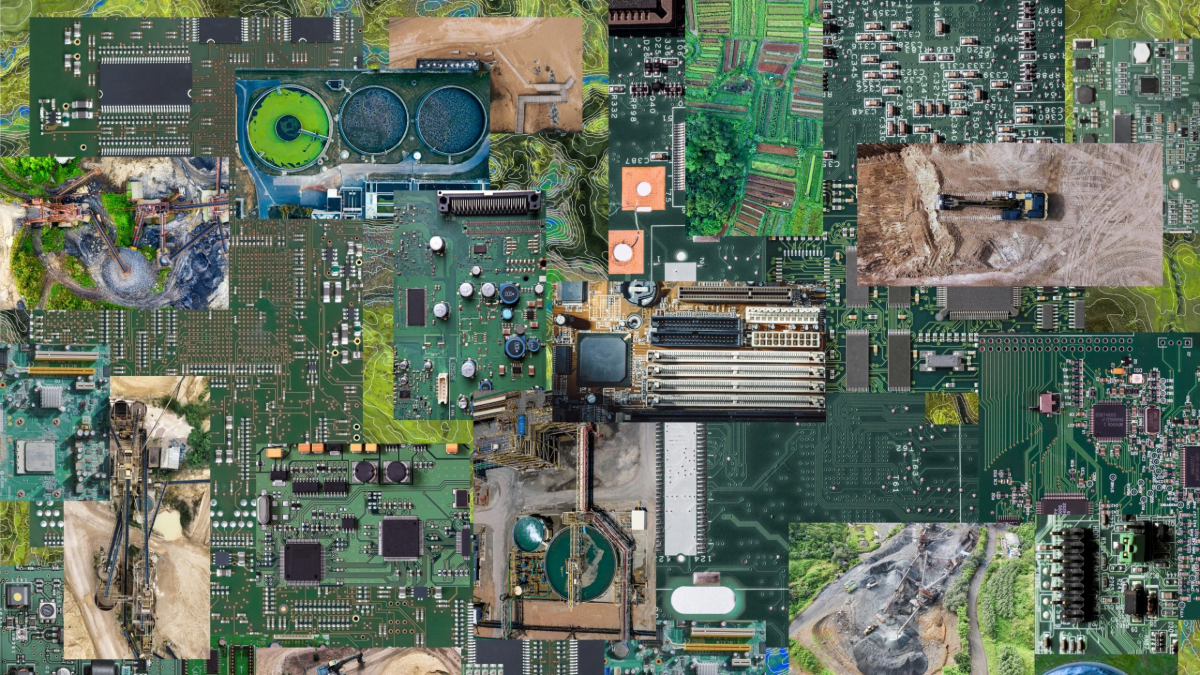
Silicon Landscapes by Sinem Görücü / Better Images of AI / CC by 4.0
In Brazil, the debate over AI development is obsessed with frontier models and data centers, but that obsession has a blind spot. The vast gamut of AI issues goes way beyond that, and for a country that aims to reindustrialize, edge AI, which is when the inference that runs on local hardware rather than in distant data centers, deserves a much louder debate.
The country's biggest AI move so far runs the other way, toward data centralization, supercomputers, and new hyperscale data centers. In August, the Brazilian government announced it will invest 2.3 billion reais ($444.2 million) in two AI projects, including a supercomputing partnership with China’s Huawei and iFlytek and a tender for a second supercomputers. These supercomputers will run applications built on intensive, centralized data collected and entrusted to the government, powering AI public services such as digital public tools, automated government procurement assistance, and telehealth data transcription. According to the Brazilian Minister of Management and Innovation in Public Services, Esther Dweck, this is a strategy dubbed “Base de Dados Brasil” which aims to centralize, integrate, and safeguard Brazil's citizens data to be used in AI training. But Brazil is a country of contrasts: it ranks fourth for wealth inequality among the 56 markets in UBS’s 2026 Global Wealth Report. Its public investments also contrast, reflecting how resources are distributed.
For example, computer labs are present in only 27% of public schools serving elementary grades, rising to only 73% of public high schools, according to 2024 school census data compiled by Todos Pela Educação. A Regional Center for Studies on the Development of the Information Society (Cetic.br) 2025 survey also found that video surveillance cameras are present in 79% of schools in the country's state capitals.
And so, while there's a lively debate over access to Nvidia's latest chips and where to build new data centers, and officials talk about bringing hyperscale infrastructure into the country to pool the data Brazilian citizens generate through public infrastructure, 84% of employed young Brazilians work in jobs that don't require specific qualifications, and only 1 in 7 land a technical or higher-level post, according to Brazil's Ministry of Labor and Employment. Only 12% of high school students want to pursue engineering, and math is a major reason why, according to a 2025 survey by CIEE and Instituto Locomotiva. Young Brazilians rate their confidence with the subject as just 5.2 out of 10, and 79% say gaps in basic education are a barrier to continue their studies. In the Program for International Student Assessment (PISA) 2025 results published in September, Brazil again scored below the Organization for Economic Cooperation and Development (OECD) average in math.
So, debating only frontier models and hyperscalers is largely buying the vendor's argument dressed up as a development argument. Many public and private sector AI applications in Brazil don't need frontier capabilities. They need reliable, bounded, locally controlled inference — often referred to by tech firms as “edge AI” — and workers ready to fix and maintain this infrastructure.
Why edge AI matters for countries in need of industrial development
Edge AI is a fancy name for a type of data processing realized locally, through small, specialized, well-scoped models that beat chasing frontier scale in industrial data processing, manufacturing, as well as agricultural and lower-tier industrial automation, like defect detection on textile or footwear lines, predictive maintenance in packaging and food processing, or structural monitoring on mining sites in general.
This kind of automation offers a diversified path — provided countries build the standardized, shared policy and funding framework that lets a new economy grow around it, the way China has sought to. China's industrial AI strategy, as mapped in a 2025 World Economic Forum and Accenture review, is organized by what each sector actually needs to run. Intelligent transport requires low-latency computing for real-time monitoring and data analysis, while smart manufacturing demands highly precise, specialized computing capabilities. Chinese firms, the report notes, “often find it beneficial to prioritize specialized, smaller models tailored to specific scenarios” than to chase frontier capabilities. The state backs this with layered policy: Beijing sets strategic direction, provinces and cities build AI clusters around their own industrial strengths, and a national program (East Data, West Computing) physically relocates computing capacity toward western regions with abundant renewable energy. This is infrastructure matched to the job.
Brazil doesn't have to invent this model from scratch, but if the country is thinking about reindustrializing by adding a layer of high productivity with AI as the motor, it needs purpose-built edge inference technology, sufficient for the applications that matter most on the ground.
The jobs argument
Local edge infrastructure is, at bottom, an industrial policy choice. Training people to maintain, adapt, and build on this hardware creates skilled technical employment that can't be offshored. It also creates the conditions for more local data storage and genuinely new, local approaches to processing that data. Compare that to the current trajectory: hyperscalers being announced generate plenty of jobs on paper, but a July 2026 Getulio Vargas Foundation (FGV) study estimated that, for a model 100-megawatt data center, 85% of the jobs are tied to the construction phase, and only about 4% become permanent operation and maintenance roles. The study suggests only 15% of jobs overall are permanent, counting spillover into other sectors. The risk is that what’s left is a thin layer of engineers working for data monopolies, and a large base of gig workers managed by algorithms they don't control. More investment in edge AI is a possible third path, but it needs intentional, focused policies that create islands of innovation inside the country.
To be fair, this connects directly to Nova Indústria Brasil (NIB), the federal industrial policy launched in January 2024, which sets aside 300 billion reais (about $58 billion) in financing through 2026, since expanded, for six missions with targets for 2033. NIB is one of the right vehicles for this argument, but in my view, it has yet to make it, lacking both regional integration and a grounding in local AI policy.
This isn't a fringe position, either: Andrew Ng, the co-founder of Google Brain, former chief scientist at Baidu, and now an advocate for what he calls "data-centric AI," has spent years making a similar argument from inside the industry, that most manufacturing and industrial problems don't need a giant model, they need a small, specialized one fine-tuned on good data, sometimes as few as 50 examples, running close to the factory floor, as Ng pointed out in a 2022 interview with IEEE Spectrum.
Probably no one in the "west" wants to hear that there is something to learn from China, but Brazil is hedging its bets between the US and China, and so maybe it makes sense for the country to be a laboratory for how to adopt some of these approaches, and to distinguish itself from what cloud companies want to sell.
Despite the fact that the NIB’s fourth mission states that the focus is to promote the digital transformation on the factory floor, public remarks from Management and Innovation Minister Esther Dweck have framed the issue around centralized national data infrastructure with a unified digital identity, a national database meant to sustain AI development and enable more personalized public services, not edge computing, and not a plan for where the hardware that would actually deliver those service runs. It appears that the government's instinct keeps circling back to big, centralized datasets: identity, health, social benefits. That's a reasonable place to start, but it needs to run parallel to one that makes services more local, with purpose-built hardware that is less cloud and energy-demanding.
Brazil's own tax incentives point the same centralized way. The Redata regime, (Lei 15.504/2026, signed September 2026) suspends federal taxes on electronic components and IT equipment, but only for companies with approved data center projects, a status that requires meeting sustainability requirements and commitments such as offering part of their capacity to the domestic market or investing in innovation. That explicitly excludes any company enrolled in Simples Nacional, Brazil's tax regime for small and micro businesses. The country's major new AI-adjacent tax break is built for hyperscale infrastructure, not for the small electronics shops, repair technicians, or edge-hardware integrators I argue deserve the investment instead.
Of course, edge hardware still requires supply chain continuity, firmware support, and maintenance capacity. That doesn't disappear. But it becomes an opportunity rather than a dependency, because building that capacity locally is the point. Brazil already has a large, mostly informal repair workforce that keeps old phones and electronics running, most of it operating outside formal registration, in a sector where informality likely runs above Brazil's national rate of 37.5%, according to Brazilian Institute of Geography and Statistics (IBGE) continuous national household sample survey data. With roughly 480 million computers, tablets and smartphones in active use in the country, the repair market sustains a large amount of highly specialized technical labor. Not exactly the same skills edge hardware will require, but proof of the country's underlying capacity. That market is also precarious: informal, often unlicensed, and its workers are sometimes treated as targets by police rather than as technicians. Without them, most Brazilians wouldn't be able to keep their phones running or afford new ones. Edge AI policy could formalize and extend that exact repair logic to a new class of hardware, and it doesn't have to happen alone. Brazil could partner with foreign firms to train workers domestically, the same way it partners for everything else it doesn't yet make at scale.
Brazil's specific case
Brazil already has centrally standardized Digital Public Infrastructure (DPI) that allows dozens of private and public companies to plug into shared protocols, such as the Pix payment system. However, another big potential for the country resides at the margins, in the opportunity to automate what already exists or create new manufacturing lines supported by edge AI. One example: the CESAR innovation center’s Manaus unit and UCB Power developed a computer vision system for inspecting battery components at UCB Power's factory in the Amazon, using a 4K camera and edge AI to process visual data locally, without the need to send images back and forth to the cloud.
The scarce resource in edge AI is arguably not silicon but technicians. While the market-spread model of centralized, frontier-scale AI runs in resource consuming data centers, uses data that continuously creates risk, can draw on an underlying surveillance architecture, and offers a small layer of superjobs for elite engineers, the edge layer offers a much more favorable industrial policy that goes beyond hardware and software, leveraging a policy that upskills and converts the existing workforce, like technicians registered micro-Entrepreneurs, underemployed STEM grads, gig workers, and others, into registered, higher-value technical laborers. This would be a jobs-first industrial policy that requires hardware, software, and training — not the opposite.
Authors