Charting the Transatlantic Far Right Campaign Against Europe’s Digital Rules
Dean Jackson / May 19, 2026Dean Jackson is a contributing editor at Tech Policy Press.
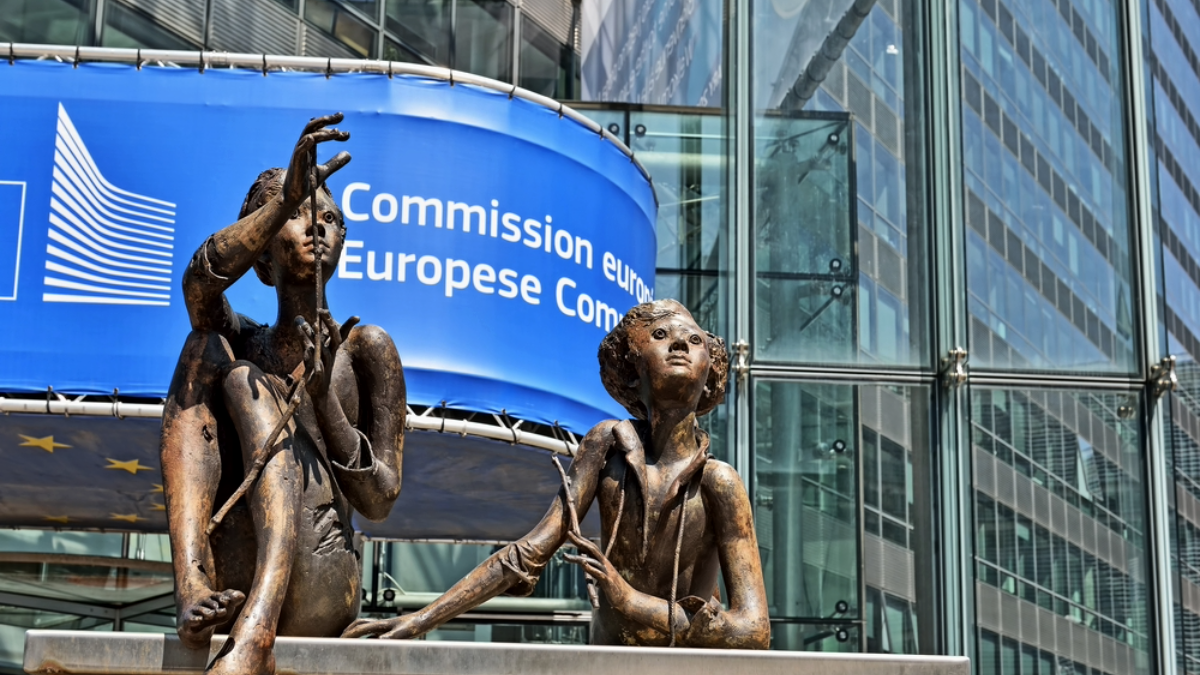
Office of the European Commission in Brussels. Shutterstock
On Thursday, March 5, United States Under Secretary of State for Public Diplomacy Sarah Rogers testified before the House Foreign Affairs Committee. In response to a question from Rep. Keith Self (R-Texas) about what the State Department is doing to defend free speech in Europe, Rogers responded that "There's a lot of bad faith accusation[s] that when we stick up for democratic self-determination and for expression in Europe, that we’re taking partisan sides. No, we are taking the side of self-governance, which we chose 250 years ago and we think has benefited our allies, too.”
According to The Guardian, less than a month later, US Secretary of State Marco Rubio signed a cable instructing US diplomats to confront foreign propaganda and tell “America’s story” on the continent by working with local European influencers, embracing Elon Musk’s X, and working more closely with “the Department of War’s Psychological Operations.” Rubio’s cable and Rogers’ comments both come in the wake of the White House’s release of a national security strategy that warned of the “stark prospect of civilizational erasure” in Europe. Many on the continent regarded the strategy “as a blatant declaration of interference in their internal politics, and intended to boost the prospects of the European far right,” as the German news organization Deutsche Welle reported.
The White House strategy regards American technology firms as an asset that the US can utilize to achieve its economic, military, and diplomatic goals. Consistent with that view, the administration is also pursuing an active campaign against European tech regulations, such as the Digital Services Act (DSA), which Republican leaders regard as “censorship.”
What is the relationship between the Trump administration’s Europe policy, the US tech sector, and far-right political actors on both sides of the Atlantic? And what is on the record about potential political support in the European Parliament for neutering the DSA? To assess these questions, Tech Policy Press collected and analyzed recent public reporting on meetings, joint appearances, and other transatlantic linkages between the Trump administration and European far-right figures and movements. This assessment follows reported efforts by the Trump administration to support “MAGA-aligned” organizations in the EU, as well as Republican allegations that Europe’s digital regulations and their enforcement against Elon Musk’s X constitute anti-conservative censorship.
Below are our findings.
Two years of transatlantic engagement
Tech Policy Press has produced a timeline of events, beginning at the time of the 2024 presidential election, where prominent far-right figures such as Elon Musk, Trump administration officials, tech industry leaders, and right-wing European politicians intersected.
A few things stand out from our review.
- The pace of such events is increasing. The gap between entries on the timeline narrows considerably as it approaches 2026. This is likely both a consequence of the Trump administration’s accelerating efforts abroad as well as growing media coverage of these connections.
- Both official and unofficial forms of diplomacy appear to be ramping up. Overseas organizations like the German far-right party Alternative für Deutschland (AfD), Nigel Farage’s Reform UK party, and Hungarian think tanks and nonprofits lead in the number of reported touch points with US figures. Under Secretary Rogers has visited and appeared alongside other groups and politicians in France, Italy, and Poland. The Heritage Foundation has emerged as a non-governmental convener, as has ADF International—an organization that recently testified before the House Judiciary Committee. In April, US Vice President JD Vance visited Budapest to support Hungarian Prime Minister Viktor Orban’s reelection and accused the European Union of election interference in advance of Orban’s defeat.
- Big Tech is in the background, but Musk is center stage. While there are known touchpoints between Silicon Valley firms, the Trump administration, and European far-right figures, the most prominent figure at the center of such relationships is Elon Musk.
Assessing European demand for weaker digital regulation
How large is the European interest in Washington’s narrative of censorship and grievance? To try and answer that question, we searched for documents—such as European parliamentary questions, plenary statements and joint letters—to identify Members of the European Parliament whose position on the Digital Services Act (DSA), Europe’s landmark digital regulation, may align with the censorship narrative proffered by the Trump administration and US Rep. Jim Jordan (R-Ohio), chairman of the House Judiciary Committee, who has attacked Europe’s digital rules in Congressional hearings and official Committee reports.
Our search turned up nine documents that together were signed or sponsored by 55 members of the European Parliament (MEPs), indicating the presence of a minority bloc within the Parliament. These members have raised concerns and questions about the DSA that suggest alignment with the right's censorship narrative.
- The 2022 Strengthened Code of Practice on Disinformation (P-001369/2024), July 17, 2024
- Censorship of speech under the Digital Services Act (DSA) (P-001375/2024), July 18, 2024
- Potential agreements and avoiding preventive censorship on digital platforms under the DSA (E-001563/2024), August 28, 2024
- Cost of censorship on social media (E-000567/2025), February 7, 2025
- Plenary debate transcript on the DSA (CELEX C/2025/05389), 2025
- Spillover effect of the Digital Services Act (DSA) into non-EU countries (E-003271/2025), August 22, 2025
- US government lobbying campaign to eliminate the Digital Services Act as a censorship tool (E-003303/2025), August 27, 2025
- One hundred experts write to European Commission warning EU legislation risks censoring global speech (ADF International press release), October 9, 2025
- Multi-million euro fine against X to enforce the EU censorship agenda under the guise of alleged violations of transparency obligations under the DSA (O-000047/2025), December 19, 2025
The Members of Parliament that make up this loose bloc cluster heavily in three groups: Patriots for Europe (PfE), Europe of Sovereign Nations (ESN), and European Conservatives and Reformists (ECR), with occasional non-attached members. The sponsors of these documents together represent less than 8% of the Parliament—far from a dominant faction, but also not insignificant.
The content of the parliamentary questions sponsored by MEPs on this list is another interesting source of information. In one such question, Christine Anderson (a member of Germany’s AfD and the ESN parliamentary group) cited a US House Judiciary Committee report when asking whether or not the DSA would have a spillover effect on other countries. Another question, by MEPs Mary Khan (ESN) and Petra Steger (PfE), remarked on US lobbying efforts to overturn the DSA, noting that “as a matter of principle, all efforts that lead to the abolition or at least a substantial relaxation of the Digital Services Act, which, under the guise of fighting disinformation, is being misused as an ideologically motivated censorship tool to suppress unwelcome opinions in the digital space, should be supported.” The language of these questions suggests that far-right MEPs are paying close attention to US government activity around European regulation.
If the far-right scores further electoral victories in the European Parliament or in national elections, it could expand the bloc’s influence. Still, scrapping the DSA is a political long shot—but diminished enforcement may be an eminently more attainable goal. The nature of this analysis—which only identified the MEPs most vocally opposed to the DSA—almost certainly understates the appetite for relaxing the EU’s posture on enforcement, which may extend to other European lawmakers for different reasons altogether.
The most likely path to a watered-down digital regime runs through Europe’s center-right. The list above includes six MEPs from the ECR, which ranges from rightwing-to-far right, and just one from the center-right European People’s Party (EPP). But European appetites for regulation have been waning since the release of the Draghi report: for instance, in October, German Federal Minister for Digital Transformation Karsten Wildberger, a member of the Germany’s center-right Christian Democratic Union, said that the “pendulum has swung way too far” on digital regulation just days after meeting with a US diplomat.
Outstanding questions for future analysis
Overall, this analysis captures an early and still-developing effort to reshape the transatlantic relationship along lines set out in the Trump administration's 2025 National Security Strategy, one in which American technology firms are assets, European digital regulation is a target, and far-right political movements are treated as potential allies. The effort spans official diplomacy, non-governmental channels, and domestic political messaging in both the United States and Europe.
What the evidence shows is that the architecture of this effort—the personnel, the organizations, the parliamentary allies, the diplomatic cables—is now visible enough to track. The outstanding questions concern the scale and nature of these connections, their funding, and how far they extend beyond the actors identified here.
A note on methodology
Claude and Perplexity were used to surface and collate relevant news reporting and to search European Parliament records for MEPs whose public statements align with the censorship narrative described in this piece. Editors verified results against primary sources.
Authors