Cindy Cohn on How to Sustain the Fight Against Authoritarianism
Justin Hendrix / Mar 8, 2026The Tech Policy Press podcast is available via your favorite podcast service.
Today's guest has spent thirty years on the front lines of one of the defining battles at the intersection of technology and democracy: privacy and the fight for who controls your digital life.
Cindy Cohn is the executive director of the Electronic Frontier Foundation (EFF), and she has been in the room for some of the most consequential fights over digital rights since the internet became part of everyday life—from fighting for encryption in the 90s, to the NSA mass surveillance revelations, to battling FBI gag orders that kept Americans in the dark about government data requests, and now for the fight against the grave civil rights and privacy abuses of the Trump administration.
Now, as she’s preparing to step down from her role at EFF, she's telling her story, and trying to recruit a new generation to the fight. Her new book, Privacy’s Defender: My Thirty-Year Fight Against Digital Surveillance, out March 10 from MIT Press, weaves her personal journey with the legal battles she's fought on behalf of whistleblowers, researchers, innovators, and everyday people.
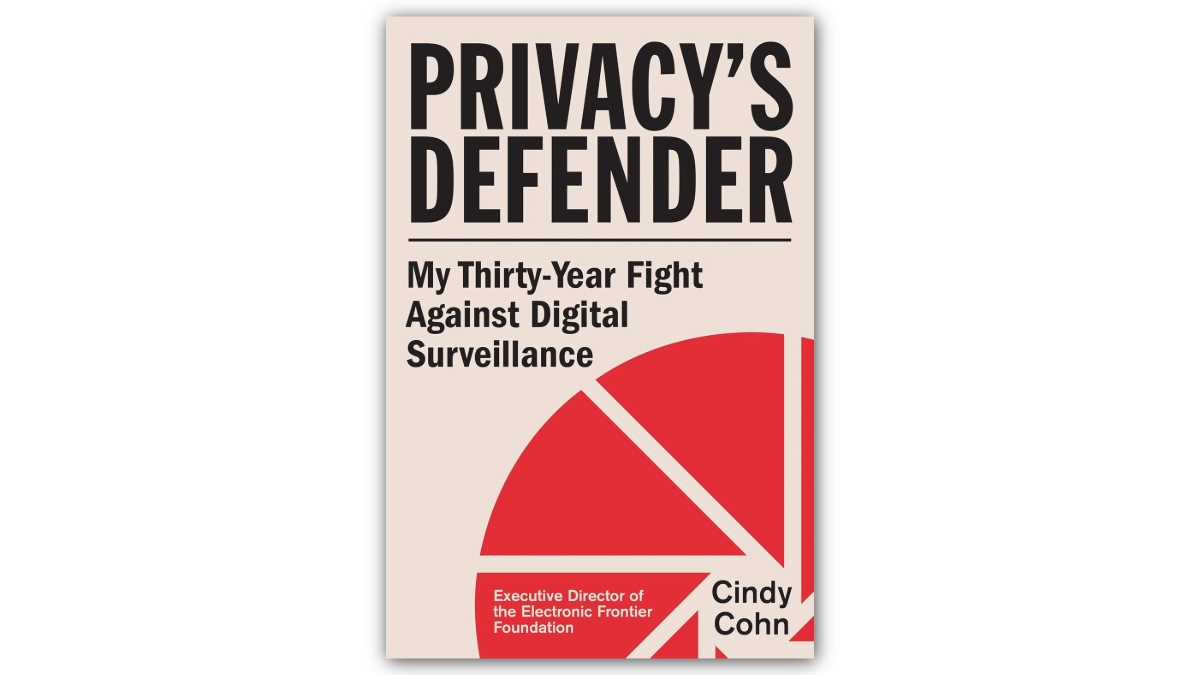
What follows is a lightly edited transcript of the discussion.
Cindy Cohn:
My name is Cindy Cohn. I am the executive director of the Electronic Frontier Foundation, and I am the author of Privacy's Defender: My Thirty-Year Fight Against Digital Surveillance, which will come out from MIT Press soon.
Justin Hendrix:
Cindy, it's a pleasure to have you here, and I'm excited to talk to you about this book. And this is the first time I've had the opportunity to have you on this podcast. So I think my listeners are probably well familiar with the Electronic Frontier Foundation, well familiar with your work as an organization. They may not know so much about you and certainly about your path. So I want to get into that just a little bit before we get into some of the issues of the book.
I want to talk about the Iowa origin story. You opened the book in a San Francisco courthouse, but you talk about how your kind of thinking about these things started in Central Iowa. You described feeling like you didn't quite fit in, the adopted kid, the Jewish family in a mostly Christian town. You talk about your mother's illness, your parents' messy divorce becoming fodder for gossip. You write about all of that in terms of childhood, perhaps being an education in what privacy is for. Did you see it that way at the time or only in retrospect?
Cindy Cohn:
I'd say it's mainly in retrospect. In writing the book, I tried to pull out the things that I think were formative, but overall, I had a really fun, easy childhood. Again, these things were not present, but everybody has stuff. I think in deciding that privacy was really important later on in life, I did try to look back and figure out where did those seeds come from. I think most things that people are passionate about have some seeds in their history. And so I tried to pull them out here.
Justin Hendrix:
Let’s talk about Mr. Lewin, this kind of pivotal moment that you portray in the book.
Cindy Cohn:
Yeah.
Justin Hendrix:
Tell me about Mr. Lewin and the situation that you were in and how this individual came to your aid.
Cindy Cohn:
Yeah. By the way, I use pseudonyms for everybody, but Mr. Lewin was my best friend's father growing up and he was a lawyer. And I tell a bit in the story, he really is my inspiration for becoming a lawyer myself. But I largely thought that because unlike my father, he was available to take us water-skiing in the summer. And I thought that was a better job than the one... My dad was a traveling salesman and wasn't around a lot. I did learn a little later that water-skiing doesn't come with a JD and I might've been a little wrong about that as a kid.
But when I was in high school, there was a wave of evangelical Christianity that kind of came across my high school. And this happened in a lot of places in the middle of the country in the early '80s. It wasn't unique to my little town, but I really started feeling like I was being targeted for conversion by kids I'd grown up my whole life. And I really rebelled against that. We weren't a particularly religious family, but we were Christian, and that had been okay when I was a little kid. And suddenly, I was being treated as if I was somehow broken and they were there to fix me. And that was not okay with me.
And then I started looking around and realizing how much of what was going on in the little town was really based in the presumption that everybody was Christian. And most importantly, in the incident that happened here, I was in choir and I'm still a singer, and we had to perform a lot of religious music. We had a Christmas program every year. It was almost always completely Christian music and some of it quite religious, not just the Christmas carols and things like that. And then we rolled around to Easter and we were supposed to do a whole program of religious music in a local church on Easter Sunday. And I felt uncomfortable with that.
We were practicing and I felt like a fraud. And it seemed to not be noticed by our choir teacher. So I went to Mr. Lewin, who was a lawyer, and I said, "I'm not really comfortable with this. Is this okay?" And he said," No, it's not okay." Oh, so the first thing I did was I went to the choir director and I said, "I'm not really comfortable with this. Can I skip the concert?" And he said, "No, you're graded on performances and your grade will go down." I was a good student. I wasn't going to let my grade be impacted by this.
So then I went to Mr. Lewin and I asked him what he thought about the situation and he said, "No, that's not right. The constitution, the public school shouldn't be making you sing in a church and if you're not comfortable with it." So he went and talked to somebody. I don't know that I know exactly how he did it, but all I knew was later he said, "Don't worry, you don't have to sing in the church and it can't impact your grade."
And I just felt this rush of relief and gratefulness and this idea that somebody had stood up for me and protected me against... School's pretty powerful when you're a kid and got me this. That feeling was really one of the moments when I think back on, I think about how I decided not just to be a lawyer, but to be somebody who really stood up for people with less power.
Justin Hendrix:
So I'm going to fast forward now to San Francisco, 1990. You do a fellowship at something called the UN Center for Human Rights in Geneva. You wander back to San Francisco. You're throwing a housewarming party and this fellow shows up in tie-dyed socks that turns out to be, I suppose, an important connection.
Cindy Cohn:
Absolutely. Fundamental. The person's name is John Gilmore, and he was one of the founders of the Electronic Frontier Foundation. But really, I met him because he showed up with a bunch of hackers in my living room. And one of the other guys who came to that party I ended up dating, but meeting John and these people who were... Remember this is 1990, so this predates the Worldwide Web. These are people who were living in a version of what most of us have all the time now with instant free communications with people all over the globe in an ongoing way.
I remember in 1990, you had to save up money to have a long distance call. And again, I'm older, this may be lost on younger people, but counting the minutes that you could stay on a call before it got really, really expensive. It's just a whole different level to be able to have ongoing kind of distance-free communications. And these guys were doing that. And I just thought it was amazing.
Justin Hendrix:
A few years later, he calls you, says there's a grad student at Berkeley who the government is threatening to jail apparently for publishing math. Tell us about this. What does this become?
Cindy Cohn:
Yeah. This becomes a case called Bernstein versus Department of Justice. So the math PhD student is a guy named Dan Bernstein. He lives in Germany now. He's still a professor, but he was a PhD student at the time. And John calls me and said, "There's this grad student. He wants to publish some computer code on the internet, and if he does, he'll go to jail as an arms dealer." And I said, "What does it do? Does it blow things up?" And he said, "No, it keeps things secret." And I was a baby lawyer at that particular time, but I said, "Well, that sounds like a First Amendment problem to me." And he said, "Me too, will you take the case?"
And this really introduced me into the world of what was actually going on on the internet much more deeply than my boyfriend and his friends chatting at all hours of the night on black screens with green letters. So John explained to me a lot more about what was going on with cryptography and how science was developing through internet publication. They were pretty far ahead of the rest of us because the universities and the government were hooked up rather than scientific ideas being published in papers, on paper that were then sent around in magazines. It was being published on an ongoing conversation online.
And one of those places was a news group, which for folks who might be a little younger, it's kind of a decentralized version of what NowMon might get on Reddit, right? Little forums that have topic areas where people who are interested in stuff can sign on and communicate. Again, Reddit's owned by a company, and this is much more distributed. It was an organization called Usenet that managed this. And Dan wanted to publish this little computer program and indeed, the US government had export regulations that said that if he didn't get a license to do this, he could go to jail as an arms dealer on the US munitions list, which is the list of things you can't export without a license. There are things like surface-to-air missiles and tanks and software with the capability of maintaining secrecy. And that is what Dan wanted to publish.
So I took on the case. I went to my little firm. I was at a small firm in San Mateo at that point, and I convinced them to let me do this case pro bono. And we set about to try to figure out how to make it so that a math student could publish his work online and not have to get a... And the government wasn't handing out licenses to people like Dan. So the idea that he had to get a license wasn't just a hoop he had to jump through. It was actually a barrier.
And so we put together a First Amendment challenge to the arms export control regulations ultimately called Bernstein versus Department of Justice, and set about to get this hurdle out of the way of all of us having access to strong encryption, because I knew and we knew that this was going to be a key to us having privacy and security online. That turns out that encryption is really one of the ways that you can build privacy and security in digital communications. And there aren't very many others. It's really very central.
Justin Hendrix:
This kicked you off. This started your path. And of course, now I suppose you've looked at these issues around privacy, around the relationship between the state and individual freedoms and rights in more ways than... You've probably forgotten more details about this particular intersection than I'll ever know, but I want to kind of maybe just abruptly bring it to the present moment and ask you a little bit about where we've got to in this country.
I mean, I don't know. I kind of feel in my core that just the last few months, what we've seen in Minneapolis, what's happened on the streets there, some of the movements of the federal government against members of the press, some of the other major infractions around privacy and privacy law from the Trump administration, things like the Department of Government Efficiency pooling data in ways that before were kind of thought to be, I don't know-
Cindy Cohn:
Illegal.
Justin Hendrix:
Totally illegal and inappropriate, right? I don't know. Where's your mind now as you cast it across that arc from that point where the fight started for you to where we are right now?
Cindy Cohn:
I have good days and bad days, I think, like anybody who is engaged in these battles. I would say on the bad days, I feel a little like Cassandra, the Greek goddess who was always screaming about the terrible things that were happening that nobody else could hear, and that we have been screaming about the potential that all of this surveillance and lack of attention to security could end up really empowering authoritarian governments since the '90s. This was our worry. A little later, Ed Snowden came along and called it turnkey totalitarianism, which is a phrase that I think is pretty apt, that we set up the structures by which a government like the Trump administration could come and really turn up knobs that were already there and create a much more authoritarian and state that the rest of us would be stuck with and would have very little power against.
I think of privacy not as something like a tarp you put over your head before you do something illegal, but more a check on power. It's how we protect ourselves against an authoritarian government. It's also how we protect ourselves against business models that are aimed at violating our privacy. It's not either or, sadly. We don't get to pick which one we think is worse. We have both. And they are feeding each other. In the worst of times, I feel really sad and despondent about how bad it's gotten and that the things that we have been advocating for for a very long time, if we had actually taken steps as a society to really implement them, it would be a lot harder for someone like the Trump administration to do some of the stuff they're doing now.
On the other hand, when I'm on my more optimistic days, if we didn't have access to strong encryption, we would be much worse right now, in a much worse position. If we didn't have the privacy laws that we do have, we would be in a much worse position. I am on more Signal conversations than I can count, and they aren't just with security people anymore. They're with people in regular society who have recognized that they want to stand up against this government, but also that they need privacy in order to do it securely in a way that protects them and their loved ones.
Privacy is a team sport, right? Sometimes people think about my privacy. I don't have much to fear. I'm not really likely to be a target. And that's really not the right way. That's not how the government thinks about your privacy and it's not how you should think about your privacy. It's really, who are the other people who you're communicating with? Who are the other people who are in your Rolodex and your files and what are their risks that you have to think about? Because that's how the government works. They use contacts. The NSA calls it contact chaining to get to the people that they're actually targeting and also to do these wide swaths of things like ICE raids. They try to figure out where a whole bunch of people are that they can do together.
So I think that on my happy days, I'm glad that we have the things that we have and I know that we would not have had them had it not been for the fights that we did going back to the '90s. And on my darker days, some days you look at the road behind and some days you look at the road ahead, and depending on which one you're focusing on, you can feel better or worse. I think both things are true. The bad news is we have a lot to do. The good news is we have solved harder problems as a country and as a world than the danger of a surveillance state and a totalitarian government.
We have done this and in the United States, we've fought harder problems than around the world. People have thrown off authoritarian rulers before and made it to a better world. So those are things to just keep in mind so that we don't end up in despair because despair serves the powerful. It's what they want. Because if you're in despair and you're just sitting around feeling bad about things, you're not organizing, you're not strategizing, you're not building community with other people who agree with you. And so just as, again, I'm probably more of a strategist than anything. Just as a strategy, they'll let those guys win.
Justin Hendrix:
I hear you saying fighting over every inch matters because you never know what room that will give to someone else to continue the fight. Let me ask you specifically about what EFF is doing around what we've seen in Minneapolis and what we've seen in the ICE/CBP vein, in particular, over the last few months. What's ongoing?
Cindy Cohn:
Lots of groups are doing a lot of good work around ICE. And most of the center of the work in Minneapolis is done by people in Minneapolis. But what we are trying to do is we have been mapping surveillance all across the country for a long time. The Atlas of Surveillance, which is led by a couple of my colleagues, including Dave Moss, is an attempt to try to give people information about where surveillance is happening. We've specifically started actually down the US border in the South because there's so much surveillance there, and that ends up being the test bed for a lot of things that get rolled out everywhere else.
We have worked a lot on issues around protecting people's data privacy and trying to stop data from being collected in one part of the government from being used in other parts of the government. People who follow this stuff may know that the president issued an executive order on data silos saying that data silos need to end and that the government needs to have access to information across the government, not just in the particular areas. This really violates some things that have been sacrosanct in the law, like you should tell the IRS the truth and that data won't go anywhere else.
We know there is an effort right now, it's in the courts, and there was just a decision that came out today that I haven't had a chance to read yet on whether ICE can have access to IRS data. There's new reports coming out of some of the trials, one in Oregon specifically about Palantir, a company providing a tool to ICE agents locally that incorporates Medicaid data in some way to help them identify where they're going to do their raids. And then overall, the thing that EFF always does and has done for years and years is we have surveillance self-defense materials up on our website that both we use to train people in security when they're engaging in protests or activism or journalism or other, crossing a border, but also that are used by lots and lots of people who do security trainings who aren't us.
We tried to build tools that are scalable such that you don't have to be... Compared to the size of the problem, we have a very small staff. We tried to build tools that are hopeful for people all across the country and around the world to be able to train people in how do you use Signal? What do you do if you have your phone at a protest? How do you evaluate the risk to you and others and make intelligence choices based on what security people call your threat model?
So some people might not want to take their phone to a protest. Other people might want to take their phone to a protest, but turn off the biometrics, the facial identification due to a weird quirk in Fifth Amendment law. Your face can be used and your biometrics can be used to open up your phone, but requiring you to put a password into your phone is harder for the cops and we would argue requires a warrant, and this is a fight we're in all across the country. But right now, that means you're a little safer if you turn off the biometrics, decide whether you want to take pictures, think about how to maybe scrub the... Some people may want to scrub the identifying information that automatically happens with pictures. Other people might want something that can be used in a court of law, and so they're going to want to keep that information that the phone logs about where and where you were.
So these are all things that, again, we try to make resources available in things that we internally call playlists to help people evaluate who they want to be, what risks they want to undertake and make the right decisions for them, because there isn't a one size fits all answer to this. And we really tried to bring that into the conversation. I know that there are people who want for simple rules to attending a protest. And you can go so far with that, but generally you have to presume who that person is. And most of those rules are presumed based on people are upper middle class, white people who are not at great risk of being targeted. And those aren't the right rules for many, many other people. And most of us probably have somebody in our phone's Rolodex who is at much greater risk than us.
And you have to think about that in terms of what are you taking to the protest, what are you doing, and how are you doing those things? So that's a long answer, but we're doing a lot. And then just being a resource as we run a legal referral network, people, especially with digital issues, can reach out to us and we will try to connect them with lawyers. Even if we can't help them, we tend to do impact cases, meaning cases that if you take on, we'll make big changes in the law or policy as opposed to small cases, which can be very, very compelling. So we try to find everybody counsel. We help advise coders who are developing tools, things that might be used to track ICE or otherwise.
We have a set of lawyers who are specialized in trying to help people who are doing those kinds of things. And then we try to help contextualize what's going on. We participated as amicus. Anyway, it's a whole range of things because we are an organization with activist lawyers and technologists, and we're working in all of these domains and ways that we can best be supportive of, honestly, the frontline people who are on the ground handling these situations.
Justin Hendrix:
You are a practitioner, and the book is a practitioner's memoir. I do want to just turn back a little bit to some of the legal fights that you described and get a sense of what it looked like from the inside. You already described the Bernstein case, this question of code is speech. Let's talk a little bit about some of the other national security phenomena, the NSA cases, the national security letters. Take us through one of those. Maybe we could start with the NSA, what we learned there. One of the anecdotes that you include that stands out to me is this quote from former NSA and CIA director, Michael Hayden, who said, "We kill people based on metadata." I don't know. How does metadata become such an important piece of the legal picture here?
Cindy Cohn:
So metadata is—and again, I fight this metaphor, but I still think it's a good way to entry level this, which is—think of an envelope with a letter in it. The letter is the content of the communications and the addressing information on the outside is the non-content or the metadata. Again, there are ways in which that metaphor isn't great, so don't hang onto it too closely, but it's a good starter one. And so if you think about your communications, whether that's an email or a chat, or whatever, that you would think that who you're talking to, how often you're talking to them, the location of where you're talking to them from, which many, many devices register and the frequency that you communicate with them, that's all metadata. And then what you actually say to each other is content.
And there are two things to keep in mind about this. One is that the law has traditionally treated the metadata different from the content and has required a Fourth Amendment full judicially approved warrant for one, and most of the time not required a judicial approval for the other. And this goes back way pre the internet, but that's one distinction. A second distinction is something called the third-party doctrine that came up in the '70s that basically says if you give information to a third party, like your bank or your ISP or Google as your service provider, it generally has less protection as well and doesn't require a full Fourth Amendment warrant. When sometimes you might hear lawyers talk about how we're chipping away at the Fourth Amendment, these are the kinds of things that we're talking about, this shrinking, what gets protected by a full Fourth Amendment warrant to something very small.
And then the second side of this is that metadata is really, really important. It's really useful for investigators. And you don't need access to the content of people's communications in order to get almost all of what people want. As the official pointed out, we kill people based on metadata, meaning we don't need to know the content of the communications in order to order hits on people in the context of war or CIA actions and those kinds of things. And that's what he was admitting, which is absolutely true. This kind of conflict is one that we have had to deal with for quite a while.
And in the context of the National Security Agency mass spying that was done secretly after 9/11, or things like national security letters, which were actually above board changed in the Patriot Act, government access to metadata en masse became much, much easier after 9/11 and the technology developed enough so that they could really do stuff with that. And of course, now we're in a time of AI where what they can do with this data is even greater than it was after September 11th, where they could do rudimentary contact chaining.
And President Bush, when some of the secret program first got revealed in 2005, said, "If you're talking to Osama bin Laden, we want to be listening," that's contact chaining. And we learned later that they were doing three hops, which meant if somebody was talking to Osama bin Laden and somebody was talking to them and then somebody was talking to them, the government was tracking all of that, which meant everybody who talked to the pizza parlor where some terrorist ordered pizza was suddenly on the government's watch list. The numbers get exponential really fast.
And so we had heard that some of this was going on secretly. We knew some of it was going on above board, and we knew that we had to, if we were going to actually give people privacy again, we were going to have to take on these problems. Between September 11th and late 2005, we heard bits and pieces of things, but we really didn't have what we needed to bring a lawsuit, which requires admissible evidence. And that all changed first in December of 2005 when the New York Times, after sitting on the story for over a year until after President G.W. Bush was reelected, actually released a story about the government's spying. And then about a month after that, we had somebody knock on our door at EFF offices in Shotwell Street in the mission and hand us the schematics of how some of this spying was happening. And it was a whistleblower who I think has not gotten nearly enough attention for what he did. His name is Mark Klein.
Justin Hendrix:
So you talk a little bit about the fact that across some of your efforts that you feel like the wins weren't clean after you prevailed on, for instance, encryption export regulations in the '90s. I don't know. What's it like to have these partial victories or how do you kind of explain that phenomenon?
Cindy Cohn:
The encryption victory was as close to a clean win as we had in terms of we got the regulations, the courts agreed with us that the regulations were unconstitutional and then the government backed down. They basically reduced the encryption regulations to something more like a... I think you have the email strong encryption to the government on your way out the door to export them, which is nothing like the barrier that it was when we started. So it's a tiny little administrative step now.
And the result has been that all of us have strong encryption. I talk a little bit about Signal, but honestly, we encrypted the web in part as a result of the Bernstein case. So that one was pretty clean. But then later when Mr. Snowden came out with his documents, which much later, 2013, we discovered that the government had instead gone to some of the technology companies and tried to get back doors into our encryption, some of which seemed to have been successful, others were not.
So we learned that even though it looked like we won on the surface, they were still working hard behind the scenes to make sure that we didn't have the privacy that we think people need. It got much worse after for the NSA spying. The government was doing three massive programs that we sued over starting in 2006. Some of it was Mr. Klein's evidence, which had to do with upstream tapping into the internet backbone. Some had to do with massive collection of internet metadata, and some had to do with a collection of telephone metadata.
And we sued over all three of those programs. The fights went on and on and on. These all needed to be stopped cold. And instead, we chipped away. Things are much better than they were when we started. We made lots of gains and did some other good stuff along the way, like increasing the role of the secret FISA court and increasing government, theoretically increasing congressional oversight if Congress wanted to exercise the power that it has. But we didn't get the clean wins that we wanted.
And it's frustrating because the American people deserve privacy. We deserve privacy, full stop. And it seems like something that ought to be, that I think is rooted in the Fourth Amendment, the idea of being secure in your papers is like in that text of the Fourth Amendment. But quite apart from the Constitution, I think it's a human right. It's how we create a check against power. It's how we do self-government in a self-governing society. And the fact that we've had to fight so hard to get it and really have only been able to chip away at the problem is it's an ongoing frustration.
On the other hand, this is something John Perry Barlow, who was one of EFF's founders, told me early on that kind of remains one of my North Stars. And what he says is, what he said to me was, "Nobody gives you your rights. You have to take them." And that's an evergreen challenge for people, like that Ben Franklin famously said after the Declaration of Independence was ratified, "What did you get? A Republic if you can keep it?" Right? It's the same idea that self-government isn't something that we just get handed and we get to luxuriate in. It's something that we have to fight for all the time.
And fighting for privacy is my little corner of it. Of course, it's not the only one in order to have a true self-governing entity. And we're lucky that there's a big digital rights community that has been built up, but also a broader community of people who are trying to push forward for democracy. But I think one of the things you learn when you do this for a long time is that it's not like a TV show where at the end of the episode is all tied up. It is an ongoing struggle and you're always the underdog, but yet it's important and worthwhile because we don't want to live under a dictatorship. We don't want to live under a king anymore. And that was the right decision and now we have to... Each generation has a fight to keep that or extend it. And ours is a doozy.
Justin Hendrix:
There's a piece in Vox by Zack Beauchamp kind of making this argument that in many ways, if you really look at what's going on in the United States right now, we might be witnessing a very large pro-democracy movement being born with some of these concerns, I think, around surveillance and the state's ability to collect information on citizens at the core of that democracy movement. On the other hand, of course, as you say, AI is moving quickly. There's not the federal restrictions in place that we need to defend ourselves. It does seem like we could potentially be in the beginning of something a little different. Your book is also about recruiting the next generation of people.
Cindy Cohn:
Absolutely.
Justin Hendrix:
I don't know. Who are you trying to draw in? Who are you trying to draw in to this fight?
Cindy Cohn:
I think there are a few circles. There were a few books that I read when I was a law student that inspired me to do this. And so in some ways I'm trying to pay it forward and be that voice for the next generation of quite literally the next generation of Cindy Cohns. But I also think more broadly, I really tried to tell these stories not because everybody should be a digital rights lawyer, but because whatever your skills are and your interests are, there's room for you to be part of making the world a better place.
I didn't start out thinking that this is what I was going to do. I just kept seeing opportunities to continue to do stuff that would help make the world better and being lucky, but also deciding to take them. And part of why I put some of my personal story in this is that sometimes it can feel like something that other people can do that you can't. And I tried to be as honest as I could about how this all happened and how much of it was happenstance and how much of it was... I'm a fine lawyer. I'm not trying to be falsely modest, but this isn't something that you need to be a special person to do.
And so I'm hoping it'll inspire technologists. I think, especially in the first part about the encryption fight, it's really a love letter to that early hacker community who showed up and stood with me as I stood up in front of a federal judge to try to explain this strange new world, and the fact that they were all there and really talking about it and pushing it. There was activism done by John, but lots of people around this issue. That's why we were able to win. We were there with the right legal arguments, but we were riding a wave of other people doing what they could do in their realm to free up encryption.
And I think that's how it has to work. So whether people are technologists, activists, artists, statisticians, which my husband ended up being, and I tell the story about how I met him in this, there's always a place that you can be to try to help make things better. And I wrote the book hoping that it could inspire people who don't come from my story, but who can maybe see themselves in the trajectory.
Justin Hendrix:
You say in the book, “I am trying to recruit you.”
Cindy Cohn:
Yep.
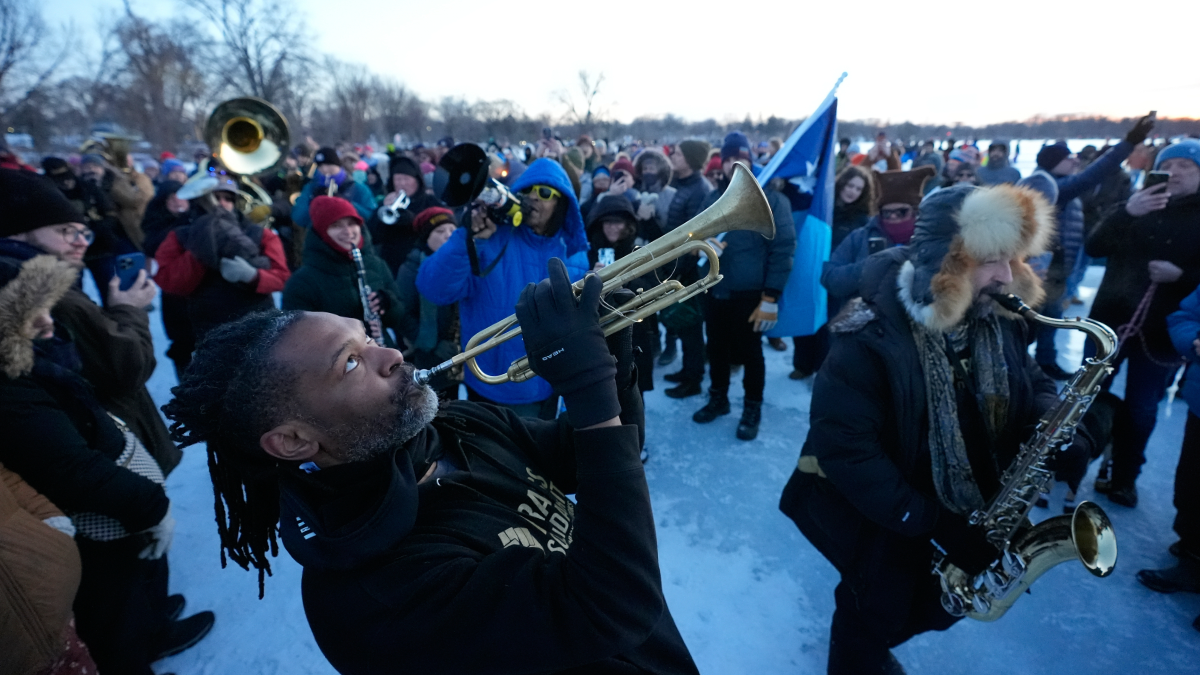
Trumpeters play while activists light candles on frozen Lake Nokomis, spelling "ICE Out," on Saturday, Jan. 31, 2026, in Minneapolis. (AP Photo/Alex Brandon)
Justin Hendrix:
So hopefully some of them will listen to this and be recruited. I want to ask you one last question about a theme that runs through the book, which is music. You talk a lot about the extent to which music sustains you and how your engagements with music and with other musical people are kind of important points in your life. Yep. Let me just ask you a little bit about that.
Cindy Cohn:
Yeah. Again, because I wanted this at one level to be a handbook for how you spend your life doing this, I did include some of the things that really sustained me. And music is one of those things. It led to some weird things, right? When I first got involved with all these hackers, I discovered that John Perry Barlow, who was the lyricist for the Grateful Dead, was one of the founders of EFF. I've been a very lightweight version of a Dead Ahead since college. This gave me a way to feel like I could be part or at least connected to this community when I'm not a technical person. The amount of time I've spent on the command line is very, very small. But it made me feel like, okay, there might be a place for me there.
And then as life has gone on, building a community of people who can support you through thick and thin and who aren't necessarily connected to the work that I do has been a real refuge for me as when things are not going well and when I need a break and all of that, I've got this other community of people who are amazing and accomplished people, but who don't... My entire identity isn't as being the legal director of EFF at the time and now executive director of EFF. And I think that is one of the ways that you can stay sane when you're doing this work for the long haul.
And that certainly is true for me. And also, I've been lucky enough to get to work and talk to activists all over the world about how they do it. And almost everybody will tell you that they have a safe space where they can recharge. And again, some of them say it's just a safe space in my brain. Right? It's not always safe to do this work, but having that balance has been tremendously important to me for doing this for 30 years and counting now. And I think that that's an important thing because sometimes people get really excited about being an activist and then they burn out. And that doesn't help the cause.
We have to be in this for the long run, as I tend to tell young EFF lawyers, the lawyers in the Department of Justice who are on the other side of you, they spend their careers doing this and they get better at it. And so we have to be able to spend our careers doing this so that we get better at it. It can't always be experienced DOJ lawyer against newbie, which I was lucky enough that we were successful in the '90s despite that dynamic, but that's not a winning dynamic in the long run. So you have to find ways to sustain yourself. And music has been one of the ways that I've been able to sustain myself over time, music and the community around music. So I wanted to include that because I think if I'm writing, if I'm trying to recruit people, I want to recruit them to the whole story.
Justin Hendrix:
Indeed, I'm grateful that you took the time to talk to me about this book and certainly grateful for all the impact that you and the organization that you've built have had on the world. What's next for you? I assume it's not going to be total retirement.
Cindy Cohn:
No, no, I'm not retiring. You don't spend a life in nonprofits and retire at my age unless there's no trust fund in the Cohn family. But quite apart from that, I am fired up by this moment. I want to be part of the fight. And I'm stepping down from EFF. That'll probably be sometime in early summer and I'm very happy for EFF. I think that after 25 years at the organization and leadership, it's important for it as an organization to let new people lead.
And the primary reason I'm stepping down is that recognition that a healthy organization can have a change in leadership. And I've been there a really long time. It's time for other people to get a chance to move up and take the reins and maybe do some different things than I'm going to do. So that was the primary reason I decided to step down. But also, I want to get closer to the work. EFF just made a new shirt based on, I think, in part because of me that said, "Let's sue the government."
I started out my career doing that. I like being in the thick of the fight. And as the executive director of a 125-person organization, no matter how wonderful they are, and they are wonderful, the amount of time that I get to spend doing the kind of thick of the fight work as opposed to the administrative and care and feeding of 125 smart souls, it's off for me. It's time for me to get back to the more frontline work.
So I'm not sure exactly what that's going to look like now. I'm trying to take this moment and see what comes up and see what calls to me. As I told the EFF team when I announced that I was stepping, "I don't think I'm done suing the government yet, but I want to see where the best fit is between my skills and what I know how to do and what is needed." And I suspect that might be in tech, but it might not be. We'll see. But it'll definitely be, I'm not done pushing to make the world a better place. It's who I am. And I'm waiting to see what comes up as the next best opportunity, after a little break. I promised my husband I will try to take the summer off.
Justin Hendrix:
Break you deserve. This book's Privacy's Defender: My Thirty-Year Fight Against Digital Surveillance on sale March the 10th. Cindy Cohn, thank you very much.
Cindy Cohn:
Thank you. And by the way, if you go to eff.org/privacysdefender, I am doing a little book tour. So I'll be coming to a few places. I know your audience as well. I'm going to be going to RightsCon and I'm going to be going to the summer security conferences in Vegas as well. So if people want to come, I'm just delighted to sign copies of the book or just talk to people. But I know for your audience, those are places that folks might turn up.
Justin Hendrix:
I will see you at RightsCon.
Cindy Cohn:
Excellent.
Authors