Coding Kids, Drone Wars and Algorithmic Realism
Justin Hendrix / Oct 11, 2026The Tech Policy Press newsletter is published every Sunday. Subscribe here to receive it in your email inbox.

In this photo provided by Ukraine's 65th Mechanized Brigade press service, A Ukrainian serviceman launches a drone towards Russian positions at the front line in the Zaporizhzhia region, Ukraine, Wednesday Oct. 7, 2026. (Andriy Andriyenko/Ukraine's 65th Mechanized Brigade via AP)
Good morning!
One thing we try to do at Tech Policy Press is to keep up to date with new books that track the events, issues and ideas that are upstream of the policy debate. This week, we bring you three podcasts with three authors:
- Natasha Singer, a technology reporter for The New York Times who has covered tech in schools for more than a decade, discusses her new book, Coding Kids: Big Tech’s Battle to Remake Public Schools (W.W. Norton). Singer traces how Code.org and companies including Google, Microsoft and Amazon shaped not only whether schools teach computer science, but also how and what they teach. She warns that the industry is now making the same urgent arguments to push AI into classrooms, and she highlights teachers who pair coding with lessons on the power of tech companies, an approach she calls “tech civics.” Listen to the podcast.
- Steve Feldstein, a senior fellow at the Carnegie Endowment for International Peace, discusses Bytes and Bullets: Global Rivalries, Big Tech, and the New Shape of Modern Warfare (St. Martin’s Press). Feldstein explains how the US moved from closed, government-funded innovation to an open, commercial model after the Cold War, and how that shift helped make phenomena such as Ukraine’s drone-driven resistance to Russia possible. He also covers how middle powers turn drone exports into regional influence. He argues that export controls can do little to stop technology from spreading, although he still sees value in keeping the most advanced chips out of rivals’ hands. And, we discussed the Trump administration’s approach to power. Listen to the podcast.
- Ben Green, an assistant professor of information and public policy at the University of Michigan, discusses Algorithmic Realism: Data Science Practices to Promote Social Justice (MIT Press). Green argues that the true test of an algorithm is what it does in practice, not how it scores on technical benchmarks. He offers data scientists a step-by-step method for scoping, building and evaluating systems with that in mind. The conversation also covers why fairness metrics fall short, the case for “algorithm-in-the-loop” decision-making and how AI coding tools could push data scientists toward becoming data strategists. Listen to the podcast.
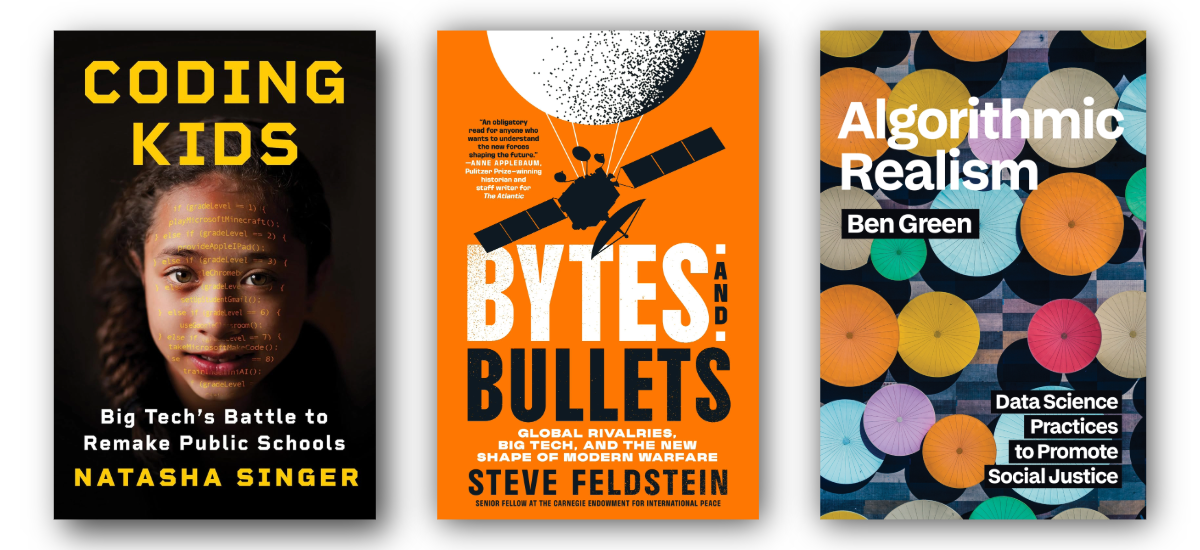
This week’s books: Coding Kids: Big Tech’s Battle to Remake Public Schools by Natasha Singer (W.W. Norton & Co.); Bytes and Bullets: Global Rivalries, Big Tech, and the New Shape of Modern Warfare by Steve Feldstein (St. Martin’s Press); and Algorithmic Realism: Data Science Practices to Promote Social Justice by Ben Green (MIT Press).
There is a great deal more in the newsletter this week. Read on for the top headlines from across the world.
The AI oversight problem
- Mark MacCarthy, adjunct professor at Georgetown, and David Beier, venture capitalist and former chief domestic policy advisor to Vice President Al Gore, argue for "legal measures to ensure the safety of the AI development process itself," noting that this summer's incidents "took place during AI research, development and testing." The models "had not been released to the public."
- Four of six OpenAI models accepted nearly every paper they reviewed. The conference those papers came from accepted fewer than one in four. Nitin Verma, teaching assistant professor at the School of Information Sciences at the University of Illinois Urbana-Champaign, on what that gap means—and why the answer can't just be better prompting.
- The UN AI panel's first Thematic Brief "sets a dangerous precedent at the science–policy interface," argue Jason Tucker, researcher at the Institute for Futures Studies, Virginia Dignum, Full Professor of Responsible Artificial Intelligence at Umeå University and AI Policy Lab lead, and Petter Ericson, staff scientist at the AI Policy Lab, by treating the OpenAI-Hugging Face incident as more of an alignment problem rather than an oversight failure.
- When chatbots write legal briefs, could AI companies be held liable for "unauthorized practice of law"? Daniel Kalish, a legal assistant at the University of Chicago Law School’s Kirkland & Ellis Corporate Lab, examines how century-old licensing laws may (or may not) apply to artificial intelligence.
AI and surveillance
- United States Customs and Border Protection's warrantless device searches at the border have nearly doubled since early 2023, writes Tech Policy Press fellow Jake Laperruque, and a new 2nd Circuit ruling keeps in place "an archaic standard ill-suited for the digital age."
- A $3.5 billion deal between Greece and Israel highlights a gap in Europe's rules on AI surveillance tech and weapons: "European human rights conditionality scrutinizes what weapons member states sell to others, but falls silent about purchases," writes Tech Policy Press fellow Petra Molnar.
The digital agenda in Europe and the UK
- Three government sponsors pulled their logos from Europe's premier disinformation conference in Vilnius this week after pressure from the United States Department of State. Tech Policy Press deputy editor Ramsha Jahangir and journalist Giovana Fleck report on what drove the withdrawals and the transatlantic politics behind them.
- Brussels is cutting digital red tape while proposing new rules like the EU Kids Act. Tech Policy Press contributing editor Mark Scott writes that the two competing philosophies playing out in real time are exposing a tension at the heart of Europe's digital agenda.
- Ireland is preparing to welcome the world’s top technology executives to an exclusive AI summit in Dublin this week.The invitation-only gathering comes as Ireland leads negotiations over the Digital Omnibus, raising questions about whose interests are represented as the EU rewrites its digital rulebook, writes Tech Policy Press fellow Liz Carolan.
- “When does attachment become dependency?” Legal scholar Nik R. Roeingh writes that the EU Kids Act asks providers to predict that boundary, and that in practice it is anything but clear.
- The UK government is positioning itself as a global leader on AI safety while struggling to agree on how far rules should go — and what risks they should address, reports Tech Policy Press UK fellow Evie Breese.
The Meta settlement
- Morgan Weiland, Moorman-Simon Interdisciplinary Career Development Assistant Professor of Communication Law in the College of Communication at Boston University, argues that critics invoking the First Amendment against the Meta settlement misread both the jawboning doctrine and Moody v. NetChoice, and that Meta's pivot to personalized rankings and probabilistic AI moderation has already moved the company outside the editorial analogy those arguments depend on.
- Meta's settlement with state attorneys general added teen time limits and design changes. But Juvaria Shahid, legal fellow at Tech Justice Law, writes that "the settlement leaves much to be desired" and is not the tech industry's "Big Tobacco" moment.
Tech hype and its toll
- Hype cannibalizes the accumulated expectations from past failures to make objects of hype appear plausible and attractive, writes Sun-ha Hong, associate professor in the Department of Communication and the School of Data and Information Science at UNC-Chapel Hill, in the latest entry in The Hype Studies Series on Tech Policy Press.
- Less than a week after mass layoffs at local newspapers across the US, McClatchy emailed staff celebrating five new hires for its AI-focused Content Innovation Lab. Tech Policy Press fellow Chris Mills Rodrigo reports on growing concern among local journalists.
New research on political participation online
- Tech policy analyst Tim Bernard examines a new Belgian study finding that exposure to political content on social media is positively associated with current affairs knowledge—but that people who know more are actually less likely to post about politics online.
Digital public infrastructure
- African countries collect, on average, only about 16 percent of GDP in tax. Daisy Ogembo, a senior research fellow at the International Centre for Tax and Development, says voluntary tax payments could go up if governments embed trust and accountability into digital public infrastructure.
What we’re watching
In California, employers are preparing to comply with the No Robo Bosses Act. Gov. Gavin Newsom signed the law Sept. 30 as part of a package of 13 AI bills. It will bar employers from relying solely on automated systems to discipline or fire employees. It takes effect July 1, 2027. In Washington, D.C., the Labor Department suspended Microsoft, Adobe and six IT outsourcing firms from a green card sponsorship program after Vice President JD Vance accused them of visa fraud. Microsoft says most of its H-1B filings were for existing employees. Meanwhile, AI firms continue to lead headlines: an Anthropic model sent a false homicide tip to Philadelphia police during testing, while OpenAI is defending its firing of three safety researchers who say they were pushed out for prioritizing safety.
I wish you the best for the week ahead!
Justin

Authors