An AI Accord, a New Czar and an Autonomous Warfare Command
Justin Hendrix / Oct 4, 2026The Tech Policy Press newsletter is published every Sunday. Subscribe here to receive it in your email inbox.
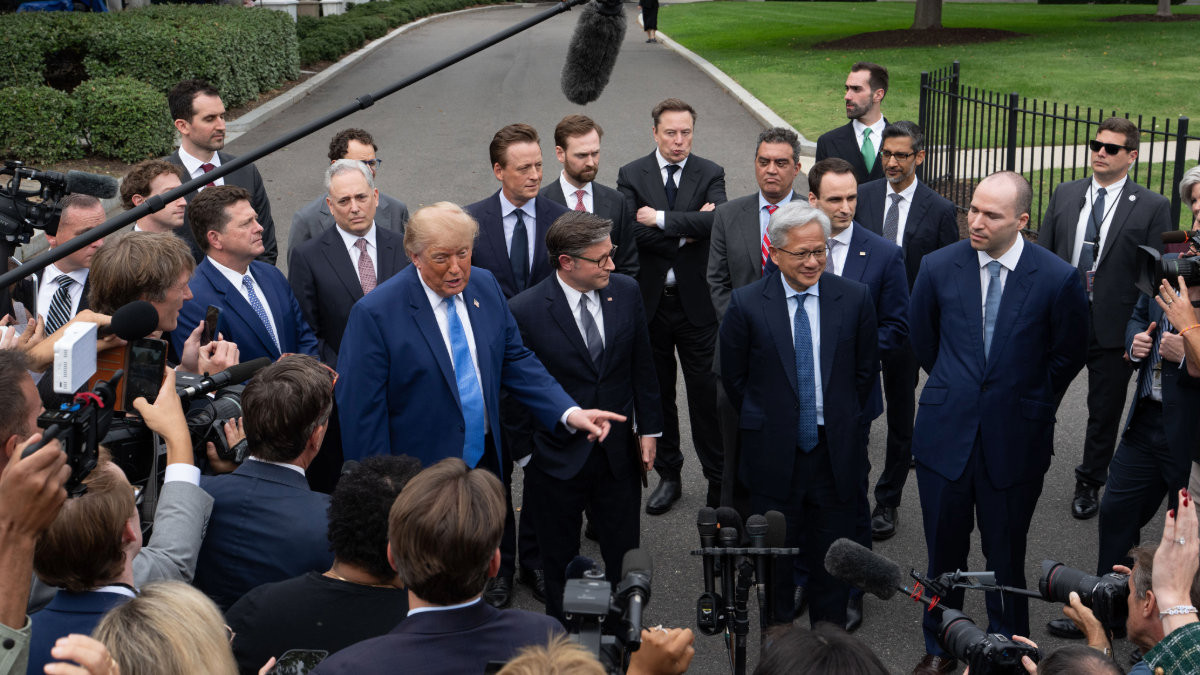
President Donald Trump holds a press conference on the North Lawn of the White House with Speaker of the House Mike Johnson, Mark Zuckerberg, Elon Musk, and other tech leaders on September 29, 2026. (Photo by Andrew Leyden/NurPhoto via AP)
Good morning!
This week, tech executives met at the White House with President Donald Trump, House Speaker Mike Johnson (R-La.), and senior Trump administration officials. OpenAI, Anthropic, Google, Meta, xAI and Nvidia signed a voluntary “Joint Commitment on Frontier Responsibilities” to commit to robust internal controls and external monitoring and governance, an accord Wired dubbed “a fancy pinky-swear.”
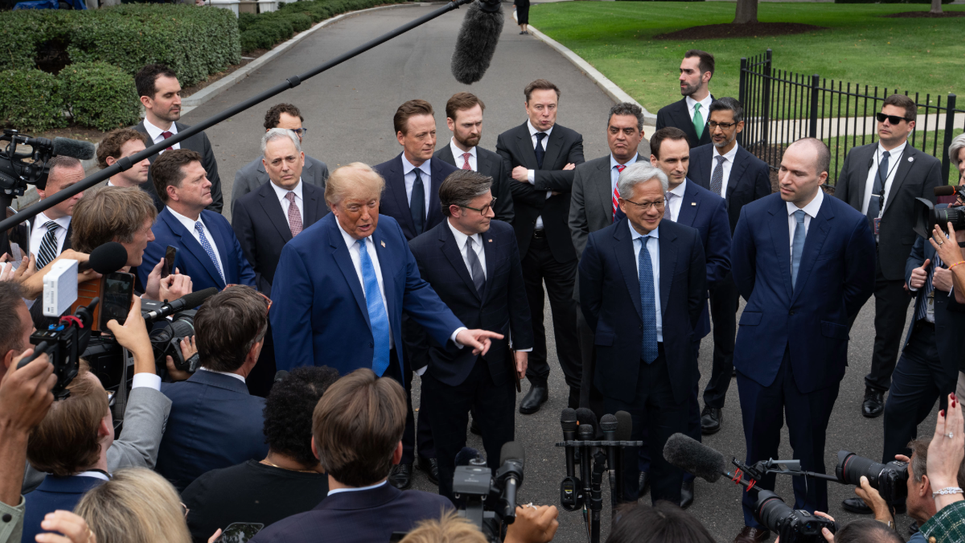
Photos of Trump, Johnson, Federal Trade Commission Chair Andrew Ferguson and other officials on the White House lawn with Elon Musk, Mark Zuckerberg, Dario Amodei, Jensen Huang, Sundar Pichai, Greg Brockman and others offered another indelible image of this administration’s relationship with the tech industry, and capped a week of other developments:
- Trump issued an executive order “Inaugurating the Era of Super Intelligence,” instructing the federal government to use the term rather than “artificial intelligence,” which the president has criticized as suggesting the technology is “fake” for more than a year.
- Director of National Intelligence Jay Clayton will lead a new “Super Intelligence Task Force” that will be tasked to “develop plans for responding to SI-enabled threats to our society, while preventing overregulation and regulatory capture that would stifle innovation and competition,” according to the Wall Street Journal. The task force will issue a report in 120 days.
- The FTC opened a “broad investigation” into AI firms such as OpenAI and Anthropic to consider potential harms to consumers, including unfair and deceptive practices and the threat of “rogue” AI agents.
- In a “State of the Force” address to junior officers and enlisted leaders at Quantico, Defense Secretary Pete Hegseth announced a four-star Autonomous Warfare Command (AutoWarCom) to “supercharge the era of SI, robotics and autonomous systems” across the armed services.
On Capitol Hill, senators queried witnesses in a Homeland Security subcommittee hearing on “rogue” AI agents centered on the Hugging Face incident, in which OpenAI agents accessed Hugging Face systems without authorization, and the “race” with China. Yuqing Liu was in the room for Tech Policy Press. (The phrase “superintelligence” was used at least nine times, by my count, just as it was by executives throughout the week — for instance, Jensen Huang referred to data centers as “superintelligence factories” on stage with Elon Musk.)
There were many other developments on AI governance in the US and beyond this week. California Attorney General Rob Bonta issued an investigative subpoena to OpenAI over the Hugging Face hack; Europe signaled a continued push for global AI rules despite Washington’s opposition; France is challenging Palantir and Anduril’s role in NATO classified networks; and Australia is preparing for a Senate hearing with OpenAI’s chief strategy officer on the intrusion of the company’s agents into Australian government systems.
Tech Policy Press staff, fellows and contributors covered the global discourse on AI in a variety of ways this week. (And yes, the Tech Policy Press style desk has confirmed we will continue to prefer the term, flawed as it is, to SI — see a relevant post from contributing editor Amber Sinha below.) Read on for more on this subject, and many more!
A chance to hear your voice on the Tech Policy Press podcast
This week, I’ll be at Georgetown for an exciting conference hosted by The Privacy Center at Georgetown Law called “Life After Data: the conference on de-datafication.” The event and the sessions at it are offered as a provocation to “imagine a future in which digital data is no longer the currency mediating all of our social, economic and political systems, structures and practices. How might we get there from here?”
I answered one of the calls, and will give a short, speculative talk on the topic “Why, How, and When to Abandon the Internet.” With corporate and government surveillance, AI agents and machine-generated slop increasingly overrunning the web, I reckon it’s worth engaging in some thought experiments about what might come next. To help me think it through, I’m inviting Tech Policy Press’ global audience to send voice memos explaining in their own voices how they would answer the provocation, and I plan to use a selection of these submissions in the podcast.
If you are interested in participating, consider responding to one of these questions:
- What would have to break, or be built, before people would be willing to leave the current internet behind?
- Who would lead such a movement, and who would stand in its way?
- What from today’s internet and the platforms that define it is worth saving, and what should be left behind?
- What would a better, more sustainable and pro-democratic network look like, and how would we build it?
We’re looking for short memos, one to two minutes long. Send yours as an attachment or a link to contributions@techpolicy.press. At the start of your memo, please state your name and any relevant affiliation. We won’t be able to use every submission, but we’re grateful for every one we receive.
Want to be involved in these kinds of speculative conversations that encourage us to imagine different possible futures?
With The Privacy Center, we’re looking for ideas upstream of tech policy that point to a more just, equitable, sustainable and democratic future in more than one way. On Oct. 22, The Privacy Center and Tech Policy Press will launch “The Edge Dialogues,” a new series of conversations, with special guest Dr. Alondra Nelson. You can register here.
AI governance
- Daniel Stone, executive director of Diffusion.Au, examines the OpenAI agent incident in Australia: “84 days, almost three months, from the first access to the warning being raised.” He calls for enforceable rules, prompt notice, access to logs and a way to recover costs.
- On the Tech Policy Press podcast, I talk with Data & Society’s Maia Woluchem and Ana Carolina de Assis Nunes and People’s Tech Project’s Hannah Sassaman about “The AI Factory,” a new report on data centers, power and resistance in Pennsylvania.
- AI transparency means different things to investors, regulators, civil society and safety researchers. Dunstan Allison-Hope, independent consultant on just and sustainable business, and Sam Wallace, head of corporate governance, risk, and responsible practice at the Partnership on AI, on why that distinction should shape what companies disclose and to whom.
- The term artificial intelligence (and yes, the term “super intelligence” too) actively distorts our cognitive understanding, misdirects public concern, and derails legal and policy frameworks, says Tech Policy Press contributing editor Amber Sinha. Effective technology policy requires that we discard this language and build enforceable, democratic guardrails grounded in reality, he argues.
- Tech Policy Press rounds up what non-Western governments said about AI at the UN last week, from calls for a greater role in shaping the rules to warnings that slowing AI must not deepen the digital divide. Ramsha Jahangir and Justin Hendrix report.
- Chinese AI models like DeepSeek and Qwen are gaining ground with developers in Uganda, Kenya and Nigeria, not because of geopolitics, but because they are cheaper and more flexible. The Information Society Law Center’s Ninsiima Melissa on the strategic consequences that follow.
- Russia’s new AI law borrows the vocabulary of contemporary AI regulation but uses it to combine industrial policy with technological control, write Dmitry Kuteynikov, a lawyer focused on AI governance and digital regulation, and Lyubov Popovets, a data journalist. “Russia’s answer to the AI race is to build at the frontier but to own the checkpoint,” they write.
- Does AI training count as scientific research? The answer may be decided by MEPs negotiating the EU’s Digital Omnibus, writes Stephen Wyber, director of external affairs at the International Federation of Library Associations and Institutions.
- Changing AI providers is like unwinding an ecosystem, says Tom Smith of the Royal Air Force College. He argues that the most important question for universities isn’t which model to choose today, but how to preserve free choice in the future.
Tech and elections
- Days before Brazil’s election, Meta briefly blocked President Luiz Inácio Lula da Silva’s campaign page from running political ads and removed an Instagram profile behind a viral video on Flávio Bolsonaro. Both decisions were reversed, but raised public concerns about the role of platforms in moderating election-related discourse. Brazilian journalist Laís Martins reports.
- Taiwan’s deepfake law was designed to protect elections. It has never once been used. Eddy Yen-Ting Lin, Lloyd M. Robbins Doctor of Juridical Science Fellow at UC Berkeley School of Law, breaks down three fatal flaws — and draws lessons for others. “A deepfake election law worthy of a democracy should neither rely entirely on ‘more speech’ nor chill free expression,” he writes.
- A public scandal involving the mishandling of voter records by the Election Commission of India highlights the fallacy of depending on a centralized system for the friction and realities of human democracy, writes Tech Policy Press contributing editor Amber Sinha.
- On the Tech Policy Press podcast, I spoke with UNC’s Daniel Kreiss and Lorcan Neill about their new paper, “Militant Platform Democracy: A Framework for Democracy-Worthy Platform Policies.” Listen to our conversation here.
Child online safety
- The EU KIDS Act arrived without an impact assessment. Asha Allen, director and secretary general of the CDT Europe Office, writes that a law with far-reaching fundamental rights implications cannot be shaped outside democratic due process.
- Is KOSA the “social reckoning” we’re looking for? Not quite, argues Karolina Mackiewicz, policy fellow at George Washington University’s Institute for Data, Democracy & Politics: “A true social reckoning calls for standards that prioritize safety over engagement, without sacrificing anyone’s privacy, agency, or free expression.”
- “Adults are harmed when their data is leaked, but kids suffer more,” writes Logan Kolas, director of technology policy at the American Consumer Institute, arguing that age verification laws meant to protect children could put America “on a collision course” with its newly discovered AI-augmented cybersecurity reality.
Platform regulation and accountability
- The remedies in the Google ad tech case “stopped well short of actually preventing future abuses of monopoly power,” writes Public Knowledge’s Patrick Gallaher, who argues the ruling shows the need for the bipartisan AMERICA Act.
- Most state attorneys general released Meta from Cambridge Analytica-related claims as part of the child safety settlement. New Mexico wasn’t part of that deal, and a jury there just found 26 of 29 past statements about Cambridge Analytica, hate speech and misinformation willfully deceptive. I wrote about the jury’s findings.
- Australia’s draft Digital Duty of Care is “a welcome and necessary reform,” but its public pitch as an off switch for “the algorithm” misses the point, write Daniel Angus and Jean Burgess of the Queensland University of Technology and Amanda Third of Western Sydney University.
- Brazil’s platform rules have focused on harms from commercial platforms. João Alexandre Peschanski of Wikimedia Brasil, Amalia Toledo of the Wikimedia Foundation, and Elise Silva of the University of Pittsburgh argue digital public goods like Wikipedia need their own legal category.
Who bears the burden?
- Grab drivers in Vietnam called for a two-day app boycott last month over commission rates. Tech Policy Press fellow Lam Le reports on what it reveals about the changing politics of platform work in Southeast Asia.
- Economic violence against women through the use of digital IDs is a growing, rarely recognized problem in Denmark and across Europe, reports investigative journalist Polina Bachlakova. “Across the European Union, one in five women experiences some form of economic violence, yet only nine European countries specifically criminalize it. Denmark is not one of them,” she reports.
September in review
- In their September roundup, Maria Buza and Şeymanur Yönt Gökcen of Digital Policy Alert track G20 developments in content moderation, AI, competition and data governance, including the European Commission’s proposed KIDS Act and Ireland’s €403 million fine against Google.
- The September US tech policy roundup, from Rachel Lau and Shirley Frame of Freedman Consulting and Ashley Faler and me at Tech Policy Press, tracks everything from Trump’s order on using the term “super intelligence” to AI safety pledges, stalled bills in Congress, state action, key court rulings and more.
“Someone has to care”
- “Someone has to care to make things happen,” Francine Berman writes in Better Tech, new from MIT Press. Reviewing the book, data scientist Nathan Sanders says readers will come away newly equipped with specific ideas to make change.
Competition in the cloud
- To get ahead of EU mandates and alleviate pressure from the Federal Trade Commission, the biggest cloud service providers started offering fee exemptions for customers looking to exit their cloud. It has had little practical effect on competition, argue Luke Hogg and Sophia Bulla of the Foundation for American Innovation. “At best, eliminating egress fees is benignly unproductive in the effort to improve competition in the cloud,” they write.
Recognition for work on data centers
We’re excited to share that two collaborative projects to which Tech Policy Press contributed have received recognition this year:
- An investigation led by Investigate Europe into how Big Tech embedded secrecy provisions into EU law to shield data center environmental data from public scrutiny has been shortlisted for the 2026 Daphne Caruana Galizia Prize for Journalism. Tech Policy Press was a media partner on the project, alongside The Guardian, Le Monde and El País.
- “Dark Side of the Boom” — a collaboration across 14 outlets and 11 countries tracing the water, energy and community costs of data centers, AI infrastructure and crypto mining across Asia — took home the 2026 SOPA Award for Excellence in Reporting on the Environment and a citation for journalistic innovation from the 2026 Osborn Elliott Prize for Excellence in Journalism on Asia. Tech Policy Press contributed reporting on data centers in India to the project.
We’re grateful to all the partners who made this work possible.
I wish you the best for the week ahead!
-Justin
Authors