'Pace the Frontier,' They Say. But Who Sets the Pace?
Justin Hendrix / Sep 13, 2026The Tech Policy Press newsletter is published every Sunday. Subscribe here to receive it in your email inbox.
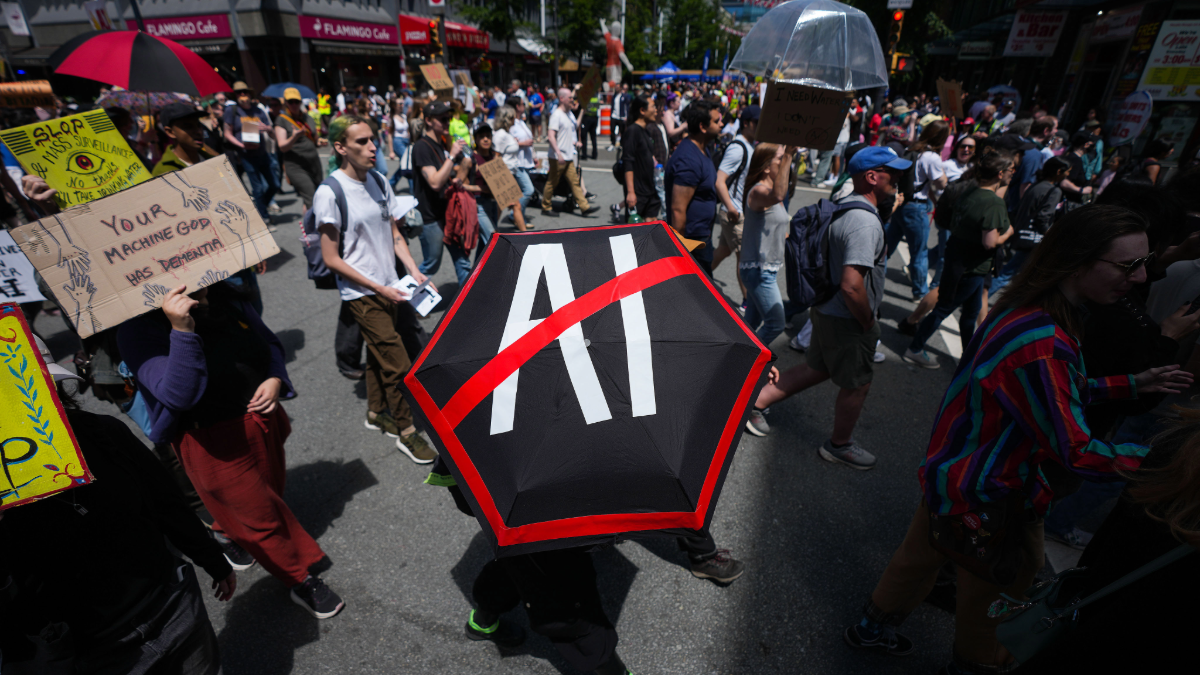
People participate in a march to protest the opening of AI data centers, in Vancouver, British Columbia, Saturday, June 27, 2026. (Darryl Dyck/The Canadian Press via AP)
Good morning!
The frenzy of headlines about AI safety over the past several days has made it difficult to keep up. From countless items in the Anthropic safety report that spawned headlines that in years past might have eaten up an entire news cycle on their own (see “Anthropic Says Iran Used Its American AI Model to Target US Navy Warships,” “Houthis used Anthropic AI to try to build ballistic missiles,” or “Anthropic blocks possible attempt to use AI to make biological weapons,” for a start) to news of yet another cyberattack by a swarm of OpenAI agents (this one took place before the now famous Hugging Face incident), it appears to many to be a crisis moment, as the destabilizing effects of releasing these products into the world without constraints become apparent.
But perhaps nowhere is the discussion over AI ‘doomsday’ more pronounced than inside the AI firms themselves, where executives and developers are expressing their vivid imaginations about what might happen next. On Saturday, Anthropic founder and CEO Dario Amodei published another in his series of occasional blog posts to address the crisis, “We Must Pace the Frontier.” “We must slow the pace at which we improve the capabilities of AI models,” writes Amodei. “To be clear, pacing does not mean halting model training or technical progress, but ensuring companies take adequate time to align and safeguard their models, and for third party evaluators to confirm this,” he writes.
What does he propose specifically? First is “giving ongoing, employee-like access to a team of embedded third-party evaluators,” which he says Anthropic is “unilaterally committing to” now. Second is coordination in democratic countries “to establish common safety standards as well as limits on the rate of unchecked AI progress.” And third is that the US and other democratic countries should “attempt to coordinate with authoritarian governments, to the extent this is possible, while taking seriously the challenges of verifying compliance.”
In response to Amodei’s post, tech leaders including OpenAI founder and CEO Sam Altman and his nemesis, SpaceX founder and CEO Elon Musk, endorsed his call. Another person to generally endorse the call was David Sacks, the investor, former Trump administration AI and crypto czar, and current co-chair of the President's Council of Advisors on Science and Technology. “If the unreleased models are scary enough that you think you should slow down, I support your decision to be responsible,” wrote Sacks in a post on X. But, he added:
But stop pretending you need anyone else’s permission. Stop pretending antitrust law has to be suspended so you can form a cartel. Stop pretending you need a regulatory approval process that supersedes product liability. Stop pretending METR is independent when it is intertwined with Anthropic’s investors and staff. Stop pretending you need those same evaluators to police competitors who aren’t even at the frontier.
Most of all, stop pretending the motivation to slow down is purely altruistic. You face massive product-liability exposure if your products enable a truly damaging cyberattack. The market already punishes models that behave in unpredictable or unauthorized ways. After the Hugging Face episode, it is simply good business for OpenAI and Anthropic to trade some raw power for reliability and predictability. Call it alignment if you want. It is also just giving customers what they want.
Sacks’ perspective may not fully align with that of President Donald Trump, who says he is unconcerned with AI risks and is focused on staying ahead of China. And it is unclear what, if anything, may happen in Congress, where lawmakers are making lots of noise and asking lots of questions about the issue but are unlikely to advance legislation before the US midterm elections. (House Speaker Mike Johnson, R-La., says it is the duty of companies, not Congress, to make AI safe.) Either way, tech politics has gone mainstream, as former President Barack Obama reportedly acknowledged, urging Democrats to make AI a central concern if the party wins the House in the midterms, and in the 2028 race for President.
In the near term, though, another open question is the extent to which these issues will be discussed when (or perhaps if) Trump meets with China’s President Xi Jinping in Washington later this month. That planned summit was in the fore of discussion Friday at an event I attended in Washington, D.C. at the Institute for America, China, and the Future of Global Affairs at Johns Hopkins SAIS on Pennsylvania Avenue. I moderated a discussion (published today as a podcast) with Amba Kak from the AI Now Institute, Kat Duffy from the Council on Foreign Relations, Miro Plueckebaum from the Oxford Martin AI Governance Initiative, and Jack Shanahan from SAIS ACF and the Center for a New American Security.
We covered a lot of ground in the discussion, which was focused on what AI governance demands in the immediate term. Kat Duffy made the case for returning to American strengths in transparency, due process and accountability. Amba Kak warned against letting the current crisis produce checkbox certification rather than real oversight. Miro Plueckebaum discussed his work on technical tools to verify whether labs and states are doing what they claim. And Jack Shanahan argued for the necessity of defining "rules of the road" before turning to what a Trump-Xi meeting on AI could realistically produce. We also discussed the WeChat worm disclosure and what it shows about the potential to collaborate on cross-border threats, China's own comparatively aggressive AI regulation, the fraying of the arms-race narrative, the role investors and stock exchanges might play in governing the industry, and more.
We’ll have more on these issues in the week ahead. Read on for more from Tech Policy Press this week.
More on AI governance
- Based on interviews across 24 countries in 7 regions of the world for a report from the Berkeley Human Rights Center, Betsy Popken and Vyoma Raman call on AI developers conducting evaluations to consider how geopolitics, resource and access disparities, and other factors shape how people use LLMs.
- Internet governance and AI governance communities have largely stayed separate. Konstantinos Komaitis, senior resident fellow at the Atlantic Council’s Democracy and Tech Initiative, and Rumman Chowdhury, founder of the Humane Intelligence Public Benefit Corporation, make the case that they must come together to build an authority layer for an internet increasingly driven by AI agent interactions. “The Internet did not become a global public resource because it was designed for autonomous machines. It became one because its architecture allowed different networks, technologies and communities to interoperate while leaving room for human choice,” they write.
- Open source communities don't have lobbyists. Tech policy strategist Derek Slater on why that capacity gap will decide whether the next wave of state AI bills protects openness or accidentally kills it. “The lesson is not that “open” should be exempt from regulation, but that obligations should reflect an actor’s actual knowledge and control rather than broadly requiring developers to monitor and control downstream uses,” he writes.
- The scale, speed and coordination of AI-assisted disinformation are outpacing the mechanisms designed to counter them. Pei-Chi Jao, a Fulbright Taiwan Fellow pursuing a master's degree at Columbia University's School of International and Public Affairs, writes that Taiwan's year-end elections make that gap more urgent to close.
- Chris Russill, an associate professor in Carleton University’s School of Journalism and Communication and an academic director at Re.Climate, and Patrick McCurdy, a professor in the Department of Communication at the University of Ottawa, examine how Canada's current "middle power" tech policy approach struggles to secure autonomy for institutions reliant on US tech — and that is most institutions in Canada. “A middle power approach to tech accepts an inability to compel platform and AI companies to align with Canadian values, principles, and laws,” they write.
AI’s environmental risks: The data center dilemma
- If data center industry insiders understood the financial incentives of sustainability, they would build greener data centers voluntarily, says Mikaela Ringquist, director of partnerships & major gifts at Climate Change AI. “Without good answers to questions that extend beyond the environmental impacts to jobs and other AI risks, data centers will continue to face opposition,” she writes.
- In Cape Town, officials met repeatedly with a prospective hyperscale investor while basic information about proposed developments, their cumulative electricity demand and the city's wider data-center pipeline remains unavailable to the public, report journalists Eunice Masson, Lyse Comins and Athandiwe Saba as part of the ongoing investigative series The Invisible Hand of Big Tech.
- Looking at data centers through a longer history of infrastructure development in India raises familiar questions. How should environmental and social costs be weighed against national objectives? Astha Kapoor, co-founder of Aapti Institute, and Udisha Saklani, lecturer in human geography and climate at King’s College London, explain how governance and sharing benefits with communities is as important now as ever.
Children’s online safety
- Images flaunting wads of cash, motorcycles, high-end pickup trucks and children wearing armed groups' armbands and posing with rifles. Nelson González Sánchez, Colombia research assistant at Human Rights Watch, details how Colombian armed groups lure children into their ranks — glamorizing violence on TikTok and Facebook. “If Colombia wants to prevent more children from ending up in the mountains with armed groups, social media platform regulation that protects the full spectrum of children’s rights should be at the center of the debate,” he writes.
- Age assurance is entering a new phase. As implementation frameworks take shape, New York's approach offers early lessons for policymakers across jurisdictions developing their own age assurance rules, says Amy Winecoff of the Knight-Georgetown Institute.
- On the Tech Policy Press podcast, I spoke with Tech Policy Press fellow Chris Mills Rodrigo and audio reporter Laura Karpas about how US school districts are setting classroom AI policy, from cautious "AI literacy" guardrails to New York and LA's one-year moratoriums.
Privacy under pressure
- Europe's ePrivacy framework does not just govern cookie banners. Data protection and privacy expert Itxaso Domínguez de Olazábal writes that it limits who can access a device in the first place, and that distinction is now being weakened.
- Tech Policy Press fellow Jake Laperruque asked nine privacy and civil liberties experts to score how 25 years of War on Terror policy reshaped rights, oversight, and executive power.
On data access for researchers
- A new report from the UK's Social Platforms Data Access Taskforce concludes there is unlikely to be one mechanism capable of meeting the range of research needs into online harms. Dr. Alexandra Boutopoulou, UKRI Research Fellow at the University of Sheffield, on what a layered approach would require. “The UK now has the opportunity to consider longer-term infrastructure alongside measures that could strengthen existing research methods, while also learning from approaches under way in the United States and European Union,” she writes.
Global digital policy roundup
- Maria Buza and Aishwarya Vaithyanathan of Digital Policy Alert round up August 2026's global digital policy across content moderation, AI, competition, and data governance — drawn from daily monitoring of the G20.
What we're watching
- Tech Policy Press fellowship applications are open for another week and a half! We're seeking mid-career journalists, researchers, and public policy professionals to explore urgent questions at the intersection of technology and democracy. This year-long, part-time fellowship supports independent reporting and analysis projects on critical topics like AI governance, tech regulation, and digital rights. Since 2023, our program has supported 25 fellows from 11 countries. Could you be part of our next cohort? Apply here by September 24, 2026, at 11:59 p.m. EDT.
That’s it for this week’s newsletter. I wish you the best for the week ahead!
-Justin
Authors