To Change Data Centers, Flip the Narrative on Sustainability
Mikaela Ringquist / Sep 9, 2026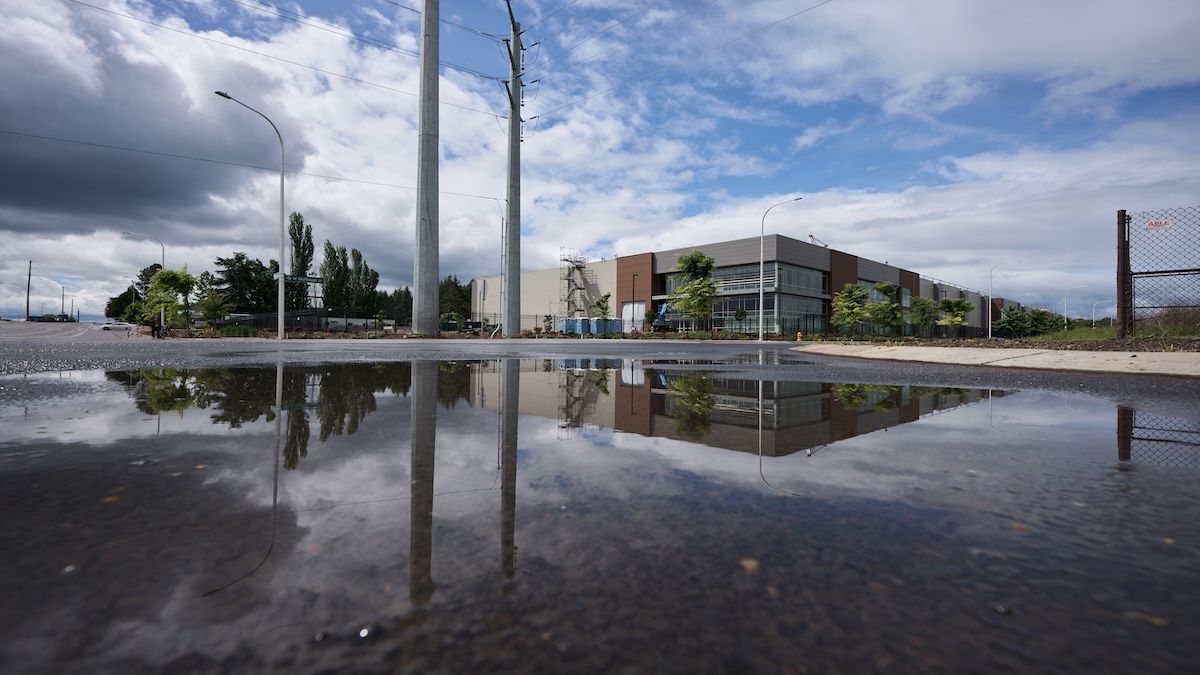
Electrical infrastructure at a Flexential data center in Hillsboro, Oregon, on May 16, 2026. (Photo by Alex Milan Tracy/Sipa USA)
The AI race has spurred a worldwide frenzy to build massive new data centers, especially in the United States. Data centers are projected to consume up to 12% of US electricity by 2030, and their combined water usage could increase fivefold by 2028.
In response, a nationwide community backlash has surged. Between May 2024 and March 2026, $292 billion worth of new projects were canceled or stalled due to local opposition; $130 billion of that occurred in the first quarter of 2026 alone. Three in five Americans now oppose a data center being built near them. Even Erin Brockovich, the famed 1990s environmental activist, is back on the scene with a new map crowdsourcing community complaints; it has already received over 9,000 submissions.
But is the backlash actually prompting data center developers to change their practices?
In March, I attended the Data Center Dynamics (DCD) conference in New York to get a firsthand sense of how data center developers were perceiving the backlash.
Perhaps as a threat? In the breakfast line at the conference, a man next to me noted that one attendee had brought a personal body guard, referencing the recent (albeit unrelated) shootings in New York City of executives at Blackstone and UnitedHealthcare.
The people I spoke to on the exhibition floor, where thousands of people (mostly men) mingled, viewed sustainability as a nice-to-have rather than as an imperative. On stage, many panelists discussed the importance of energy efficiency, better transparency, and community engagement. A select few presented on sustainability initiatives, such as waste heat recovery.
Even so, what I heard expressed most, was frustration at what they see as the unfair demonization of an industry that has been around for decades and provides the backbone of the internet.
What I heard then, and from other data center professionals since, is that the industry’s priorities are as follows: speed, speed, speed, cost, and only then sustainability.
Flipping the narrative on sustainability
For those of us concerned about the sustainability impacts of the data center buildout, the need for solutions feels urgent. In the United States, the present possibility of a nationwide policy strategy to reduce data centers’ environmental footprint is essentially zero.
While local regulators have some leverage, we must also find ways to incentivize data center developers to adopt sustainable practices voluntarily. This doesn’t preclude a larger conversation about the necessity of the rapid data center buildout, but I do believe their interests (higher financial returns) can align with my interests (positive impact on the climate and environment). If they must build, they should build greener.
Let’s consider the many ways in which sustainability is good for business:
Reduced construction times and operational costs
Data centers are expensive to build, requiring a lot of upfront capital costs. The frontier AI companies have already spent over a trillion on investments while generating only a fraction in revenue. The backlash is causing data center costs to increase, as local tax breaks are repealed, projects face delays, and facilities cover higher utility costs. Geopolitical tensions, including the US-Iran war, are pushing costs in the AI supply chain up further.
Meanwhile, clean technologies have become more cost competitive.
Given that a typical data center’s highest operating cost is energy, energy efficiency should be a top priority. Afterall, the cheapest megawatt is the one you don’t have to build. In one pilot, reducing Power Usage Effectiveness (the ratio between total energy consumed and energy consumed from IT equipment) by 16% saved $262,000 annually in a 1 MW data center.
Data centers can procure renewable energy, which remains the most cost-competitive form of new-build energy generation, even without tax subsidies. For data center operators concerned about the intermittent nature of solar and wind power, significant cost declines in battery storage make batteries a clean and reliable addition to the energy mix.
By contrast, gas-fired power plants are getting more expensive to build. Recent data from BloombergNEF shows that costs have risen 66% since 2023. The average construction time now takes 23% longer, with current waitlists for new gas turbines extending beyond 2028.
Water usage and noise pollution are among the most contentious issues in local disputes over data center development. Advanced liquid cooling methods, such as direct-to-chip cooling, use less onsite water and improve energy efficiency, helping reduce operating costs. They are also quieter because they require less noisy, high-speed fans.
Data centers can also incorporate circularity into their design and construction. Reusing structural materials can be cheaper than sourcing virgin materials, reducing costs by 15% to 20% over a building’s lifecycle. Retired equipment can be repurposed and resold. Currently, only 10% of critical raw materials from data center e-waste is recycled and reused—a missed business opportunity.
Moreover, repurposing vacant industrial buildings, or even shopping malls, would reduce the need to clear land for new facilities. The added benefit is that many of these sites are already connected to energy grids and water infrastructure, helping to expedite permitting and construction times.
Better risk mitigation and future-proofing
Circularity also reduces supply chain risks. Critical minerals like copper, lithium, and aluminum have few substitutes and are resourced through highly concentrated supply chains. The combination of increasing demand and decreasing supply has prompted new startups to focus on recovering critical minerals from wastestreams.
By investing in sustainability, data centers reduce another form of risk: compliance risk. Last year, more than 200 bills were introduced across all 50 states to regulate data centers. That regulatory momentum has continued in 2026, with local moratoriums across the country, and statewide pauses on new large data centers in New York and Texas.
Prioritizing sustainability positions facilities as “future-proof” assets that will meet tomorrow’s regulations today. This proactive approach not only increases the likelihood of getting projects greenlit, but potentially prevents costly retrofits, avoids regulatory penalties, and increases the probability that facilities can operate without interruption as standards evolve.
Enhanced public trust and brand reputation
Data center developers who prioritize sustainability, transparency, and genuine community engagement, from planning to operation, will differentiate themselves and increase stakeholder trust.
Companies that disclose their environmental impacts yield higher financial returns, with companies in emissions-intensive industries such as energy, mining, and manufacturing demonstrating the strongest correlation. Sustainability also enhances B2B competitiveness, as lower-emission data centers are better positioned to help customers meet their own Scope 3 decarbonization goals.
The unprecedented scale of data center growth also creates unique opportunities to drive innovation on sustainability. Large data center operators can serve as anchor customers for emerging technologies, helping de-risk new energy and water technologies.
One example includes working with municipal leaders to feed data center waste heat into district heating systems, greenhouses, or aquaculture systems. Breakthrough research is also prompting AI data centers to incorporate flexibility into their electricity usage, especially during periods of peak demand.
Policymakers should offer both carrots and sticks
While market incentives can raise the ceiling on data center sustainability, regulations should still be enacted to raise the floor, ensuring no active harm is done.
The first priority should be increasing transparency, so that more stakeholders can gain a complete understanding of data center impacts based on auditable measurements.
This should begin during the permitting process, with developers conducting site assessments of expected impacts, with third party verification. At minimum, data centers should be required to publicly disclose their water and energy use. Water disclosures should extend beyond onsite usage to include water consumed at the power source.
During emergencies or peak demand, such as heat waves, municipalities should reserve the right to curtail data center power use to avoid straining the grid. This can go hand-in-hand with offering faster interconnection times to energy-efficient facilities, like in Germany, where data centers with flexible connection agreements (FCAs) get faster grid connections.
Tax incentives should be reserved for developers that can credibly demonstrate commitments to sustainable practices. In the UK, for example, data centers can claim tax relief on investments in energy saving technology.
Finally, government officials should use the power of the purse through their own procurement practices and only award IT contracts to tech companies that meet specific criteria.
How to win the race
The conversation around data centers primarily centers on how this infrastructure is built. Less attention is given to why. Back at the DCD conference, I kept hearing the refrain that we need to “win the AI race” with vague allusions to “beating China.”
Yet, in the US, people are not only concerned about data centers. They are becoming increasingly skeptical about AI itself, questioning whether this so-called race will leave them behind. Without good answers to questions that extend beyond the environmental impacts to jobs and other AI risks, data centers will continue to face opposition.
Perhaps it’s time to reframe the “AI race”, not as merely a geopolitical one, but as a race against an AI future where large, centralized models monopolize the market, widen inequality, and deplete our resources, versus one where small, diversified models are built from the bottom up, powered sustainably, and used to yield benefits across society. In this scenario, AI models will also be smaller and more efficient, needing fewer data centers in the first place.
After all, this technology should be a means to an end, not the end itself. Slow and steady—and sustainable—wins the race.
Authors