How China-Africa Relations Are Shaping the Geopolitics of AI
Ninsiima Melissa / Sep 28, 2026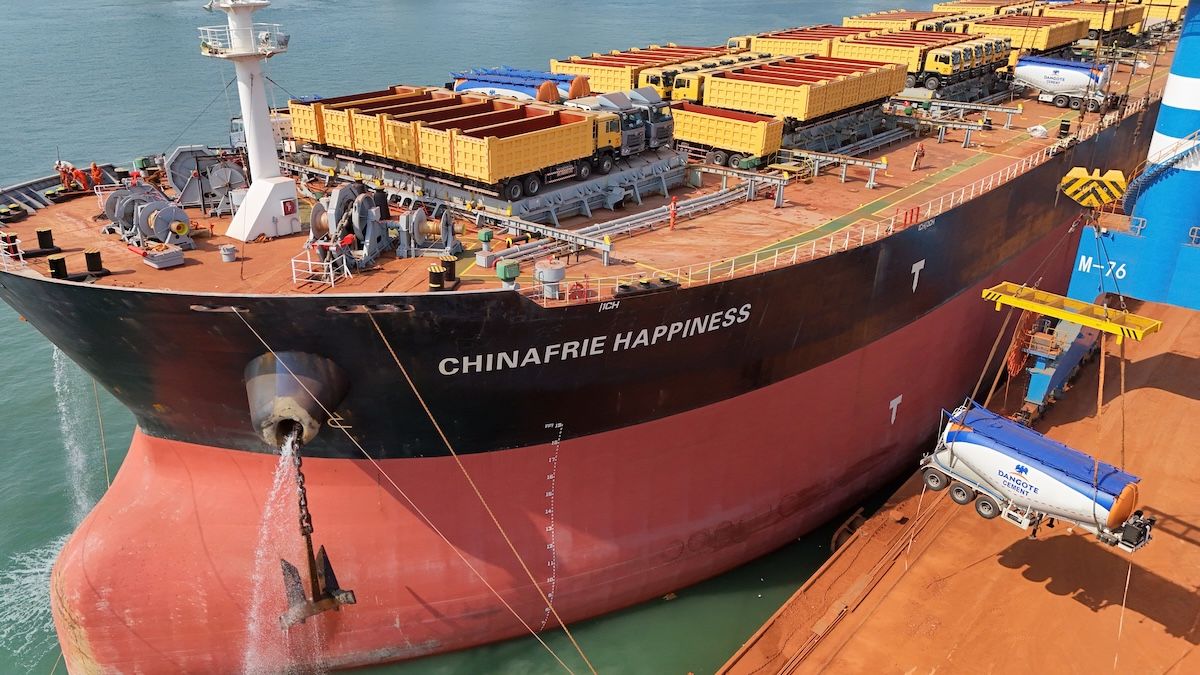
Chinese engineering vehicles are loaded onto a China-Africa liner at Yantai Port in Shandong Province for export to Africa on April 27, 2026. (Photo by Costfoto/NurPhoto via AP)
The US-China AI race has once again emerged as a key area of focus in global news headlines, particularly following the conclusion of the recent Trump-Xi Summit and the effective closure of the global AI performance gap between the two countries earlier this year. This is not to say that the two countries are at parity in every dimension of AI performance; they have different advantages in areas such as patent volume, model performance, research output, and investment. Nonetheless, this development signals progress toward China’s stated ambition of becoming a global AI leader by 2030.
China’s AI development efforts are unfolding alongside its expanding economic influence on the African continent. Over the past two decades, China has progressed from an emerging donor in Africa to the continent’s largest bilateral creditor. Its strategic position on the continent is creating opportunities for its economic partnerships to intersect with its broader global AI ambitions.
To this end, China has deepened and leveraged its economic relationship with African countries in various ways, from educational programs to political exchanges. Of these, however, critical minerals, foreign direct investment in digital infrastructure, and market penetration for Chinese AI models stand out as among the most important.
Critical minerals
Demand for AI infrastructure, such as data centers, advanced chips, batteries, and other electronic components, is rising. In turn, so is demand for critical minerals such as copper and germanium, which are used in electrical infrastructure and semiconductor manufacturing.
Africa possesses abundant deposits of these minerals. Namibia, for example, possesses germanium deposits, while the Democratic Republic of the Congo (DRC) holds nearly two-thirds of the global cobalt mining supply and some of the world’s largest copper reserves. Copper is critical for the hardware that underpins the AI boom, especially compute and power infrastructure.
China positioned itself as a key player in the DRC’s mineral supply chain as early as 2007, formalizing the relationship through the 2008 Sicomines agreement, which granted Chinese state-owned enterprises access to the DRC’s vast copper and cobalt mines in exchange for infrastructure funding commitments. This enabled Chinese firms to acquire substantial stakes in the DRC’s copper mining operation. In 2025, DRC copper exports increased by 10 percent, with Chinese firms playing a leading role in the country’s copper production.
China also currently holds a dominant position in the global germanium supply chain. In 2025, a Chinese firm, Sinomine, received approval to construct a germanium plant in Tsumeb, Namibia. This mineral has key applications in AI infrastructure, such as specialized semiconductors and high-performance fiber optics, a boon for China’s AI supply chain.
Digital infrastructure collaboration
China is currently the biggest financier of infrastructure projects in sub-Saharan Africa, especially in sectors such as transport, energy, and mining. This has placed African countries in a position to receive China’s alternative sources of infrastructure funding, distinguished by a willingness to provide resource-backed financing with varying degrees of concessionality and occasional debt relief.
Poor infrastructural readiness is a major constraint on AI development in Africa, as many countries on the continent are falling behind in critical domains such as reliable power for network connectivity and secure cloud architecture for compute. Institutional recognition of the need to secure Africa’s AI future by ensuring reliable digital connectivity and energy access has created an opportunity for China, which is already at the forefront of Africa’s infrastructure revolution, to further expand its influence on the continent.
This growing influence has enabled it to advance its Belt and Road Initiative (BRI), which aims to create global connectivity through new trade routes, and especially to provide it with a strategic trade advantage by diversifying transportation routes that reduce exposure to disruptions along concentrated global supply chains. In turn, China’s Digital Silk Road (DSR), which is part of the BRI, is playing a significant role in Africa’s AI infrastructure readiness by financing digital infrastructure projects on the continent with the help of private multinational companies and policy banks.
The growing African market for Chinese technology
Chinese AI models have become a key building block for tech innovation in African countries, evidenced by their growing popularity among developers in Africa, especially Uganda, Kenya, and Nigeria. Because such developing countries face compute, connectivity, and data constraints, developers have found innovation to be more accessible where open-weight models are locally modified as opposed to building models from scratch.
It is within this ecosystem that China’s open-source AI models like Qwen and DeepSeek have become increasingly prominent for their relatively low-cost deployment, open-weight access, and fine-tuning flexibility. While these AI models practically appeal to African developers, the growing use of Chinese digital technologies is giving Chinese firms greater access to African markets while creating opportunities for China to advance its technological interests across the continent. The more African businesses build applications on top of Chinese models and run them over Chinese servers, the more revenue accrues to Chinese AI companies and the more likely other African developers are to do the same.
By 2025, Africa, home to about 17 percent of the world’s population, already represented a large potential consumer market, with an AI market value of $4.51 billion and a compound annual growth rate of 27.42 percent. So far, Chinese technologies have gained a foothold in this market in domains such as agriculture, where Chinese-made agricultural drones support smart agriculture initiatives; healthcare, where Sino-African digital collaboration initiatives are advancing medical research; and national security, where Chinese-backed surveillance technologies are driving smart city initiatives in Africa.
Implications for US-China competition
While China’s economic engagements in Africa have funded substantial developments in parts of Africa, its regional partnerships have also shaped market dynamics, consumption patterns, and resource acquisition, potentially giving China strategic advantages over its primary competitor in the global AI race, the US. Taken together, these channels, which have emerged due to China’s economic position on the African continent, could undermine the efficacy of the 2025 US AI Action Plan, particularly its efforts to counter China’s global technological influence.
This plan identified strategies including exporting American AI to meet global demand and strengthening export controls to block China’s access to critical components in the semiconductor manufacturing pipeline. The effectiveness of these strategies depends in part on the US’s alliance-based structural power, which has contributed to its influence across these critical supply chains and has been reinforced by relationships with other technology powers such as the UK, Israel, the EU, and South Korea.
However, China’s advancements already pose a significant risk of erosion to the US’s global structural power, and its strong economic and technological presence in African countries gives it opportunities to pursue its AI ambitions despite US efforts to hinder them. Specifically, the factors described above (access to critical minerals, infrastructure networks, and African markets for AI products) all strengthen China’s position in key areas in the AI ecosystem, thus potentially limiting the effectiveness of the US’s efforts to check its AI ambitions.
Considerations for Africa
China’s engagements with African states illustrate that Africa is not simply a spectator of global AI developments but an emerging actor in the geopolitics of AI. Its demographic growth, natural resources, and expanding consumer markets have attracted Chinese investment, highlighting the continent’s strategic importance. This has created an opportunity for African states to leverage these advantages to build domestic AI capacity, promote regional cooperation, and strengthen representation of their interests on the global stage.
However, African states must also establish safeguards to prevent external investment from cultivating digital dependence. Such dependence could erode the digital sovereignty of affected states, leaving them vulnerable to the weaponization of digital infrastructure to exert influence over political, social, and economic outcomes. Therefore, African countries should diversify technology partnerships and establish robust digital frameworks capable of addressing surveillance and data governance concerns. To maintain the possibility of mutually beneficial relations, African states must also prioritize regional economic integration to increase their collective bargaining power over the terms of AI investment and technological cooperation on the continent.
Authors