How Trump’s Data Regulation Crackdown Undermines Digital Sovereignty
James Görgen / Mar 12, 2026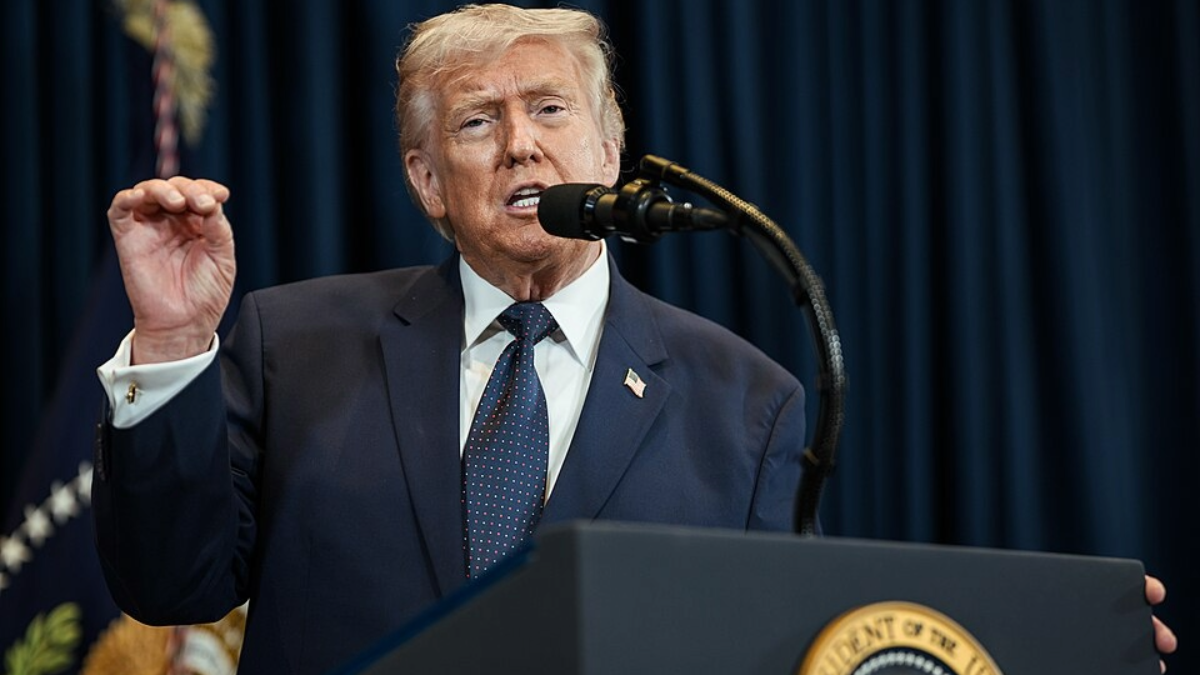
President Donald Trump delivers remarks at a press conference on Monday. (Official White House Photo by Daniel Torok)
The Trump administration last month reportedly issued a formal directive to its diplomats worldwide to actively combat any data sovereignty and localization initiatives adopted by other countries.
The document — an internal State Department cable dated February 18 and signed by Secretary Marco Rubio — classifies such measures as direct threats to artificial intelligence services, cloud computing and global data flows.
Read in isolation, it appears to be little more than a routine diplomatic note, albeit a serious one. Read alongside the Trump administration’s July trade investigation against Brazil, as well as similar developments at the G20 and the World Trade Organization (WTO), the directive reveals a coordinated, wide-ranging strategy to prevent sovereign nations from regulating how American platforms treat data and content created by their citizens online.
A doctrinal diplomatic onslaught
Rubio's cable is not a reactive document. It is doctrinal. Classified internally as action request — that is, a request for concrete action, not mere observation — it instructs United States diplomats to monitor legislative proposals on data in their host countries and to intervene with local governments and regulators to discourage such initiatives. The language is unequivocal: US representatives must "counter unnecessarily burdensome regulations, such as data localization mandates".
The central argument put forward by Rubio is that data sovereignty laws "disrupt global data flows, increase costs and cybersecurity risks, limit Artificial Intelligence (AI) and cloud services, and expand government control in ways that can undermine civil liberties and enable censorship." That amounts to a strategically constructed narrative for it brands sovereign regulations as basically synonymous with authoritarianism and censorship. In doing so, Washington is attempting to seize the moral high ground before any technical or legal debate can even take place.
It is no coincidence that the European Union's own General Data Protection Regulation (GDPR) is explicitly mentioned in the cable as an example of a regulation that imposes excessive restrictions on the processing and cross-border flow of data.
As an alternative, diplomats are instructed to promote the Global Cross-Border Privacy Rules Forum — an initiative the US and its allies launched in 2022 by the US and presented as a model for trusted data flows that preserves privacy without resorting to national barriers.
The embedded message is clear: the US defines what counts as trusted.
This is not an isolated episode. Last year, Rubio ordered a lobbying campaign against the European Union's Digital Services Act (DSA). Furthermore, the Trump administration announced plans to launch an online portal — Freedom.gov — to help European and other users circumvent content moderation rules, including restrictions on hate speech and terrorist propaganda.
The data sovereignty cable is yet another chapter in a systematic offensive in defense of the American Big Tech business model.
Section 301 and the platforms case
In July, the Office of the US Trade Representative (USTR) opened a formal Section 301 investigation against Brazil — one of the most powerful instruments in the American trade arsenal — covering six areas but centering on the digital axis.
The immediate trigger was the Brazilian Supreme Court's June ruling partially overturning Article 19 of the Internet Civil Rights Framework, exposing digital platforms to liability for harmful content even without a specific court order.
The Trump administration framed this sovereign constitutional decision as an "attack on American companies" — a position formally echoed by Google, Meta, X and Microsoft in submissions to the USTR. The investigation also targets Pix, Brazil's instant payment system as an alleged disguised state subsidy; telecommunications regulator Anatel's Resolution 780/2025 on data center certification and marketplaces; and Brazilian competition authority CADE's action against Apple's in-app payment practices.
The geopolitics of coercion
The USTR investigation creates a Sword of Damocles over Brazilian digital policy, with the threat of retaliatory tariffs functioning as a powerful deterrent against Brazil advancing regulations that displease American platforms.
Combined with Rubio's cable — which instructs diplomats in Brasília to actively monitor and combat data sovereignty initiatives — the result is a multidimensional pressure environment operating simultaneously at the economic, diplomatic and rhetorical levels.
This bilateral pressure is reinforced by two multilateral instruments. The US G20 presidency, culminating at the Leaders' Summit in Miami this upcoming December sets a deliberately narrow agenda, focusing on deregulation, energy, and innovation and erasing the digital sovereignty norms built under the Brazilian and South African presidencies in 2024 and 2025, respectively.
The US boycotted the Johannesburg Summit in November, and the website for its G20 presidency website published as its sole content an image of Trump alongside the phrase “THE BEST IS YET TO COME”.
At the WTO, the US is proposing an indefinite extension of the 1998 moratorium on customs duties on electronic transmissions, which would shield a growing share of the global digital economy — software, streaming, cloud and AI content — from any sovereign taxation.
Developing nations including India, South Africa and Indonesia have opposed it, arguing it deprives them of fiscal revenue and constrains their capacity for digital industrialization.
What is at stake
When the US State Department formally instructs its diplomats to fight against data sovereignty initiatives across the globe, it is protecting a concrete national interest of the highest strategic value. Data is the primary input of the digital economy — and the rules governing who controls it, where it is stored and how it is processed determine who captures the economic, political and technological value it generates.
Rubio's cable explains a great deal. It explains why digital regulatory frameworks advance so slowly in countries such as Brazil. It explains why debates on platform liability, digital services taxation and data protection face resistance far beyond domestic circles. And it explains, above all, why the Section 301 investigation should not be read as a conventional trade dispute, but as part of a broader strategy to contain any sovereign regulation that might restrict the global operations of American Big Tech firms.
Add to the Section 301 investigation the administration’s diplomatic offensive and you have the perfect conditions for the reversal of sovereign measures. Brazil has folded on other occasions when this argument was used by the US.
This has been done not through explicit coercion, but through something more subtle and effective: the creation of an environment in which sovereign digital regulation appears too costly, too dangerous and diplomatically imprudent. But Brazil has the right — and the duty — to do what Washington does: protect its strategic interests with technical rigor, cohesion and resolve. That is not anti-Americanism. That is sovereignty.
Authors