Lula’s Win Signals Fight to Regulate Social Media Will Escalate in Brazil
Tatiana Dias / Oct 27, 2026Tatiana Dias is a fellow at Tech Policy Press.
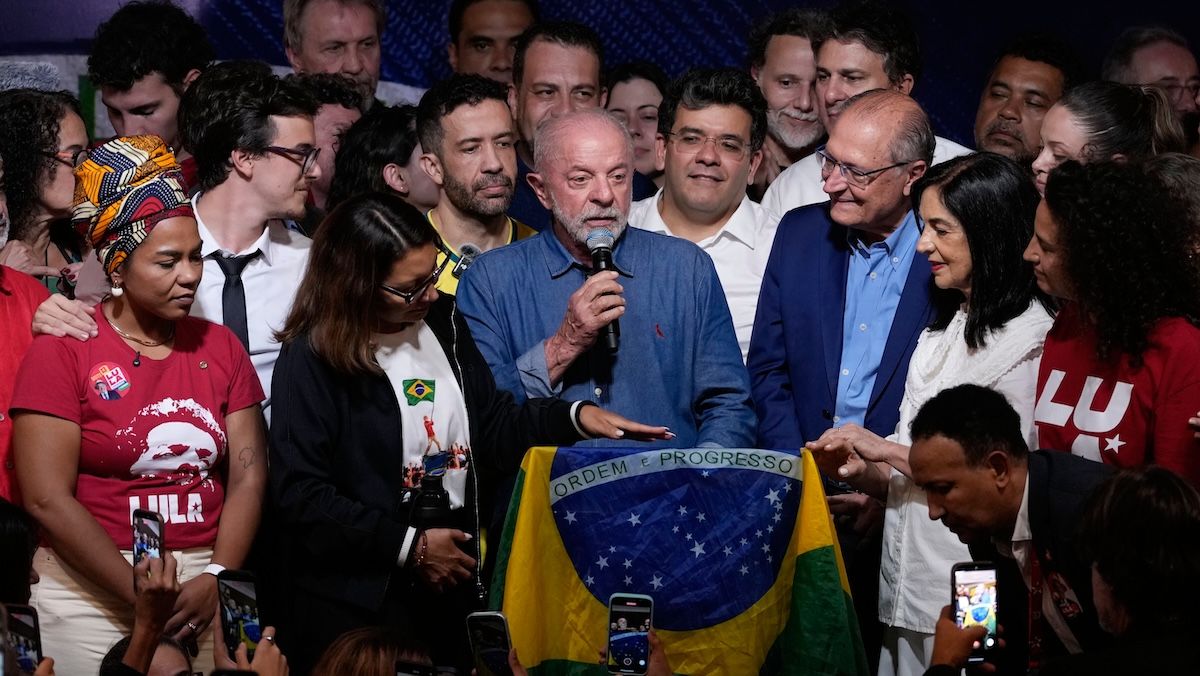
President Luiz Inacio Lula da Silva delivers a victory speech after winning the presidential runoff in Brazil, Oct. 25, 2026. (AP Photo/Andre Penner)
In an extraordinary win after the largest popular campaign in the country’s democratic history, Brazil re-elected President Luiz Inácio Lula da Silva of the Workers’ Party (PT) to another term. Lula’s victory is not only a defeat for the far-right candidate, Flávio Bolsonaro of the Liberal Party (PL). It is also a defeat for United States President Donald Trump — who had in Bolsonaro a subservient ally — and for Big Tech companies faced by mass accusations that they manipulated public debate and harmed Lula.
Now, anchored in a huge political victory, Brazil’s push to regulate Big Tech is set to reach a new level. In his first victory speech minutes after his re-election, Lula signaled that he will treat the regulation of large platforms as a priority. “This was an election in which we had to overcome outside interference coming in through digital platforms, which we are going to have to regulate,” he said. “We cannot have monstrous companies earning billions, paying no taxes, and trying to steer this country’s electoral outcome.”
Lula’s re-election was historic for several reasons. In the first round, Lula came in second, trailing by 1.87 percentage points. The outlook was bleak: a crushing defeat in the state governments and in Congress, which saw elected its largest far-right caucus ever. Never in Brazil’s history had a candidate who lost the first round gone on to win the second.
But the initial defeat became fuel. Immediately after the first round, a vast popular mobilization began, online and in the streets. Federal congressman André Janones, of the party Rede Sustentabilidade, led an online mobilization called “Lula’s Army” built around a WhatsApp group and “missions” that gamified the campaign and created the largest group in Brazil, with 10 million members. In the streets, pro-Lula demonstrations across the country broke attendance records — the largest, in São Paulo, brought more than 2 million people to Avenida Paulista.
At the same time, the temperature on social media was rising, with an explosion of complaints that the large platforms — particularly Meta, which controls WhatsApp and Instagram, Brazilians’ most popular communication channels — were interfering in the election. The organization I co-direct, CTRL+Z, collected more than 1,200 reports of censored profiles, removed content, and restricted pages, most of them from the left. Lula’s own profile was the target of a series of restrictions and failures that hurt his reach, according to Meta employees. The company denied political interference and claimed that “technical failures” resulted in the account restrictions that harmed Lula.
Whatever the reason for those failures, Meta’s influence on the Brazilian election inflamed the anger of pro-Lula Brazilians. The political fight also became a struggle for Brazil’s sovereignty against the power of Meta, Mark Zuckerberg and Donald Trump. On Monday, October 19, CTRL+Z joined with Código Não Binário, Sleeping Giants Brasil, Artigo 19, Diracom and others to organize the first protest against Big Tech in Brazil, outside Meta’s offices in São Paulo, drawing more than 1,000 people.
In this election, Big Tech became a symbol of US imperialism over Brazil, and became a mainstream concern. These elections delivered tech literacy to Brazilians on a massive scale, as they came to understand the consequences of faulty moderation systems, algorithmic discrimination, and digital sovereignty. The streets began to chant “Meta, don’t meddle,” “Meta, take your hands off our election,” and “Trump, Brazil will not be your backyard.”
The pressure went international. On October 21, nine independent experts appointed by the UN Human Rights Council called on Meta to examine whether its moderation, recommendation, and AI systems had disproportionately restricted one side of the presidential race, to explain any differences in treatment, and to guarantee that complaints could be contested and corrected before the vote rather than after.
The following day, 13 US lawmakers – Senator Bernie Sanders, I-Vt., and 12 House Democrats, led by Representative Pramila Jayapal, D-Was, also wrote to Mark Zuckerberg demanding answers.
So far, Meta has not provided them, neither inside nor outside Brazil. The Superior Electoral Court barred Meta from discriminating between the candidates, under threat of a penalty of R$1 million (around $185,000) per day.
As the complaints and the outrage piled up, however, Lula was busy gaining back ground. The left’s online strategies were coordinated through actions by “Lula’s Army,” which faced threats of being taken offline by the Superior Electoral Court but survived, and through a wave of vibe-coding projects producing campaign materials and tactics. In the streets, there were tireless in-person efforts, from mass demonstrations to small stalls set up to “flip votes.”
Polls showed Lula ticking upward over the course of the second round, but Bolsonaro remained ahead. Until election day arrive — a turbulent day, marked by a lack of public transport and the need to extend voting hours. In the end, Lula added more than 10 million votes compared to the first round, in a spectacular comeback.
A harder Congress, a stronger street
In his victory speech, Lula made clear that he intends to treat social media regulation as a priority. His government has made important advances towards that end — but it is up against a majority-conservative Congress that acts as Big Tech’s shock troops to block or water down regulatory attempts.
In Brazil, many of the deputies and senators who previously acted in Big Tech’s favor come from right-wing or far-right parties, such as the ultraliberal Novo and the PL, Jair Bolsonaro’s party. Most of the deputies who backed Big Tech during the last legislative term were re-elected with sizable vote totals or won Senate seats — meaning that, in the Brazilian legislature at least, Big Tech will have an easier ride.
Pending in the Chamber of Deputies are bills including the AI Legal Framework and the Digital Markets bill aimed at curbing Big Tech monopoly power, and bills to combat online misogyny. Also under discussion are the legislative decrees (PDLs) introduced by lawmakers to suspend the Lula government’s decrees tightening rules for platforms. It is also possible that the new Congress will decide to overturn the Supreme Court’s holding that platforms are liable for criminal content circulating on them, creating new — and looser — rules in the name of “free expression.”
It will be difficult for regulatory proposals to advance in this scenario, but not impossible: the approval of the ECA Digital, Brazil’s child protection law, showed that it is indeed possible to unite Congress around essential causes.
In his new term, Lula will also be able to appoint four more justices to the Supreme Court. The nominations, however, must go through a hearing and a vote in the Senate, where the scenario is unfavorable — the largest caucus belongs to the PL, the far-right party.
But this historic second-round victory created a reorganized popular base of support for Lula, and gave the incoming government new room to negotiate with lawmakers. On October 14, for example, the Senate approved the constitutional amendment ending the 6x1 work week — six days of work for one of rest, a schedule worked by some 14.9 million Brazilians — replacing it with a five-day week and two paid days off, effective in 60 days. The Chamber had passed the measure back in May, but Senate President Davi Alcolumbre delayed the vote until after the first round of the presidential election. When it finally reached the floor, amid an intense campaign online and in the streets, opposition evaporated: Senator Flávio Bolsonaro, who had opposed the measure, voted in favor.
The lessons of these victories give new energy to the Brazilian left — which now appears to have grasped the urgency of regulating and restraining the power of large transnational corporations capable of influencing an election.
Authors