Meta's Multibillion-Dollar Settlement Left a Lot to Be Desired
Juvaria Shahid / Oct 6, 2026Juvaria Shahid is Tech Justice Law’s Legal Fellow.
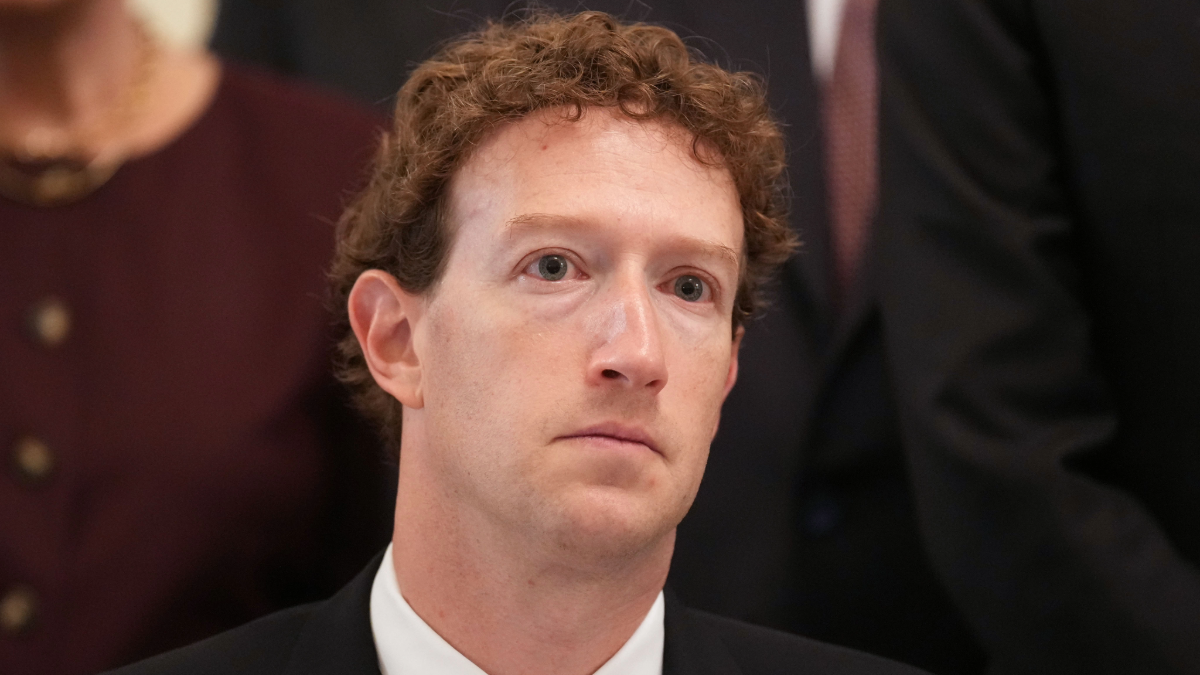
Meta CEO Mark Zuckerberg listens as President Donald Trump speaks in the East Room of the White House in Washington, Tuesday Sept. 29, 2026, during a meeting with top executives of AI firms. (AP Photo/Jacquelyn Martin)
In 1998, major cigarette companies agreed to pay over $200 billion to states after decades of denying the addictive nature of smoking. Many wondered whether Meta’s settlement, which came at summer’s end and included a payment of up to $17.1 billion, was the tech industry’s “Big Tobacco Moment.” Are social media companies finally acknowledging the harm their addictive platforms have caused?
Yet it would be inapt to analogize addictive cigarettes to the addictive, exploitative, data-hungry, and ever-evolving algorithms behind Meta’s platform. As the plaintiffs’ complaint in the addiction lawsuit against Meta alleged, Meta collected information about its users’ behaviors and interests. Meta then used those profiles to give advertisers the ability to target particular users, including emotionally vulnerable minors.
To address the impact of addictive cigarettes on youth, the 1998 tobacco agreement banned certain forms of advertising, which included bans on outdoor billboards and transit, and restrictions on sports marketing and event sponsorships. Similarly, in the Meta settlement, Meta agreed to implement a set of design changes to its platforms, including a 2-hour default daily limit for users under 18 that only a parent can adjust, no access between midnight and 6 a.m., no push notifications during school hours, and a non-personalized feed option. For a complete analysis, see Varsha Bansal and Justin Hendrix’s breakdown of the settlement.
Why Meta’s settlement is not the tech industry’s ‘Big Tobacco’ moment
But the settlement leaves much to be desired. Firstly, Meta’s safeguards are simply not strong enough. While the two-hour limit is a great way to force a teen to stop scrolling, the addictive design of the platform is bound to leave the teen distressed when their scrolling is stopped abruptly. A dopamine-spiking, infinite feed of content that has been linked to alarming changes in mood and attention is quite literally Meta’s most profitable—and harmful—feature. Allowing for a two-hour doomscrolling session is like saying “you only get like two hours of alcohol or two hours of cigarettes a day,” as Arturo Béjar, a former Meta engineer, puts it. Glaringly absent from this provision are any restrictions on data-harvesting and the surfacing of targeted advertisements during that two-hour window. A stronger agreement would have paired use limits with substantive design and data restrictions: a ban on targeted advertising to minors and a paginated feed, thereby stripping (or at least greatly reducing) the variable-reward mechanics that keep users scrolling.
To its credit, the settlement does make an effort to address some of the other engagement-maximizing features, namely autoplay and a personalized feed. But teenagers (or their parents) would have to make the affirmative choice of selecting a non-personalized feed option or disabling autoplay. Experts have specifically warned against such consent-based remedies that produce “consent fatigue” in users and disengage them from making meaningful decisions. As Adam Mosseri himself testified during the trial, Instagram has struggled to get teens to choose to “Take a Break.” Given that users usually view default settings as the status quo and keep them, a stronger provision would have disabled autoplay and a personalized feed from the moment that a teen account is created. Meta already agreed to that structure for nighttime lockouts and for hiding like counts. It is unclear why the feed and autoplay features are treated differently.
Finally, Meta will withhold 30% of the settlement (around $5 billion) and will only implement the stricter safeguards, such as dropping the default daily limit to 1 hour, if other tech companies follow suit. Specifically, Meta competitors Snapchat, TikTok, and YouTube are mentioned in the settlement, and the company has since been running a series of advertisements, publicly calling on other tech companies to follow suit. It is unclear whether these other companies will comply, with reports already surfacing that TikTok has rejected Meta’s attempts to run these ads on its platform. At the end of last month, however, TikTok agreed to enact time limits in Alabama in what Agence France-Presse called “a settlement modeled on Instagram-owner Meta's recent agreement with US states.”
Meta’s promises should be the floor for the global fight against platform addiction
As part of the settlement, Meta agreed to offer teens the choice of a chronological feed instead of the standard, personalized feed. Interestingly, Meta deployed that feature as part of its compliance with the European Union’s Digital Services Act (DSA) three years ago. In fact, the DSA has pushed the EU a few steps ahead in litigation as well: this July, the European Commission preliminarily found that the addictive design of Instagram and Facebook breaches the DSA. In February, it made a parallel finding against TikTok.
Still, this settlement may prove useful to other jurisdictions that are catching up to litigation, enforcement and regulations surrounding addictive platforms. In Canada, several school boards that are actively pursuing litigation against Meta, ByteDance, Snapchat and YouTube are watching the aftermath of the settlement closely. The proposed safeguards could potentially codify a technical “standard of care” that will set the floor for what social media companies have to comply with in other jurisdictions.
Where the fight goes next
The settlement only resolves the state attorneys general's claims; thousands of personal injury and adolescent addiction cases remain pending before Judge Yvonne Gonzalez Rogers, with the next school-district bellwether trial set for February 2027. In addition, the theory of negligent and defective platform design is still actively being used in litigation against AI companies. In 2024, public interest litigators brought a first-of-its-kind lawsuit that took a design-based approach to challenging an AI chatbot’s manipulative design features that led to the death of teenager Sewell Setzer III. Since then, dozens of wrongful death, personal injury, and products liability lawsuits have been filed against OpenAI and other AI companies.
For better or for worse, AI companies seem to be moving faster to protect themselves after witnessing Meta’s fate. On Aug. 18, OpenAI introduced ChatGPT for Teens, a ChatGPT that includes parental controls, age-prediction mechanisms, and other features to support “real-world relationships and healthy habits.” On Sept. 8, OpenAI announced it would fund grants for new research into AI and teen development. Specifically, the company seeks to understand what “technical interventions, safeguards, and design choices” can “keep teens safer.”
Whether these research efforts or the safeguards that Meta has promised to create will hold up remains to be seen. Until then, the fight for child and teen safety online is far from over.
Other tech litigation developments:
- In September, a New Mexico jury found Meta liable for over 43 million violations of consumer protection laws: On Sept. 25, a jury in Santa Fe, New Mexico, found that Meta misled New Mexico residents about how it handled third-party acquisition of user data as part of the Cambridge Analytica scandal, as well as over statements it made about misinformation and hate speech. New Mexico is asking for the maximum penalty of $5,000 per violation, which could total over $200 billion.
- AI notetaker tool can be treated as a third-party eavesdropper: In re Otter.AI Privacy Litigation, filed in Aug. 2025, is a class-action lawsuit accusing Otter.ai’s AI notetaker tool of violating state privacy laws for joining and recording video calls without users’ consent and using the results to train Otter’s models. On Aug. 13, Judge Eumi Lee largely denied Otter’s motion to dismiss, holding that Otter can be treated as a third-party eavesdropper.
- Court blocks the Pentagon’s supply chain risk designation of Anthropic: On Aug. 27, Judge Rita Lin of the Northern District of California held unlawful the Defense Department's designation of Anthropic as a supply chain risk, finding the action retaliatory under the First Amendment and beyond the department's statutory authority.
- Meanwhile, the D.C. Circuit allows the Pentagon to keep its supply chain risk designation of Anthropic: On Sept. 25, a divided panel on the D.C. Circuit sided with the Department of Defense, holding that the agency had “ample support for its conclusion” that Anthropic’s products posed a risk because Anthropic restricts its models from being used for autonomous weapons or mass domestic surveillance.
- TikTok settles the federal children’s privacy case: On Aug. 21, the Justice Department announced a $400 million settlement with TikTok and ByteDance, resolving claims that the company collected personal information from children under 13 without parental consent in violation of COPPA. TikTok was ordered to pay $300 million immediately; the remaining $100 million is contingent on the entry of an order vacating the 2019 consent decree against TikTok's predecessor, Musical.ly.
Authors