On Eve of Vote, Brazil’s Federal Prosecution Office Demands Answers from Meta
Laís Martins / Oct 23, 2026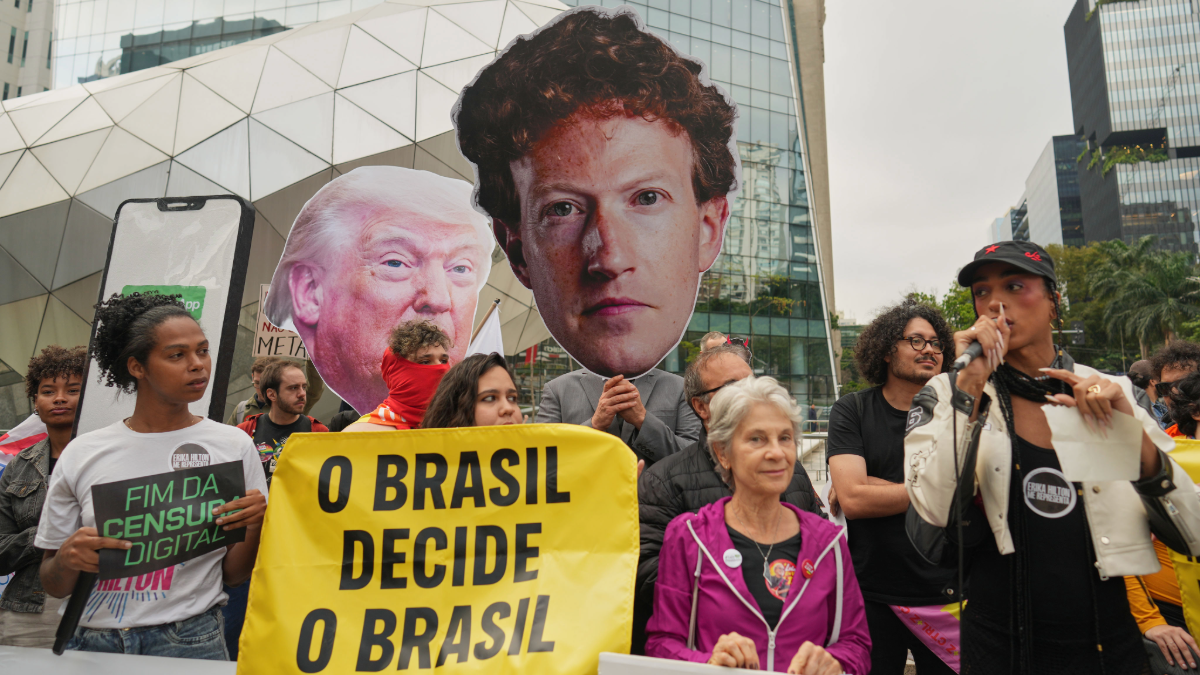
Demonstrators holding a banner that reads in Portuguese "Brazil decides about Brazil" rally against Meta over allegations of interference in Brazil's presidential election, outside Meta's headquarters in Sao Paulo, Monday, Oct. 19, 2026. (AP Photo/Andre Penner)
With days left before the second and decisive round of Brazil’s presidential election, the country’s Federal Prosecution Office on Wednesday issued urgent recommendations and demanded answers from Meta regarding content moderation actions by the platform, alleging that previous answers sent by the company were generic and insufficient. The Prosecution Office gave Meta 48 hours to respond as to whether it will comply with the recommendations.
The decision comes after a series of content moderation failures by the company over the past few weeks, amid Brazil’s most tightest electoral race in recent years, which pits incumbent President Luiz Inácio Lula da Silva against Senator Flávio Bolsonaro, the son of former president Jair Bolsonaro.
In this period, Meta took down a page of a media entity that produced a viral video on scandals surrounding Flávio, temporarily disabled Lula’s campaign page from running political ads, and disabled its Muse AI agent from generating images in support of Lula, while authorizing images related to Flávio.
Civil society organizations, including Article 19 Brazil, Sleeping Giants Brazil, Conectas Direitos Humanos and Ctrl+Z (co-founded by Tatiana Dias, a Tech Policy Press fellow) are documenting cases of takedowns, technical restrictions, account bans, reach suppression, and algorithmic discrimination that disproportionately appear to affect progressive and democratic accounts, such as student associations, activists, independent journalists and outlets.
Last Friday, a report by the newspaper Folha de S. Paulo revealed that Meta employees admitted in internal communications there were restrictions imposed against Lula’s accounts. Earlier this week, a demonstration took place in front of Meta headquarters in São Paulo, with demonstrators asking Meta to stop interfering in Brazilian elections. In Washington D.C., a group of Democrats requested explanations from Meta about its actions during the Brazilian elections.
In a statement published on its website, Meta pushed back against the allegations of political interference. “Meta doesn’t take a stand in these or any other elections, and the allegations that we are favoring or interfering in favor of any candidate or political group are false and unfounded”. The company also called the issues “technical problems” that have led to the construction of a “political narrative”.
Meta did not respond to a request for comment sent by Tech Policy Press.
The recommendations
The Prosecution Office recommended that Meta cease removing posts, suspending accounts or restricting features without a legal or contractual basis; direct human and technical resources to allow for adjustments in automatic content moderation and mandatorily submit to review posts containing terms such as “demonstration” or “march”; apply content moderation criteria in a uniform manner, without distinguishing political or ideological orientation; and ensure mandatory human review by people familiar with the language and context for material flagged by mass reports.
The office also recommended that Meta immediately restore publications, reach and features when it recognizes mistakes in content moderation and that it clearly communicate to users in clear and accessible Portuguese language every content moderation decision that has been applied to their accounts.
The office further recommended Meta use a ‘megaphone’ resource — a special feature notification that is displayed at the top of the page on its applications — to communicate moderation decisions. This resource is used by Meta in partnership with authorities to communicate about special civic events, such as election days.
One interesting recommendation is that Meta should hire an independent firm to audit the content moderation algorithms used in its platforms over the last two months. “This is very important, very unprecedented and it leaves a door open so that we can effectively have more transparency, even if obligated, from the company, and independently from the company’s algorithmic systems,” said André Boselli, coordinator for the Information and Communication Technology Ecosystems program at Article 19 Brazil and South America.
Such an audit could produce further evidence and confirmation of the company’s failures, in addition to the documentation that has been put together by civil society organizations and individual reports from users. The Folha report was based on internal messages, a rare instance of insider confirmation on the technical decisions that impact the electoral process. “This is a piece of this jigsaw puzzle that helps confirm what was being felt by people, it starts to confirm itself as a serious hypothesis,” said Boselli.
Boselli noted, however, that these are all recommendations, not legal orders, and compliance depends on Meta. For him, Meta has demonstrated that it wants the perks of “being a company that assumes this institutional role in modern society of intermediating the public debate,” but without the onus of being accountable to society.
In response to questions sent previously by the Federal Prosecution Office, Meta provided generic information that observers regard as insufficient. It claimed, for example, that it automatically blocked over 206,000 pieces of content between Oct. 1 and Oct. 5 based on electoral rules and after having identified the use of AI in political content. The Prosecution Office found, however, that most of the blocks were applied without individual justification or based on criteria meant for serious offenses, such as terrorism or CSAM.
Civil lawsuit
In addition to its recommendations, the Federal Prosecution Office initiated a public civil action against Meta in order to protect “freedom of speech, the right to information and the due informational process in the digital environment.” A federal court has to accept the Prosecution Office’s request.
In the lawsuit, as in the recommendations, prosecutors request that, moving forward, appeals to content moderation decisions should necessarily be reviewed by specialized human teams, with a$100,000 fine per account in cases of non-compliance.
The fact that the lawsuit is being initiated by the Federal Prosecution Office outside of electoral courts is significant, said Boselli. “This is a recognition that the right to democratic participation goes beyond the electoral sense,” he said. “We are not talking about litigation battles between campaigns — no, it’s citizenship itself involved.”
The prosecutors’ decision to initiate a lawsuit in regular courts comes at a time when the Electoral Court’s own actions are being scrutinized. Since the first round vote, the Electoral Court president, Justice Kassio Nunes Marques, a Bolsonaro appointee, made decisions that have raised concerns.
Nunes Marques, like many others in Brasília, is implicated in the Banco Master case, Brazil’s biggest corruption scandal in recent years. The allegations include that he attended a party during Carnival in 2025 organized by Daniel Vorcaro, the banker formerly in charge of Banco Master who is currently jailed, for which sex workers were hired. In a response to Revista Piauí, which published the investigation, Nunes Marques said he never voted in Vorcaro’s favor, never exchanged messages with him, and did not ask him for anything.
A few days after the first round vote, Nunes Marques was involved in a dispute involving a highly popular pro-Lula WhatsApp channel organized by federal deputy André Janones, a Rede member that serves as the informal digital mastermind of the Lula campaign. Nunes Marques suspended the channel based on claims of disinformation, while the Lula campaign claimed that a similar channel connected to Flávio was also riddled with disinformation but remained online.
The latest development — revealed by a Folha de S. Paulo report — says Nunes Marques and Justice André Mendonça, another Bolsonaro appointee, were circulating a draft of a rule to block WhatsApp channels in the 48 hours leading up to the runoff vote. The measure would be a direct hit to the pro-Lula WhatsApp channel, which had more than 8.3 million members by Thursday evening. After the story was published, Nunes Marques said he was against last-minute measures, while Mendonça said the rule was not an individual initiative and would still need to be discussed.
In a technical memo sent to the Electoral Court, a group of more than 100 legal experts, researchers and civil society organizations warned that blocking WhatsApp channels on the eve of elections “restricts citizens’ political freedom and significantly alters the conditions of the electoral dispute days away from the vote.”
Authors