Protect Elections by Punishing Deception Narrowly, Not by Banning Technology
Amelia Powers Gardner, Bartlett D. Cleland / Nov 3, 2026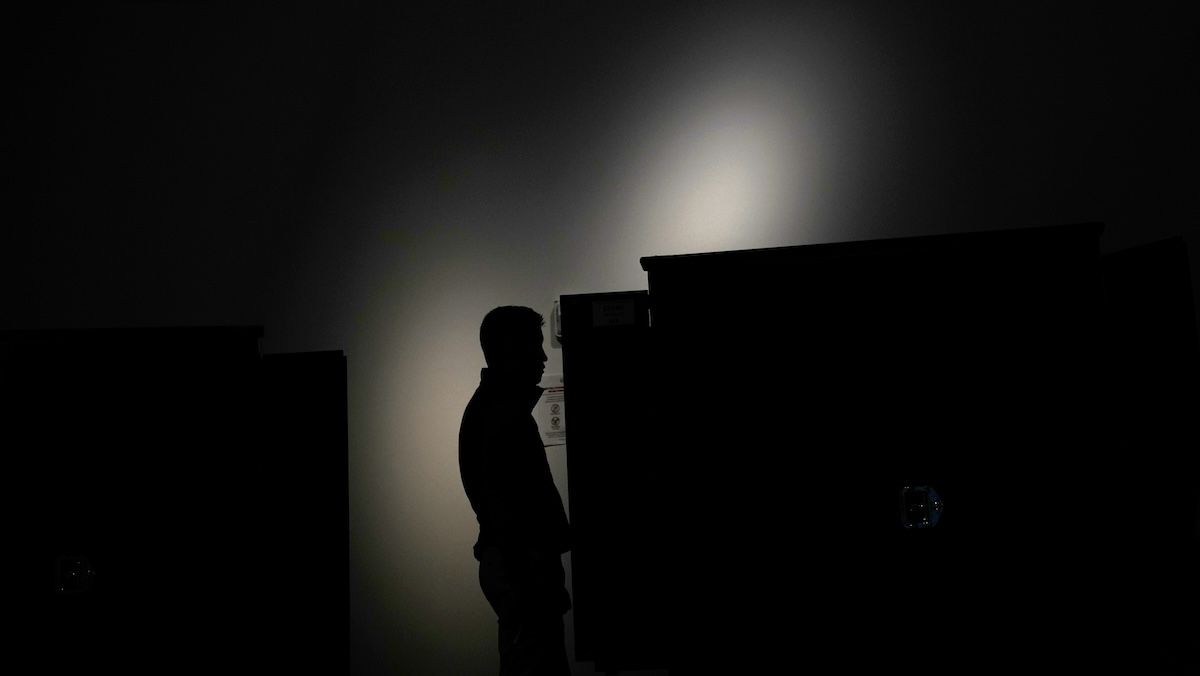
A voter casts their ballot on Election Day, Nov. 3, 2026, in Atlanta, Georgia (AP Photo/Brynn Anderson)
The November midterms will be the first national election in which generative artificial intelligence is cheap, convincing, and carried in nearly everyone's pocket. The concerns being discussed are not hypothetical.
Los Angeles County's registrar has reported that AI was used during California's June primary to manipulate publicly available footage of ballot counting to gin up fraud claims, and researchers warn that fabricated audio and video can be far more persuasive than a bare assertion. Election officials now worry less about a fake candidate ad than about fake evidence, manufactured to prop up whatever conspiracy theory is trending on election night.
Those concerns are legitimate. Taking them seriously is exactly why legislators should resist the reflex now sweeping statehouses: define the technology, then ban it. Thirty-one states have enacted election deepfake laws, and the midterms will test them. Some will work as intended. Others are likely to stumble, in practice or in court, because they aim at the wrong target or are drawn too broadly.
Start with the practical problem. Artificial intelligence is hard to pin down in a statute. It is a shifting family of techniques, from decision trees to the neural networks behind today's chatbots. Define it narrowly and a bad actor can switch to a different tool that produces the same lie. Define it broadly and ordinary photo editing, video editing, even autocomplete risk being swept in. Either way, a statute keyed to a particular technology tends to age badly, because the technology changes faster than any legislature can move.
The constitutional problem is subtler than it first appears. A law aimed at deceptive political speech is a content-based restriction on the most protected speech there is, whether or not it mentions AI, and courts review such laws skeptically. Falsity alone is not enough; in United States v. Alvarez, the Supreme Court held that even lies generally enjoy First Amendment protection.
California's AB 2839 shows the danger. It was less a technology ban than a deception ban: it reached "materially deceptive" content that had been "digitally created or modified," during a window stretching from 120 days before an election to 60 days after, and it let virtually any recipient sue. A federal court enjoined it in 2024 and permanently struck it down last year, finding it was not narrowly tailored. It swept in parody and satire, and counterspeech was a less restrictive way to serve the state's interest. Hawaii's law met a similar fate in January.
Compare Texas. Its 2019 statute is far narrower. It reaches only a fabricated video that depicts a real person doing something that never happened, made with intent to deceive and with intent to injure a candidate or influence the result, and distributed within 30 days of an election. It remains on the books. In fairness, it has not faced the kind of challenge that felled California's law, and a Texas appellate court struck down a broader, neighboring provision of the same statute as overbroad, a reminder that deception rules fall too when drafted loosely. But the contrast shows what courts are actually asking. The question is not whether a law mentions AI. It is whether the law is narrow enough to reach real harm without chilling protected speech.
A sound principle follows: as a rule, conduct that is lawful without AI should not become unlawful because AI was used, and conduct that is unlawful should not become permissible because a machine did it. The law should reach that conduct through rules written narrowly enough to survive.
The evils feared from AI in elections are mostly old evils wearing new clothes. Impersonating a candidate, faking an endorsement, lying to voters about when and where to vote, hiding who paid for a political message: many jurisdictions addressed at least some of these long before ChatGPT existed. Federal prosecutors have pursued voter-deception schemes under a Reconstruction-era conspiracy statute, though not always successfully; last year an appeals court overturned a high-profile conviction under it for lack of proof of a conspiracy. State coverage is uneven: some states lean on general fraud provisions never written with elections in mind, and in many contexts political lies remain perfectly legal. Where real gaps exist, the fix is to close them for the conduct, not the tool.
What do narrow, durable laws look like? First, they target conduct with a concrete harm rather than falsity in general: lies about when, where, and how to vote; impersonation of candidates or election officials; fabricated endorsements; concealment of who paid for a message. The court that struck down California's law itself suggested a constitutional path for narrowly tailored rules aimed at false statements about the mechanics of voting. Second, they require real intent, meaning knowing falsity plus intent to deceive voters or keep them from voting, not a claim that someone, somewhere, might be misled. Third, they are limited to the period just before voting, when counterspeech has the least time to work. Fourth, they focus on the actors whose role makes the harm concrete, such as candidates, campaigns, political committees, and paid consultants distributing election communications, rather than every user who shares or remixes a clip, and they protect parody, satire, and news reporting. Where disclosure will do the job, they prefer disclosure to prohibition, applied neutrally so an ad follows the same transparency rules whether a human or an algorithm produced it. Courts have generally been more receptive to disclosure than to bans.
Laws built this way are more likely to survive because they resemble categories courts have long tolerated, such as fraud, impersonation, and lies about the voting process that inflict concrete harm, rather than a general license for the state to police political truth. They are also more likely to work. A rule against the robocall that tells voters the wrong election date reaches that call whether it uses a cloned voice or a hired actor, and it does not need rewriting every time the technology changes.
New Hampshire offers a cautionary illustration. Days before the January 2024 primary, thousands of voters received robocalls in an AI-cloned voice of President Joe Biden urging them to stay home and save their vote for November. The consultant behind the scheme was charged under existing state laws against voter suppression and candidate impersonation, no AI statute required, and the Federal Communications Commission imposed a $6 million fine under existing caller-ID spoofing rules. But a jury acquitted him on every state charge in June 2025 after his defense argued the laws did not fit the facts: the primary lacked the national party's sanction, and Biden was not a declared candidate on the ballot. The lesson is not that new technology demands technology-specific law. It is that rules against deception have to be drafted to fit the conduct they target, precisely and in advance.
Lawmakers can also affirm, where useful, that AI is not a loophole, so no defendant can argue that a machine-made lie is somehow not a lie. Election officials should keep publishing plain-language explainers on audits, recounts, and counting timelines before Election Day, so that when the fake evidence arrives, the accurate answer is already in circulation. And AI companies should enforce their own terms of service against electoral impersonation, because the private sector can often move faster than any prosecutor.
One more dose of hard truth. David Becker of the nonpartisan Center for Election Innovation & Research cautions that AI is not radically changing the misinformation environment, because the most powerful driver of election misinformation remains false claims from prominent people, not the software. The constant in every election panic is the human being willing to lie. That is why the law's focus belongs on the lie, the fraud, and the impersonation, not on the printing press, the radio, the television, or the algorithm of the moment.
The threat is real. The best answer is older than the technology, but it takes care: punish specific, harmful deception, whatever tool commits it, through laws narrow enough to stand.
Authors