Starlink, Reliance, and the Public Battle for India’s Orbit
Amber Sinha / Nov 3, 2026Amber Sinha is a contributing editor at Tech Policy Press.
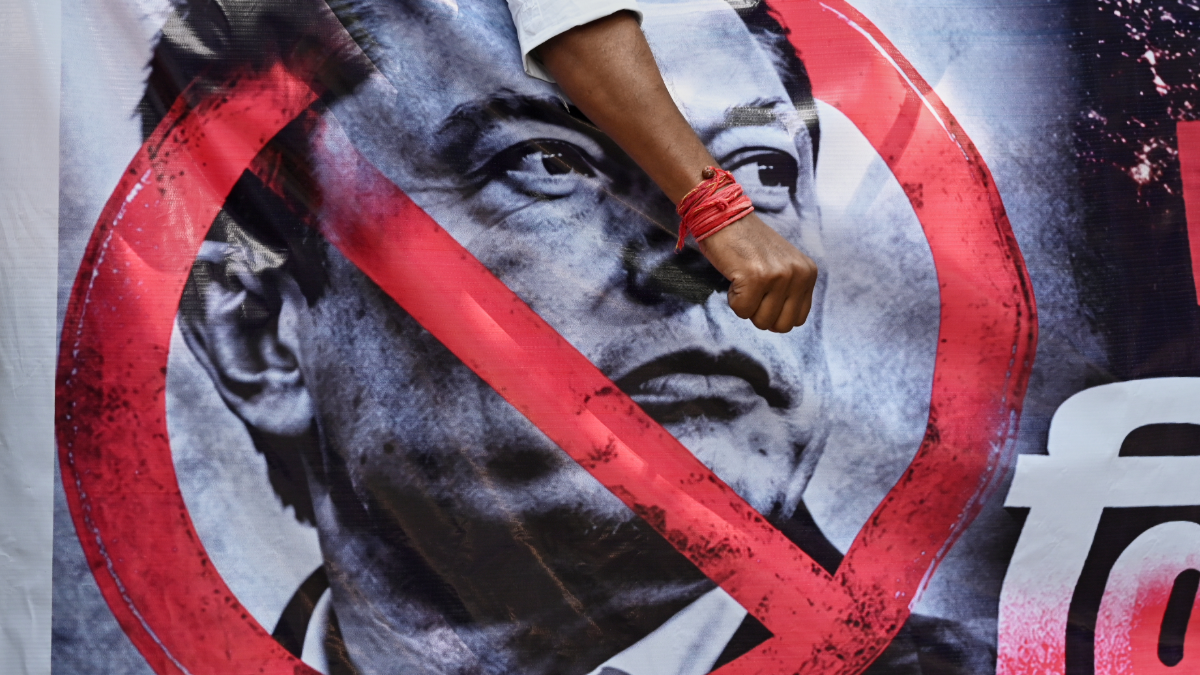
A banner with a portrait of Elon Musk is carried by members of Swadeshi Jagaran Manch, an organization affiliated to Hindu nationalist Rashtriya Swayamsevak Sangh (RSS), as they stage a protest against Elon Musk's Starlink, in New Delhi, India, Friday, Oct. 23, 2026. (AP Photo/Vipin)
There is a distinct, almost suffocating irony in watching the world’s wealthiest individual — a tech oligarch and transnational defense contractor with a direct line to the White House and unmatched influence over global communications — take to a social media platform he personally owns to complain about being cornered by "oligarchs." Elon Musk recently turned to X to accuse unnamed Indian entities of running a "monopolistic chokehold" to stall Starlink’s commercial entry, before pointedly asking whether Reliance Industries chairman Mukesh Ambani was "the real boss of India".
If we look past the theater of this public petulance, there are two parallel stories of the political economy and the militarization of technology playing out. What we are witnessing is the collision of two divergent models of infrastructural capture: the extraterritorial platform power of Silicon Valley and the state-aligned, tariff-protected dominance of domestic conglomerates. For decades, the strategic architecture of Indian telecommunications was negotiated in the quiet corridors of the Department of Telecommunications (DoT) and the Telecom Regulatory Authority of India (TRAI). Regulatory capture and corporate lobbying were discreet, backroom arts. This is a rare instance of the battle between foreign and domestic Big Tech spilling out into the open.
Public lobbying and spectrum realities
To assess Musk’s complaints, one must first cut through the regulatory confusion. The ostensible commercial clash between Starlink and Reliance Jio centers on spectrum management. For months, domestic telecom incumbents like Jio pushed regulatory bodies to mandate commercial spectrum auctions for satellite services. Their argument went something like this: because satellite broadband directly intersects with terrestrial 5G networks, allowing satellite operators to bypass competitive bidding would distort the level playing field after Indian telcos had invested billions in spectrum auctions. Starlink and Bharti-backed Eutelsat OneWeb countered that satellite frequencies are shared rather than exclusive, rendering domestic auctions technically impractical under International Telecommunication Union (ITU) conventions.
The paradox of Musk’s grievance is that New Delhi’s statutory apparatus did not side with Reliance. The passage of the Telecommunications Act of 2023 formally codified administrative spectrum assignment for fixed and mobile satellite services, explicitly resolving the primary economic dispute in Starlink’s favor.
Why, then, the public outrage? Despite legislative blessing, Musk has run into an administrative bottleneck. While Starlink secured in-principle Global Mobile Personal Communication by Satellite (GMPCS) authorization, it remains stuck in a multi-agency security vetting process overseen by the Ministry of Home Affairs (MHA).
On the face of it, Musk’s public complaints appear to be an attempt to recast legitimate sovereign regulatory compliance as crony capitalist suppression.
The domestic playbook of regulatory friction
Yet, if Musk’s posturing is disingenuous, dismissing his suspicions entirely ignores the institutional memory of India’s telecommunications sector. Musk’s claims resonate precisely because Reliance’s history in the sector is marked by aggressive regulatory maneuvering and capital attrition.
In the early years of this century, Reliance Infocomm used short-range basic services licenses to construct a nationwide mobile roaming network, forcing the state into retrospective policy accommodations through the 2003 Unified Access Service License regime. A decade later, Reliance’s re-entry into full-scale telecommunications followed an identical pattern of regulatory arbitrage. In a report presented to Parliament, the Comptroller and Auditor General of India (CAG) audited the 2010 Broadband Wireless Access (BWA) auctions. The audit detailed how a tiny firm, Infotel Broadband Services, won pan-India data-only airwaves before being acquired by Reliance within hours of the auction’s close. The DoT later allowed this data spectrum to be migrated into a voice license for a nominal fee — a move the CAG estimated conferred an undue financial advantage running into billions of rupees.
When Reliance Jio launched in 2016, its zero-tariff blitzkrieg decimated competitors. Although incumbents filed antitrust suits alleging predatory pricing, the Competition Commission of India dismissed the complaints because Jio lacked a technical "dominant position" at launch. Incumbents were further squeezed when TRAI reduced the Interconnection Usage Charge (IUC) by 57% in 2017 gutting traditional telco revenues while Jio built its IP-based subscriber base. When TRAI subsequently attempted to adjust predatory pricing rules to shield new market entrants, the Telecom Disputes Settlement and Appellate Tribunal stepped in and quashed the regulator’s order for unfairly restricting incumbent competition.
In Indian telecommunications, market incumbents rarely block challengers at the front door. Instead, they rely on protracted public consultations, technical litigation, and administrative delays to slow competitors down, securing the necessary commercial runway to develop their own competing services. Reliance’s satellite venture, Jio Space Technology, needs time to construct its infrastructure and package satcom capabilities into its enterprise bundles. In this context, Musk's outrage may not be unfounded paranoia but a reflection of how market consolidation has historically played out in India.
Digital sovereignty in orbit
However, reducing this conflict to a simple clash between two billionaires obscures the national security imperatives that may be guiding New Delhi. Low Earth Orbit (LEO) constellations are no longer viewed merely as connectivity solutions for remote regions; they are dual-use, militarized strategic assets.
While Starlink is marketed globally as an open commercial broadband network, it doubles as the foundation for Starshield — SpaceX’s dedicated national-security offering tailored for the Pentagon and select allied militaries. While Starshield layers on hardened user terminals, classified payloads, and defense-grade encryption, the two systems share an intertwined architecture. The war in Ukraine laid bare the geopolitical volatility of this arrangement.
For India, whose defense doctrine has pursued strategic autonomy, this arbitrary private power represents a critical vulnerability. Earlier, Taiwan also grappled with a similar conundrum where negotiations between Taipei and Starlink collapsed because Taiwan mandates that domestic entities hold a majority stake (at least 51%) in telecommunications providers. Aware of Musk’s commercial vulnerabilities in mainland China, Taiwan refused to exempt Starlink from ownership laws, opting instead to invest in its own sovereign satellite network.
This Musk-Ambani controversy captures a key question confronting technology governance in the Global South: an unpalatable choice between techno-imperialism and techno-nationalism. On one side lies dependence on transnational platform monopolies whose immense infrastructure can be turned off at the founder's discretion, while on the other sits a captured domestic ecosystem, where the banner of "digital sovereignty" is readily invoked to shield homegrown monopolies from external competition, ultimately constraining consumer choice and entrenching domestic oligopolies.
Authors