The Great Green AI Hoax Machine
Michael Khoo / Mar 4, 2026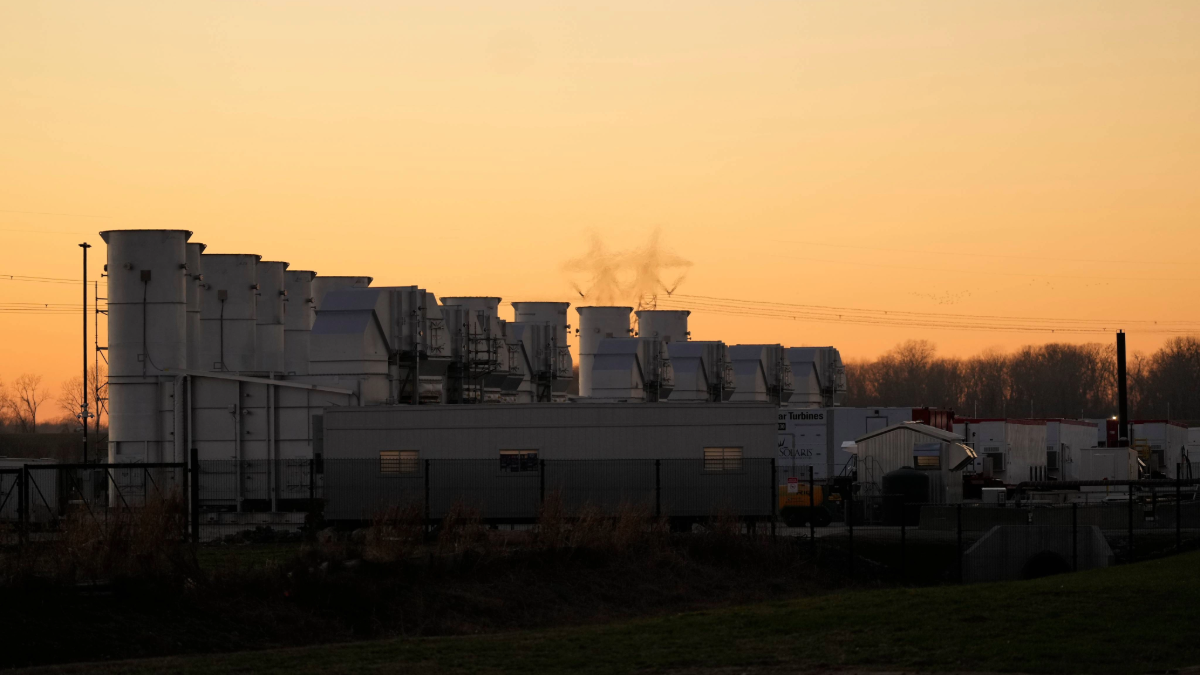
Gas turbines are seen at the xAI facility, Monday, Dec. 15, 2025, in Memphis, Tenn. (AP Photo/George Walker IV, File)
During last week’s State of the Union address, President Donald Trump announced a “Rate Payer Protection Pledge,” calling on tech firms to build their own power plants to offset electricity prices around data centers. Today, tech executives are expected at the White House to formally sign the pledge.
Observers should be on the lookout for big promises from the industry, including on sustainability. But they would do well to remember that nothing puts the "artificial" in artificial intelligence more clearly than the claims that it’s good for energy and the environment.
On that score, Silicon Valley has a history of making big promises. For example, OpenAI’s Sam Altman boldly heralds a new AI “Intelligence Age,” promising “astounding triumphs” including “fixing the climate.” Microsoft’s Satya Nadella says AI can be a “powerful accelerant” for efforts to address the climate crisis. And Google goes even further, asserting that “AI has the potential to unlock insights that could help mitigate 5% to 10% of GHG emissions by 2030—and to significantly bolster climate-related adaptation and resilience initiatives.”
Listening to Silicon Valley, you might think climate and energy problems are already being solved. They are not. Energy prices are skyrocketing across America, and carbon emissions are expanding, under the hood of an incredibly thin PR campaign, rife with disinformation.
Our new report shows that 74% of AI energy reduction claims are completely unproven, so we should be watchful for any proof behind the PR at the White House this week. Energy researcher Ketan Joshi analyzed more than 150 claims from AI giants like Microsoft and Google and found barely a quarter cite an academic paper. More than a third had no citations at all. And, in a typical circle of self-affirmation, almost a third of those that did used only corporate sources.
Google’s 5-10% reduction claim is in 2023 one of the most specific and widely cited, promising reductions equivalent to the total annual emissions of the European Union. But this number is not based on science. It comes from a 2021 blog post by the consulting firm BCG, and that blog is based solely on its “experience with clients.”
Where facts are included by companies, they invariably refer to traditional AI, not the generative AI of LLMs such as ChatGPT, which can consume 10 to 60 times more energy than traditional AI. In fact, our report found that traditional AI, which has been in use for more than a decade, is mentioned almost 40 times more than generative AI. This includes arguing—as Google has—that AI has helped data centers become 15% more efficient. Left unsaid is that these same companies are also expanding the number of energy-hungry data centers.
It’s like someone switching to lighter cigarettes and then smoking two packs a day, not one. In a classic bait-and-switch, companies point to genuine—if modest—efficiency gains from older AI systems while glossing over the exploding energy demand of generative AI.
But the global climate impacts of AI are already astounding. The International Energy Agency predicts data centers’ energy use will double by 2030. Much of this, like Grok’s massive new data center in Memphis, is powered by fossil fuels. Generative AI consumes so much electricity that the Canadian energy company TC Energy says it is pushing natural gas demand to a “record high.” The IEA says natural gas and coal together are expected to meet over 40% of added data-center electricity demand through 2030, and it notes that in both the United States and China, most data-center electricity is currently produced from fossil fuels.
No wonder AI’s Big Tech champions have effectively abandoned their climate targets. We found that last year, Google’s emissions were almost five times higher than its promised target. Amazon was about seven times above. Meta swore it would be carbon neutral by 2022, yet the chart showing its emissions is almost vertical.
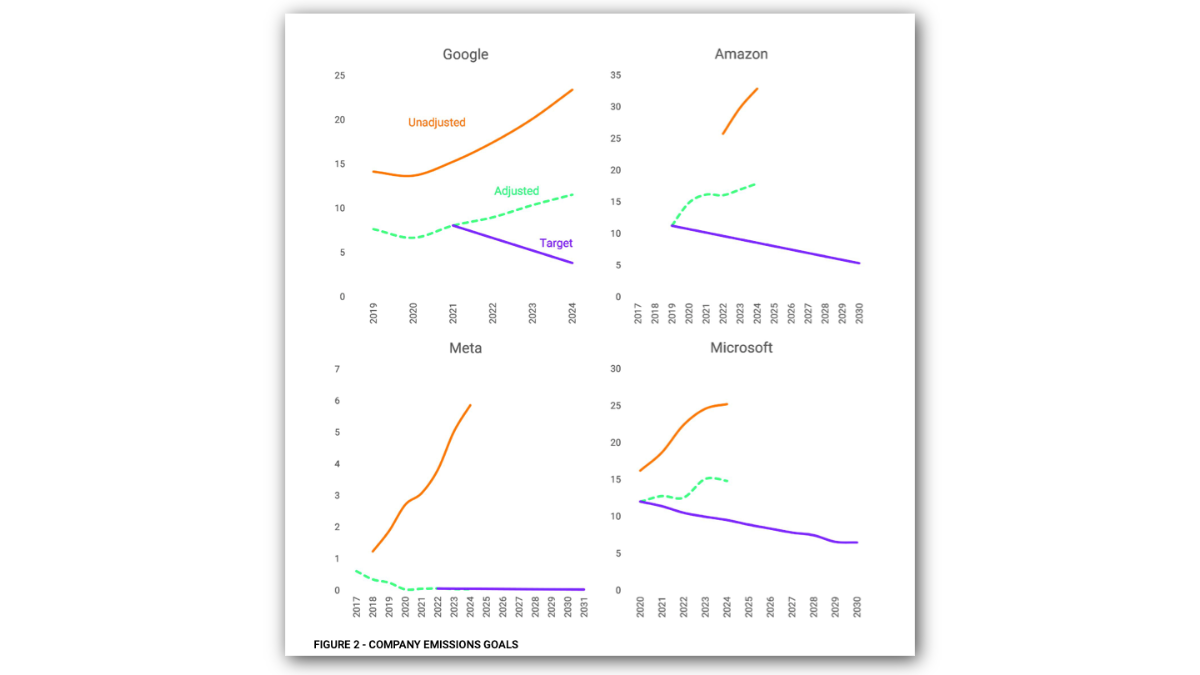
“These charts show compiled emissions data for four major tech companies compared to the trajectory of targets they set in recent years.” Source
Perhaps one day this massive expansion of energy use could be met by an equally massive expansion of renewable energy, but currently that industry in the United States is being actively dismantled by President Trump and, again, his many AI and Big Tech champions at the helm.
That positive outcome would require policy choices, public accountability, and real planning. Instead, AI expansion is racing ahead while governments and regulators still lack basic, standardized information about what is being built, where, and at what environmental cost. That lack of transparency is not an accident. It is part of the problem.
If AI companies want to claim they are helping solve the climate crisis, they should be required to show their math.
First, governments should mandate standardized, audited disclosure of energy consumption and greenhouse gas emissions from AI operations. Current corporate sustainability reports are voluntary and inconsistent. Companies choose what to measure, what to report, and what to leave out. Legislation modeled on financial reporting requirements could compel AI companies to publish verified data on the energy use and carbon footprint of their data centers, broken down by traditional and generative AI workloads. The current model—where companies cite their own blog posts and consulting reports as evidence—is a closed loop that produces more marketing than it does science.
Second, regulators should require that climate claims made by AI companies meet the same evidentiary standards as advertising claims in other industries. If a pharmaceutical company claimed its product cured a disease without clinical evidence, it would face serious legal consequences. AI companies making sweeping claims about emissions reductions should be held to the same standard.
Third, local and state governments need authority to impose environmental impact assessments on new data center construction. Communities should not have to bear the burden of increased emissions, strained electrical grids, and depleted water supplies without a say. Permitting processes should require companies to demonstrate how they will offset or mitigate the environmental costs of these facilities—and community benefit agreements should be binding, not aspirational. And we should continue to resist Trump and the tech billionaires’ outrageous push for a federal bill to preempt any state AI legislation.
There are many legislative options that look to accomplish some of this, but they require governments to stand up to the lobbying power of Big Tech leaders, not embedding them in government as enablers. Without this transparency, AI companies will take traditional AI, with its more limited energy use and proven efficiency benefits, and combine it with energy-guzzling generative AI—putting them together in the same way that toxic financial assets were commingled with legitimate ones before they triggered the global financial crisis in 2008.
These industry claims that AI is benefiting the climate are unfounded at best, and deceptive PR at worst. Pull back the curtain, and we can see that Big Tech’s current AI climate solutions look much more like a climate hoax.
This research was conducted by Ketan Joshi for a coalition of environmental groups, including Friends of the Earth, Climate Action Against Disinformation, Beyond Fossil Fuels, Stand.earth, Green Screen Coalition, and the Green Web Foundation.
Authors