Trump Left Manila Without a Pax Silica Deal. What Can the Philippines Demand?
Tom Smith / Nov 23, 2026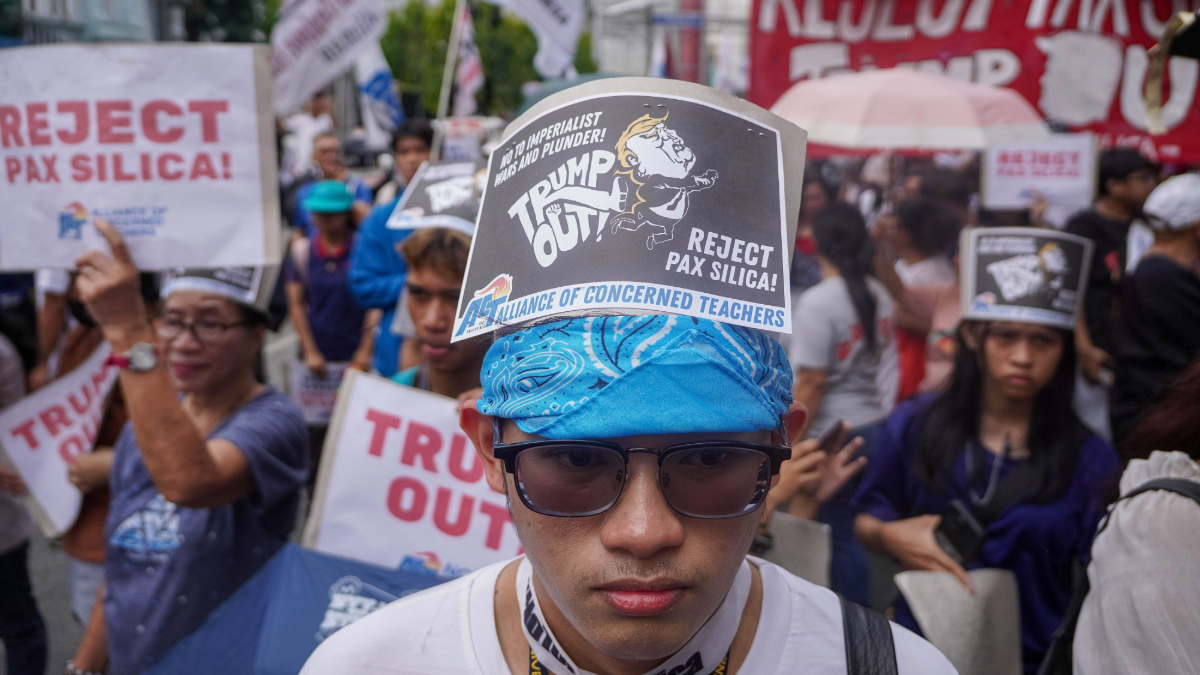
Protesters march along Recto Avenue as members of the progressive group Bagong Alyansang Makabayan (Bayan) attempt to march towards Malacañang Palace during the visit of US President Donald Trump in Manila, Philippines on November 18, 2026. Photo by Charles Edmon Perez / JNA PRESS(Sipa via AP Images)
What came out of US President Donald Trump’s visit to the Philippines?
Observers expecting major movement on the US-led Pax Silica initiative were left with significant ambiguity. The Philippines joined Pax Silica in April, but that declaration did not settle the terms for New Clark City, the proposed 4,000 acre industrial hub Tarlac. Before the bilateral meeting, Philippine President Ferdinand “Bongbong” Marcos said the hub was not on the agenda. Trade officials still aim for a framework by year-end. There is still time for the public to shape it, if Manila lets it.
Trump left Manila claiming he had concluded a major trade deal. The Philippine ambassador to Washington told Reuters that nothing had been signed; rather, he said, the US made a broad offer to supply food and energy, with terms still to be worked out.
The White House did announce a separate cloud partnership, including a plan to modernize the Philippine defense cloud. CSIS notes that Trump floated cooperation on nuclear power and an Alaska gas pipeline. None of that settles how New Clark City will be governed, what investors will owe, or what happens to the people who live there.
Pax Silica is a US-led effort to organize supply chains for AI and other strategic technologies around trusted partners. Its declaration covers everything from minerals and energy to chips and frontier models. That makes it a form of AI governance, even if its instruments are investment rules and industrial agreements rather than model standards. Deciding which countries supply the inputs, which firms control the technology, and what host governments can require of them shapes who can build and profit from AI long before a regulator gets to examine a model.
History weighs on Philippine attitudes toward Pax Silica
Manila has good reasons to court US investment and to take part in Pax Silica. Chinese pressure in the South China Sea is not an abstraction for Philippine crews, and processing more critical minerals at home could bring more value than exporting raw ore.
But in Clark and Capas, the language of strategic partnership has a history. Clark served as a US military staging post, and in 1991 the Philippine Senate rejected a treaty that would have kept US bases in the country.
However, a chip plant is not an air base. Filipinos can challenge the terms of cooperation with Washington without discounting the threat from Beijing. For reasons spanning this history to environmental concerns, Trump’s visit was greeted with protests against Pax Silica. The protests did not have to derail a signing to matter; they created an opening for greater public input on the potential deal.
Opposition to Pax Silica was apparent throughout the Philippines: The Diplomat reported demonstrations in Isabela, Baguio, and Batac, a city in Marcos’s home province. Human Rights Watch documented at least 245 arrests around the summit protests, including journalists covering them. The Philippine Commission on Human Rights said its investigators were initially denied access to detainees. On November 19, TV5 reported that 236 people arrested in Muntinlupa had been released pending further investigation.
Malacañang Palace invited students to submit a position paper as a starting point for dialogue. The network opposed to Pax Silica asked the government to publish a draft of the Pax Silica deal. That is a reasonable place to start. A government cannot ask people to comment meaningfully on an agreement they cannot read.
The workers already living through the AI transition
The Philippines spent decades building an export industry around work that companies in wealthier countries chose to outsource. Its IT and business process management industry employed more than 1.9 million people in 2025. Not all of those jobs will disappear; the International Labour Organization distinguishes between automating tasks and replacing jobs. But Filipino call center workers already describe AI tools making their work more demanding, and worker organizers are seeking protections as those tools spread.
What’s more, call center jobs and jobs at a chip plant are not interchangeable. If Pax Silica is part of a national AI jobs strategy, Manila should say which firms will hire, who will pay for training, and how workers will help design it. It should also ask what Filipino suppliers will be able to do after any one investor leaves. As the IBON Foundation points out, attracting foreign factories is not the same as building a domestic industry. Even if the government’s claim that Pax Silica could create 130,000 jobs, that forecast does not settle the industrial question.
What the public should see before a deal is signed
The Bases Conversion and Development Authority, which oversees the transformation for former military bases into civilian commercial centers, says Philippine law will apply in New Clark City and describes the site as an advanced manufacturing hub. House Bill 11758 would create a new authority, grant a utility franchise, and offer incentives to qualifying firms. Reported government estimates put demand for power and water at up to 3 gigawatts and 90 million liters a day. Who would pay for new power and water capacity, and what would households and local firms get from it? The Bataan nuclear plant, built but never brought into service, is a reminder that talk of nuclear cooperation is not a plan for supplying electricity.
In Sapang Kawayan, AJ+ reported that Aeta residents fear losing their homes. The Palace says the zone will avoid displacing Indigenous communities and farmers, but Human Rights Watch noted that officials had identified a relocation site and said it had seen no evidence of free, prior, and informed consent. Manila should publish the proposed boundaries and environmental assessments and explain how it will address ancestral land claims and obtain consent where Philippine law requires it.
In The Philippine Star, Alex Magno argues for a coalition around growth that reaches beyond the rival political camps. New Clark City is a test of what such a coalition would have to offer. Publish the framework before signing. Let communities and workers help shape it in public hearings. Make incentives conditional on commitments Manila can enforce. A deal worth having should survive both public scrutiny and a change of president.
The government should also answer for the arrests, cooperate with the Commission on Human Rights, and protect the right to organize, protest, and report on what happens next. Filipinos are entitled to ask what Marcos is prepared to concede to keep US backing as China increases its pressure in the South China Sea. They should not have to choose between defending their sovereignty at sea and exercising their rights at home.
Authors