UK Election Watchdog Develops AI System to Flag Deepfakes Within 3 Hours
James Ball / Oct 15, 2026James Ball is a fellow at Tech Policy Press.
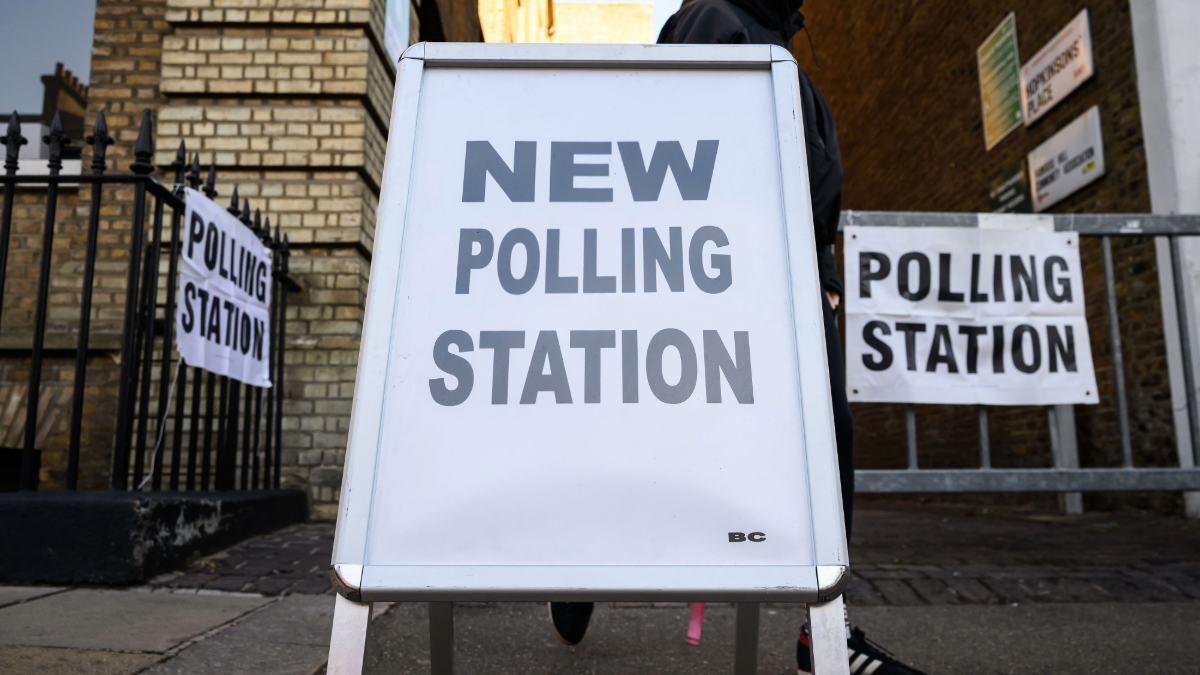
A voter leaves a polling station as voting continues in the Holborn and St Pancras by-election on October 8, 2026 in London, England. (Photo by Leon Neal/Getty Images)
The United Kingdom’s election watchdog is developing an AI-powered system designed to notify candidates of significant deepfakes within three hours of posting to social media, the organization’s chief executive said.
In wide-ranging comments at a panel discussion at the Conservative Party’s annual conference last week, Vijay Rangarajan, the chief executive of the Electoral Commission, also warned of persistent hacking and phishing attacks against the regulator and said it had detected signs of “algorithmic bias” — a form of electoral interference that would likely require the involvement of a social media company itself — in at least one UK election.
The Electoral Commission is the UK’s independent regulator which enforces laws on donations to political parties, political advertising, and other legislation around the administration and conduct of elections. Rangarajan, a former diplomat who served as the UK’s ambassador to Brazil, has been its CEO since 2024, but public interventions from him — outside of evidence sessions to the UK parliament — are relatively rare.
On the panel, Rangarajan cited a deepfake video circulated during Ireland’s 2025 presidential election that falsely depicted candidate Catherine Connolly announcing that the election had been called off and that she was withdrawing from the race. The video urged supporters not to vote. In reality, of course, Connolly had done no such thing, and in fact went on to win the election.
“If that happens to the British election, that will move a significant amount of votes,” he said, adding that it was not the Electoral Commission’s role to arbitrate rival claims made by candidates during the cut and thrust of a campaign, but rather to focus on statements such as this one that could undermine the administration of the election itself.
To address that risk, the commission conducted a pilot program during the UK’s local elections in May 2026, Rangarajan said. “We ran a full pilot, analyzed about three million posts through an AI,” he explained. “So, this is a good example of how AI can work: 147 bits of content were flagged. Humans then looked at those — not a terribly pleasant job in some cases — ten were really quite misleading, and we referred to the social media companies or to the police.”
Rangarajan stressed these posts “didn’t really have a giant effect at this point,” but added: “the fundamental point is we now at least have a system in place to be able to help voters, and help the media, and help parties cope with what I think is an absolutely certain attempt to use some of these deepfakes against the UK.”
Taking action to find the perpetrators of such deepfakes, and to bring them to justice where possible, was something the public were keen to see, he noted, but typically would be the work of weeks or months even where it was possible — meaning it would usually happen only long after an election was over.
Because of that, the Commission’s approach was “perpetrator neutral,” he said, and instead focused on making candidates and parties aware of deepfake content affecting them within three hours of it being posted — “because that's the sort of time for it to go viral” — to leave them and other authorities to respond more swiftly.
The pilot showed how such a program would work in practice: an AI would analyze posts in real time and flag them to Electoral Commission staff, who would review them and notify candidates or parties of those meeting its thresholds, ideally within three hours of the content making its first appearance.
Rangarajan said the challenge reflects the difficulty of applying laws written for an earlier era to modern election campaigns. It is often said that UK authorities are left to try to manage 21st-century elections in the digital era, with 20th-century laws written for the analog ones. “We were set up originally to deal with money and people, systems like that. It's all about information now,” he said.
“We have to then sometimes simply act in this place, obviously within our legal remits, but try to understand how law which was passed in 1983 or 2000 can apply in 2026 because it's very out of date.”
Discussing this phenomenon, Rangarajan disclosed his belief that at least one social network was displaying signs of “bias” at election time, though he did not disclose which.
He described a scenario in which a platform’s algorithm changes its recommendations during an election, showing users posts from people with one political viewpoint while suppressing those with another.
If “at election time, that algorithm happens to change without any warning, and it's proposing to you some of your neighbors with a certain political point of view, and not others, it's suppressing one bunch, and it's proposing another. You will think that your neighbors have changed [their minds]. That will influence a lot of people,” he explained.
“That is algorithmic bias, which we think we have detected to some extent already in some of the social media campaigns,” he continued. “I think that one is one for which, to be honest, there is no legislative solution in the UK's toolbox at the moment for that particular set of issues.”
Independent experts and campaigners have raised concerns about the prominent role X, in particular, plays in UK politics, after its owner Elon Musk openly embraced far-right political movements in the UK and Germany, while some British politicians have expressed concerns over the continued Chinese ownership of TikTok’s operations outside the United States.
In response to a question from Tech Policy Press on attacks against organizations trying to protect or maintain trust in elections or other democratic processes, Rangarajan disclosed the pace of attacks faced by the Commission, before suggesting his organization was unlikely to be the best one to tackle such threats.
"We run about [...] 30 to 40,000 attacks a month, often peaking at 10,000 a day at times. That's cyber-attacks, big botnets, thousands of emails, phishing attacks, all around,” he said.
"I would very much like to see a much more sovereign capability doing this. It's not obvious that the Electoral Commission is the place to do major social media monitoring. I think others could do it better, as long as that is indeed usable by us and spread more broadly.”
The Electoral Commission’s role, he said, is to enforce the UK laws as they exist, and to issue guidance to candidates and parties on how to follow them — but it is also empowered to make recommendations on those laws and how they should be modernized, in the hope that MPs act upon them.
In context, and cumulatively, Rangarajan’s remarks contribute to a clear request for UK elections to operate under modernized rules and perhaps even the creation of new offenses — even if at least some of those should not necessarily fall under the Electoral Commission’s remit.
Unlike the USA’s fixed election cycle, UK parliamentary elections can be called at short notice — the next general election has to happen by August 2029, but it could happen much sooner, should the prime minister wish it. Whether UK legislators can respond to the challenges Rangarajan sets out, then, remains a very open question.
Authors