Unpacking the Rise of 'Smart Authoritarianism' in China
Justin Hendrix / Jan 25, 2026Audio of this conversation is available via your favorite podcast service.
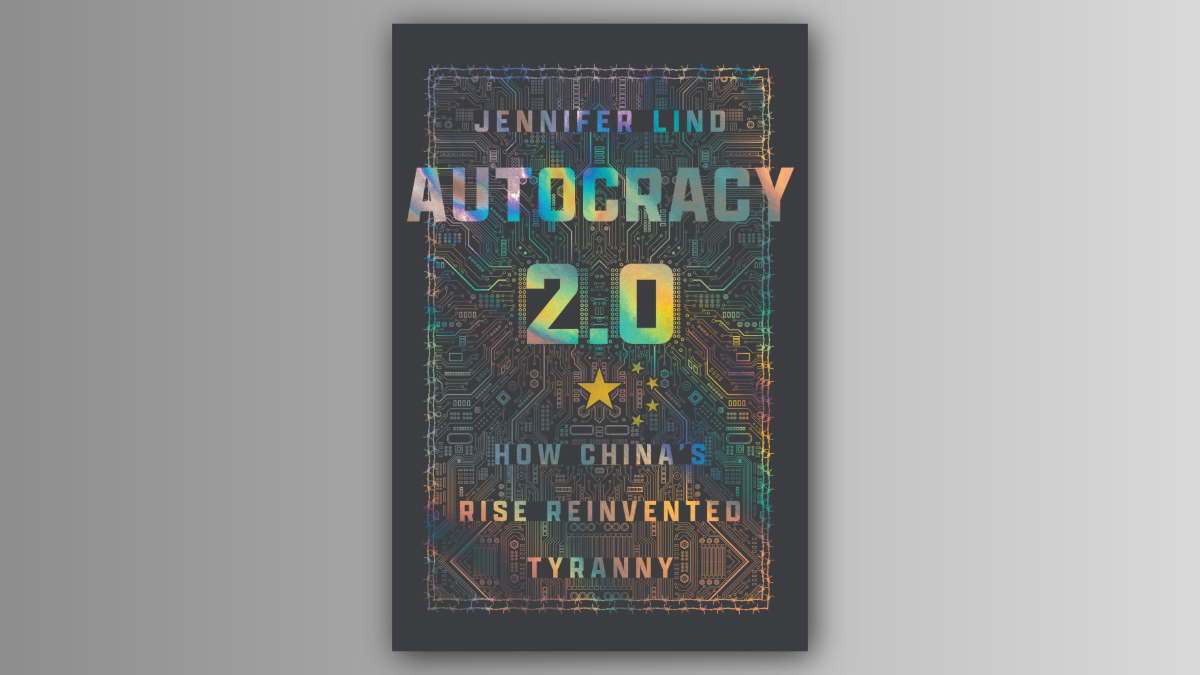
Today’s guest is Jennifer Lind, an associate professor of government at Dartmouth and a fellow at Chatham House London,the author of a new book titled Autocracy 2.0: How China's Rise Reinvented Tyranny. The book chronicles China’s rise and introduces the idea of “smart authoritarianism”: a strategy that seeks to preserve political dominance while minimizing the economic damage of repression. It’s a sharp and unsettling argument—and one that is worth considering, as the years-long wave of autocratization continues to sweep across the globe, increasingly enabled by new technologies.
What follows is a lightly edited transcript of the discussion.
Jennifer Lind:
I'm Jennifer Lind. I'm associate professor of government at Dartmouth and a fellow at Chatham House London. And I recently authored the book, Autocracy 2.0: How China's Rise Reinvented Tyranny.
Justin Hendrix:
Jennifer, you've spent your career studying East Asian security, great power politics. Can you tell us how you got started? You mentioned in the book, a trip to Japan, your first opportunity to go and see this part of the world. What drew you to these questions? How did you end up concerned with these questions around democracy and authoritarianism and technology?
Jennifer Lind:
Well, in my field of international security, China is the big story. I think the question of China's rise, US-China relations, that's going to be the question for the next several decades in the field of international security and US national security policy.
As an East Asia person, I wanted to delve more deeply into that. And so I was so struck by observing China's rise and seeing the same kinds of pretty ad hoc conversations that people were having. Some people said, "Oh, there's no way that China could ever become a great power." And then they would fill in the blank here for whatever rationale they'd like to give. And then other people would say, "Well, it's inevitable. China's going to dominate the world." And they had some half-baked rationale.
And as a Japan person, somebody who came to the study of the region through initially this study of Japan, I was so struck by how similar it seemed to our discussions about Japan in the 1980s and such. And so, "Oh, Japan's going to take over the world. Oh no, Japan can't do that for X, Y, Z reason." And then previously there was the Soviet Union, which, we had the same discussion there. As a person who is interested in international politics and creating frameworks and tools for better understanding it, my reaction was, "Don't we have a way of understanding this? Haven't we figured this out yet?" The phenomenon of great power rise, of course, is a longstanding one, a perennial one in world politics.
And so I decided I wanted to write a book on how countries rise to become great powers. And when I was getting into the thick of it, essentially what I realized for China was China basically ticked all the boxes for attributes of great powers. Great powers have to have a big population. They have to have a large economy. They have to develop a lot of military power. Check, check, check.
But the one thing that China didn't seem to possess was technological leadership. And technological leadership has always been essential for the leading powers of the world, both to have advanced economies and then also to have cutting edge military power that they use to compete against other great powers. And so China, though, a decade ago was not very technologically adept, it was very much a follower, it was very much a copycat. And people were routinely calling it a copycat and many people saying it could only be a copycat. Basically, I was interested in this question of could China become a technological innovator? Because that to me was the key question about whether China could continue its rise and become a real geopolitical competitor related to the United States.
Justin Hendrix:
This question about the conventional wisdom, you talk about this idea that, "China can't innovate thesis," which I remember that thesis felt very salient. You heard it a lot over the last few years. Do you feel like that has diminished somewhat, that you're hearing that kind of argument less lately? That even though there's still this focus obviously on, "theft," or even in this recent report from the House Select Committee that's looking at these issues, one of the reports they did on DeepSeq, for instance, really focused on the idea of theft effectively. Do you feel like that argument that China can't innovate thesis is still salient, especially in Washington? Or do you feel like it's begun to crack a little bit?
Jennifer Lind:
I think what I'm seeing is a pretty familiar phenomenon, which is we hold this opinion very strongly. And as it's shown to be patently untrue, we conveniently forget that we ever held that opinion and just immediately shift to the world that we're in. And so again, I think this is a very important moment to point out what had been the prevailing wisdom. And perhaps we need to ask ourselves, "Why did we think that way?" And then kind of adjust to this new normal that we're in.
But it also... There's so many problems associated with just this kind of erasure of the way we've been thinking about it for so many years, we won't learn anything from our mistakes. And the United States has made mistake after mistake in underestimating China. And we keep making them. And so particularly as it bears on our relations with China, it's a good thing to ask ourselves, "Why do we do this?"
I think the error of looking at a rising economy and saying, "Oh, they're a copycat," I think this is actually a really common one. There's a famous conversation in the 1950s where you have John Foster Dulles talking to the Japanese and talking about how are they going to reconstitute their economy and so on? And Dulles says, "We know that Japan could never produce anything that the United States would be interested in buying." That's pretty astounding when we compare that to the world that we're in now.
And I think we had a very similar reaction to Korea and Taiwan as they were growing their economies. At first, a lot of your listeners won't remember this, but when you saw the labels made in Korea or made in Taiwan, it was a punchline about this is just kind of cheap crap. And everything, we were reporting everything was made in Taiwan at some point. And then, again, if you look today at those countries and how they've worked their way up the value chain, these are some of the technologically most advanced societies in the world.
And so it really is a common phenomenon to dismiss these rising economies. And I think partly it's because we look at them and we see what are they producing. And the gap between where they are at the time and the global cutting edge is so profound, it's hard to imagine that they will be able to get their way out of it, but many of them actually do. And so we certainly have seen this in the Chinese case.
Justin Hendrix:
We're so invested in this kind of American exceptionalism and supremacy in the US, we just literally can't see what's happening. We're not reading the signals, the phenomena correctly.
Jennifer Lind:
The people who are in these industries, they know, they understand. But I think US policymakers are very slow to catch on. Particularly since the 1990s, we've seen ourselves as the global leader, and other countries are very much distant from us in terms of power and certainly technological power. I think policymakers in particular are pretty slow with this.
I have to say scholars have been as well. As I was doing this work, I would consistently have people informing me, "This is just wrong. There's no way that China as a authoritarian society could innovate." And there's a very prominent thought of scholarly literature on this that actually won the Nobel Prize a couple years ago, this notion about institutions being the big determinants of economic growth and innovation and the idea that autocracies are simply going to be unable to innovate because of the way they govern their societies.
Justin Hendrix:
And in the book, you point to various experts who have essentially come to the opposite conclusion, that there's really nothing that says from a technological or economic standpoint that necessarily democracy is the leading model.
Jennifer Lind:
That's my book's argument, yes. I'm building on a really creative, fruitful trend in the authoritarian politics literature. That literature over the past decade or more has been looking at the way that autocracies in our time seem to govern themselves and noting some really interesting differences with previous authoritarian governance. There are things like parliaments, for example. We thought for many years that these dictators would not want any sort of checks and balances against their rule, and so they wouldn't want a parliament, for example. Or if they permitted one, it would just be a rubber stamp. Or they wouldn't want a judiciary, for example. They wouldn't allow a media. There's all these reasons why we thought these are features of an authoritarian society that the leaders just would not tolerate.
And what that literature has shown us is they've investigated so many different types of institutions and also policies, and they've argued that, actually, creating authoritarian versions of these institutions can be really useful for authoritarian leaders. And when I say really useful, the thing that that literature has been most interested in is regime longevity. Their big question is if you govern in these ways that they refer to as lower intensity repression, for example, as opposed to high intensity repression, and if you have institutions that we normally associate with more pluralistic societies like a civil society or parliament, judiciary and so on, the literature is finding that authoritarian regimes with those features actually do better. They last longer, they perform better and so on.
I'm building on that literature, but my question of interest was about innovation. That's what I'm bringing to that conversation and also connecting that whole body of authoritarian politics literature to these really interesting debates that are going on. I'm finding that it's not just good for these regimes that they stay in power longer, they actually are more economically successful because these kinds of institutions like permitting a civil society, a private media, NGOs, universities, a political opposition in some cases, but they're keeping those still under regime control. And they're able to do that, which we didn't really think was going to be possible. But the argument that I'm making in the book is countries that do that, and I show China doing that, are going to be actually able to generate a lot of innovation when we did not think that was going to be possible.
Justin Hendrix:
You introduced a bunch of concepts building to this concept of smart authoritarianism, which you've just begun to describe, I think. But you bring up Samuel Huntington's King's Dilemma, Singapore and its model of developmental authoritarianism. How does all that play into your thinking about smart authoritarianism? What is smart authoritarianism?
Jennifer Lind:
The king's dilemma is this really useful construct, as you said, it was introduced by Samuel Huntington in his work in the 1960s. The essential argument is that we think the authoritarian leader can structure governance in a way that permits economic growth or can structure the regime in a way that maintains political control, but you can't do both, so you have to choose. Because at the heart of this idea is the notion of there's this tension between what you need to do, how you need to rule for maintaining political control, and then also the things that you need to do to generate innovation. And so the argument is the repression, the corruption, all the things you need to do to maintain control are going to be inimical to economic growth and innovation.
Essentially, that suggested that authoritarian governments faced a choice. They could experience economic growth or they could have regime control. And what my argument is is I'm essentially saying China chose door number three. It said, "Maybe we could figure out a way to have our authoritarianism and eat it too," to both maintain political control and encourage innovation. And so I see it as essentially trying to maintain a balance between the two.
And it's important to understand that as you do this, you are going to leave some economic growth, some innovation on the table. This is not about economic maximization because you're trying to have both control and innovation, so you're going to sacrifice some economic growth. That's a really key point because sometimes people looking at Xi Jinping's policies and saying, "Why is he being so stupid? He's doing a policy that means that's going to harm the economy." And the argument that I'm essentially making is, well, he knows that. And he's not trying to maximize economic growth, he's trying to maximize that sweet spot between political control and innovation at this stage.
Justin Hendrix:
Well, let's talk about also maybe, just as we've talked about perceptions of Chinese innovation or the country's ability to potentially usurp the United States at some point on innovation. There's also a lot of headlines in the US right now pointing towards China saying there's economic malaise, there's dissatisfaction with the governing party. There's lots of reasons to think that people don't feel the bargain is being met effectively. We hear these types of things, there's a kind of a buy-in. People have bought in to the promise of economic growth. And as long as everyone sort of felt there was forward progress, they'd be willing to essentially consent. But that as that changes, we see Xi Jinping being more authoritarian, more... I think you call it vicious authoritarianism at one point in the book. Maybe tightening the grip more. Where do you think we are on that trajectory right now?
Jennifer Lind:
Well, you're bringing up a lot of different topics. There's the idea of public perceptions and how the public feels. There's the idea of the future of China's economy, and so how that will affect its ability to compete and so on.
On the public perception side, I would say that you do hear anecdotally a lot of people being quite dissatisfied with the government performance and talking about it in ways that maybe historically they haven't done. I would say that that is an important strand to understand, absolutely. There's another strand, which is I think a lot of people are also very proud of China. Xi Jinping, he's seen as being one of the leaders who has helped China stand up, in the words of Mao. China has stood up. China has a seat at the table in world politics. It's influential, it's respected, it's consulted. The Americans can't just steam their aircraft carriers through the Taiwan Strait whenever they want. We can't do that anymore. It's too dangerous because China has become more powerful.
The DeepSeq moment that you alluded to earlier, that was also a moment of tremendous pride and patriotism, the notion that China made something that now the Western countries are eagerly trying to figure out how to use, and they're all downloading it. And so you hear the Europeans say, "Maybe we can attract Chinese FDI to Europe so they'll bring their advanced technology." This is such an extraordinary turn of events, and a lot of Chinese people are very excited about that.
Ultimately, it's really hard for us to know. We don't have obviously reliable public opinion polling in China. And so I think you find in a country of 1.4 billion people, you're going to see a lot of unhappiness, but also it's important to remember there is that national pride there as well.
Justin Hendrix:
Just to double down on the idea that we're reading a lot of headlines about economic headwinds in China, property crisis, high youth unemployment, I don't know, does that make it harder for the CCP to maintain the smart balance that you're talking about, the smart authoritarianism approach?
Jennifer Lind:
Ultimately, my book is arguing that despite widespread pessimism about China's ability to innovate, it was able to do so. And so this conversation that is indeed a very prominent conversation about what does the future of China's economy hold? That conversation, which is looking forward and quite speculative, is a different one from the one I talk about in my book. What I'm talking about is definitely in the rearview mirror. China is now a leading innovator. That is now. That is upon us. That is not something to speculate about for the future.
And it's very important that China was able to do this. Number one, as I said, China as a great power competing against the United States is the biggest change in geopolitics that we've seen for 30 years. We had the collapse of the Soviet Union in the early 1990s. China's rise to become a great power, and I've argued even superpower, is the biggest geopolitical change that we've seen. Just reading the headlines, just looking at changes in US national security policy, it's clearly having dramatic effects on the world. China's ability to become that full-fledged great power is already here and is a really important thing.
I would also say that the question about China's future economic performance, that I think we need to ask ourselves who's interested in that question and for what purposes? The economists are very interested in this. And they're particularly interested about can China keep growing past middle income where it currently finds itself and rising into that high income level? They're also interested in whether or not China can diffuse its economic growth more evenly throughout the country. Because right now there's the pockets of economic growth, and then there's this vast hinterland that really hasn't benefited as much from China's economic rise. Those are the kinds of questions that economists ask. And these are key questions for China's economic future. We really want to understand whether they can do this. Whether or not they succeed, for example, in lifting up the hinterland is going to have a big effect on consumerism, which China desperately needs to enhance. It's also going to affect future innovation and the nature of future economic growth. Those are really important questions.
I would mention though that, again, what we were curious about is China's ability to compete geopolitically. And what we have seen is China is more than able to do that even though it has this vast hinterland, even though it's maybe not ever going to make the high income category; the Soviet Union never did. The Soviet Union was at best a middle income economy at its peak and yet managed to engage in this really dangerous security competition with the United States.
Justin Hendrix:
I want to ask you maybe, just to follow up on that, a little bit about the extent to which the Chinese models being adopted by other countries. You point to various examples of that in different regions of the world, but where are we at in 2025? How successful is the Chinese model seen? How is it being... permutations of it being adopted in different regions?
Jennifer Lind:
I know that a lot of your listeners are interested in democracy and the kind of global struggle between democracy and authoritarianism. And I have to say, my book is not good news. Essentially, my book is arguing that autocracies are much more competent than we have, in many cases, written them off as being. We comforted ourselves by thinking that, although autocracies had several advantages in some respects, sometimes there's an advantage to having a central state directed of economic policy, for example, sometimes there's an advantage in not having to worry about the ups and downs of public opinion and this sort of thing.
But anyway, we assumed that democracies had a big advantage relative to autocracies, particularly in the modern globalized information economy and that autocracies were not going to be able to compete. Essentially, my book is saying, "Goodness, they have adapted to the new world in which they find themselves, and they are much more competitive, much more adaptable than we thought they could be.
And in the Chinese case, you saw the Chinese leadership, particularly starting under Deng Xiaoping, but then heading later on as well, you saw them looking at the Singapore model with a great deal of interest and saying, "How did the Singaporeans manage to do this? How did that party manage to stay in power and cultivate this high-tech economy?" And Singapore's the black Swan here to lift itself into the high income category. Singapore's really one of the very few countries to succeed at that. And so you see both Chinese leaders going to Singapore, studying the model, talking to them, learning from them. You also see Lee Kuan Yew, the famous Singaporean leader who ruled for so many years and kicked off Singapore's economic growth, you see him going to China multiple times and giving them advice on how to structure their economy and how to structure their politics. What sort of policies of repression and control, for example, might interfere less with economic growth.
Essentially, a lot of people looked at the Singapore case and thought, well, that can't possibly apply to China. It's this tiny city state. China's this massive country of over a billion people. We didn't think that Singapore would be a very portable model, certainly not for the China case. And what we've seen is, my goodness, the Chinese learned a lot from Singapore and succeeded very well.
Now the question is what other countries are learning from China? And here there's both an active and a passive role that China is playing. The passive role is their success. The world looks at them, they see DeepSeq, they see these robots that are in every newspaper photo that I'm looking at these days. A little disconcerting, I have to say. You see all of China's technological success. And sure, it has economic challenges, but my goodness, it's this amazing story of achievement. That's the passive way that China is promoting this model, but it's also doing it actively.
And I know your podcast spends a lot of time talking about these kinds of policies, techno-authoritarianism, how regimes rely on technology to use different means of control against their own people to sell these kinds of technologies to countries around the world, and then, of course, also supporting authoritarian governments in other ways. This is very much a portable model. It's already been used by China from the Singaporean case. And we are seeing, particularly in the Middle East, which is a very eager student of this model, we are seeing other countries talking about Singapore, talking about Lee Kuan Yew talking about China and trying to make their economies go in this new direction toward greater technological achievement.
Justin Hendrix:
I want to talk a little bit about the direct competition and intervention by the US government, particularly around things like semiconductors, and lots of news lately around expert controls. Are they on again, off again, et cetera? Your book touches on these things. You talk a lot about the investments that China's made into its semiconductor manufacturing capabilities. Obviously the relationship with Taiwan comes in here. I don't know, looking at this point, it's January 2026, we just saw, for instance, the Trump administration relax its ban on Nvidia selling those H200 chips to China after having put a ban on that in April, I believe, last year. I don't know, how are you thinking about this piece of it right now, the US approach to trying to slow China's growth by controlling certain technologies? Is any of that working out?
Jennifer Lind:
I think what you're describing as broadly the US being in the midst of this debate about how to compete with China, how to engage in a competition that is the kind of competition we've never really been in before. And what I mean by that is when you look at the Cold War, for example, there were two different global economic systems, at least two. There was the Warsaw Pact, the Comecon countries, as they were called, with the Soviet Union as the hub, and then there was the US-centered North Atlantic and then Asia and, later on, liberal market economies. And they didn't cooperate very much. There wasn't a whole lot of interaction between those two different blocks. And this time, the adversary's inside the house. This is a very different kind of competition where it's our major trading partner. We have been major technological partners.
I think one of the big untold stories about AI is actually the extent to which the United States and China developed this technology together. We cooperated significantly. We, together, achieved this faster than we would have without the other. And so that's something that I hope we tell that story someday. Perhaps we'll have the circumstances to be happy about that and celebrate that.
Justin Hendrix:
You've mentioned the themes of this podcast, and obviously one of the reasons I'm so interested in the questions that you've raised in this book is because I'm keen, and I think many of my listeners are keen to understand what can we learn that might be useful to us? Especially in reflecting on how to build more competitive democratic forms of governance and what role technology might play in that. And clearly, democracy is on the back foot around the world. We've had a couple of decades of autocratization, all the various indicators, VDIM or Freedom House or the Economist, any of those that look at all those different variables suggest that.
I just want to ask you a couple of things about the competition between these models. And this is a tiny detail, but I'm going to ask it and hope that maybe it opens up something. You point out at one point in the book that fans of the movie, Crazy Rich Asians might be surprised to learn that it takes place in an authoritarian country. Why is that important to point out?
Jennifer Lind:
It's important to point out because Singapore's government has tried very hard and has succeeded, as that's my example that I'm giving, in essentially creating and displaying a form of authoritarianism that is very different from the brutal authoritarian regimes of the past. And it is, in fact, less brutal. Again, there's this shift from high intensity repression to low intensity repression. And it, indeed, is less brutal. Instead of the high intensity repression of the past, they pursue repression that's much less brutal, much more subtle, much more targeted.
I think it's important to understand that authoritarianism has evolved in ways that make it able to hide better, make it less overt. And so that's very dangerous for those who want to see democracy spreading around the world. We would rather that it was much more out in the open, much more clumsy, much more in your face. But the tools of smart authoritarianism that I describe in the book are much more subtle.
Justin Hendrix:
It's quite a moment in America to think about clumsy or sloppy or in the face of repression and a violence, but I won't perhaps go there right at the moment. I do want to just pick up on your end point. You try to look ahead. You talk about the idea of how democracies should think about competing with authoritarians, what pro-democracy activists and researchers need to do in terms of framing their thinking. I don't know, what would you recommend that my listeners do or explore or research or put their effort into if they're keen on answering this question? It feels like to me that right now, the hard part about thinking about the struggle between democracy and authoritarianism is that we have so much struggle within our democracy and so much uncertainty about whether it will persist, we've almost got to look in the mirror a bit before we can look perhaps at competing again in this way. At least that's my own view, but I wonder how you think about this.
Jennifer Lind:
I think we're in a moment in which China's seen as having discovered some amazing growth formula and China is 10 feet tall and this sort of a thing. And I think that we see swings back and forth in the way that autocracies and autocratic political economy is viewed.
At one moment, and again, when I was writing the book, the zeitgeist was emphasizing democratic advantage and listing all of the disadvantages that autocracies have. And then we see China rising and becoming technologically significant, and then we say, "Oh my gosh, there's all these different kinds of authoritarian advantages." I think our media, they're looking for the hot story. And people are just interested in trying to figure out has the world changed, or maybe the kinds of technology we're using today actually are more suitable for authoritarian leaders. There's entirely the possibility that, with all the changes in the world, we might see change like that. It's possible.
I think over and over again, we're reminded about sticking to fundamentals, so just asking ourselves, "Are people being recruited for these jobs on the basis of competence or otherwise?" Just basics. It is the process for awarding grants or selecting bids is that a competitive one that's open or has the process kept out by a variety of mechanisms, a lot of potentially competitive people and firms. Just asking ourselves and returning to this is the market. This is the way that America has tried to think and to encourage these market-driven principles, principles related to merit rather than nepotism, like these kinds of things.
People might be tempted right now to say, "Oh, actually having the government figure out priorities is the way to go." But there's a massive literature that at other times has been correct that tells us that can also be disastrous. And as we learn more, for example, about the hundreds of billions of dollars of Chinese taxpayer money that's been poured into, say, the semiconductor sector, yes, they're innovating, they're doing well, they're lifting themselves up, but I have a feeling we're going to see that there's many costs here, that there was a lot of corruption, that there was a lot of waste.
And so I would just say if we're trying to figure out how to compete, we already know good first principles about encouraging economic competition, about encouraging innovation, and that people should very rightly speak out when they see our government moving in a direction that seems to run against that. There's nothing wrong, for example, by the government saying, "We really think we need to invest more in critical minerals," for example, and they have a good story and they've put together a competitive group that speaks openly and they think that's a good idea. That sounds perfectly good. But other times, for example, if the White House decides to take a cut of exports from particular firms, that goes against everything we know about business-government relations and sensible economic policy. And so people are right to be alert, to be paying attention. And these are the kinds of things that we should be absolutely adhering to in our beliefs rather than thinking, oh, we've been surpassed, that the democracy is passe.
Justin Hendrix:
It almost sounds like there's some congruence in maybe the way I was trying to maybe more clumsily frame this and where you've come to, which is we need to do better following best practices in our democratic system if we want to compete with this smarter authoritarianism that's emerged out of China.
Jennifer Lind:
I think that's always the right answer. We certainly don't want to be like them. What are we even talking about? The reason we have our government, a government of the people for the people is that we are a country that believes in liberty. There's nothing more important than that. If it turns out that an authoritarian country cleans our clock, oh well. This is one thing we do not want to compromise on. We are a country that wants to have free people, a representative government. And we hope and we think and actually are correct that will lead to a lot of economic prosperity.
Justin Hendrix:
The last word in this book, nearly, is about artificial intelligence and the relationship, of course, between artificial intelligence and economic growth, but also AI and authoritarianism. Do you have an instinct right now? A lot of folks that have come on this podcast have tended to argue that AI promotes the concentration of power. You mentioned the acquisition of data and the extent to which the autocrats possessing so much data is useful for political control. Various other academics have talked about AI and its ability to play a role in surveillance and manipulation in various forms of information operations, all of those things. Do you have an instinct coming out of this which way AI may lead us?
Jennifer Lind:
We've been puzzling through this for a while now. I think the initial opinion, again, which is we tended to be dismissive toward autocracies. I remember people saying that, "Oh, well, when it comes to large language models, because there's censorship in China, they're not going to be trained on as sophisticated data as the other freak societies would have, and so they're going to have a significant disadvantage there." And I always pointed out, well, there's lots of different kinds of artificial intelligence. And so for example, facial recognition. And there, China has vastly more data. The Chinese government possesses vastly more data because of the way that it governs its internal security because of its facial recognition that is just everywhere in Chinese society.
I think it's clear that they are not at a disadvantage. Sometimes you hear people speaking of an advantage. Like the example I just gave, they would say, "Oh, well, because they have so much data and it's so readily available and so on, authoritarians are going to have an advantage when it comes to AI." Again, I would not go that far. I would say they have shown us that they don't seem to be disadvantaged, and that's really important. And that's different from what we thought. But again, there are all the reasons dating back to all of these different practices, institutions and so on why democracies have many advantages in some realms and autocracies may have some in others. But democracies are not to be written off. Democracies are not to be dismissed because of our many advantages. And so I think the verdict is still very much out on AI.
Justin Hendrix:
I hope that I'll have the opportunity to have you back on, talk about this issue perhaps as more data becomes available. But certainly, I would recommend to my listeners to go and check out this book, Autocracy 2.0. There'll be a link to it in the show notes. And Jennifer Lind, very much appreciate your time.
Jennifer Lind:
Thank you so much for having me.
Authors