What India’s Forest Rights Act Can Teach Us About Data Centers
Vaishnavi Patil / Oct 22, 2026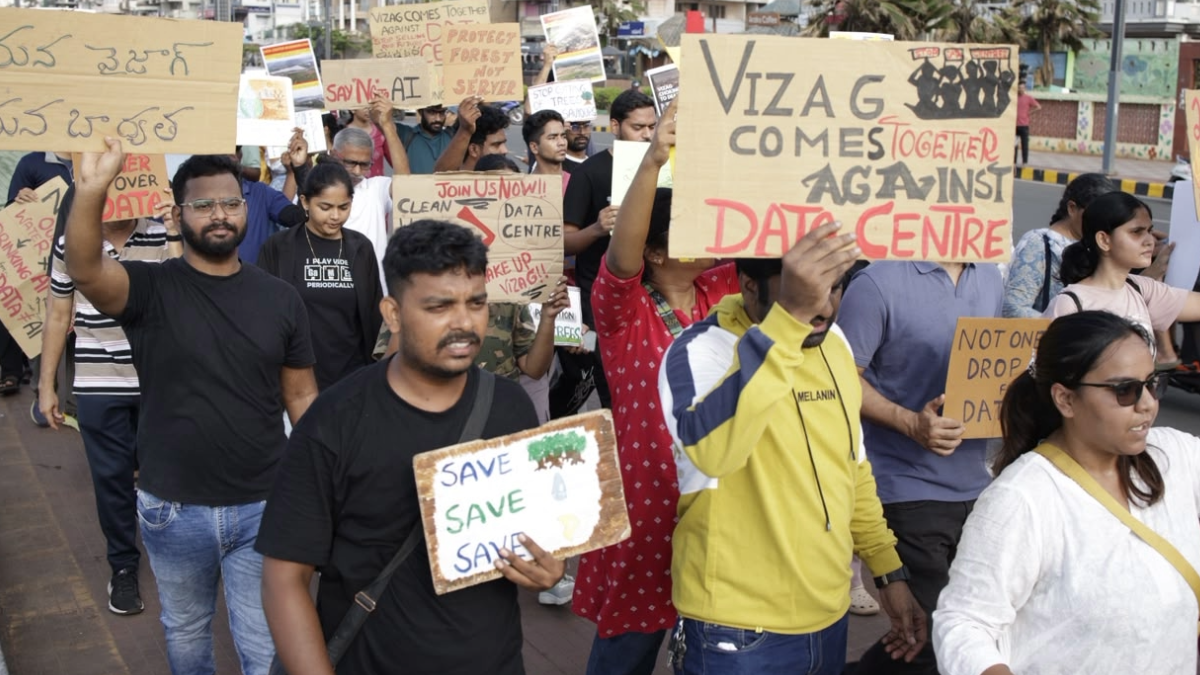
A rally against data centers at R.K.Beach in Visakhapatnam, India, on July 19. Source: Stop Dirty Data Centers
In 2025, the Andhra Pradesh government allotted 480 acres to support a $15 billion project to build a 1GW Google-Adani data center campus near Visakhapatnam. That allotment has since grown to 601.4 acres across three sites — Tarluvada (266.6 acres), Adavivaram (160) and Rambilli (174.8). The capacity appears to have grown as well, with clearance papers showing approval for 2.51GW. Despite encroaching upon the eco-sensitive zone of the Kambalakonda sanctuary and being in proximity to the Mudasarlova reservoir, the project was granted environmental clearance in just nine days. Since then, protests against this project have intensified.
Vizag is not alone. Across India, as in the world at large, planned data center projects are drawing increasing dissent from local communities, who bear the real socio-ecological costs and do not foresee the promised gains of an AI future trickling down to them.
States have begun to deploy policy instruments to address public concerns. However, solutions that only consider better engineering or cleaner impact metrics miss the point. This is not just a technical problem, it is also a problem of governance. A data center is a claim on land and its resources, and therefore a claim on people. Its policy, thus, must be anchored primarily in the politics of place, because scratch the surface and you will find data centers to be fundamentally a land rights issue. And India has a rich and unique history of articulating and fighting for land rights.
No legal instrument represents this history better than the Scheduled Tribes and Other Traditional Forest Dwellers (Recognition of Forest Rights) Act, 2006, better known as the Forest Rights Act (FRA), 2006. It recognizes land and resource rights of forest-dependent communities, defined in its preamble as those “who have been residing in such forests for generations but whose rights could not be recorded.”
In this age of data colonialism, critical resources are being extracted from communities to power a global digital system that directs the flow of value elsewhere. The FRA legacy provides us with the working grammar to confront this new form of colonialism and reaffirm pre-existing rights of communities. The grammar can be unpacked in three important rights articulated in the FRA — the right to land, right to resources, and right to development.
Right to land (individual and collective rights)
In the Vizag campus, two hundred of the 480 acres of the project belong to around 50 Dalit farmers of Tarluvada village. The land was given to landless Dalit farmers in the 1970s through a special program. This program is another example of the Indian state’s attempts to correct historical injustices, especially considering that a 2012 state survey revealed that 68% of Dalit households in Visakhapatnam district still do not own land.
And yet, the Dalit community states that they were not consulted when the decision was made. They say that the Open Category (OCs) and Other Backward Classes (OBCs) negotiated the surrender of their land, with evidence of land-pooling and acquisition processes being used to put further pressure on them. They believe that the dominant castes withheld details from them and targeted Dalit lands specifically.
It is exactly these types of power asymmetries in land and livelihoods that the FRA combats. By allowing land-dependent communities to collectively claim rights, the FRA sets an important precedent. It expands not just the definition of customary land rights but also the process for making claims. Under Section 3(1)(a), people can claim individual or collective forest rights for land they occupy and cultivate. Claims begin in the gram sabha, not the revenue department, and oral testimony and customary knowledge are permissible evidence.
The Act restricts itself to forest land. However, its methodology of making individual and collective claims can be adopted more broadly. If applied to data centers, it would translate into allotment of land only after land claims are formally recorded so that structured negotiations happen with actual right-holders.
Public consultation should also be mandated for data centers above a defined threshold. But how do you define that threshold? In Vizag’s case, due to the lack of categorization of data centers in the Environmental Impact Assessment (EIA) notification of 2006, clearances were processed for each site separately under Category B2 instead of assessing the whole project under Category A. As the Notification does not mandate public consultation for B2 projects, no hearing was conducted.
Such obfuscation can be avoided if data center policies mandate cumulative assessments of projects and the EIA notification is amended. But more importantly, public consultation around data centers should draw on the FRA’s model of deliberation through local institutions.
As rights under the FRA are place-based, claims and grievance redressal processes are triggered at the village level. If communities could lodge individual and collective claims to the land and resources on which they directly depend, and utilize them to demand accountability, consultation would follow regardless of the project category. If the state continues to insist on opening its land to tech conglomerates, granting rights to land-dependent marginal groups will allow them to protect their livelihoods more effectively.
Right to resources (use/management rights)
Hyperscale data centers cannot function without existing IT infrastructure. They are also resource-intensive, requiring an uninterrupted supply of power to run servers and freshwater to cool them. This naturally makes urban areas like Vizag attractive for data center clustering.
International Energy Agency estimates that a 1GW facility requires 20 million liters of freshwater per day (MLD), while a planned Australian project of a comparable size calculates it at 33 MLD. For Vizag, a drought-prone district with distinctly low groundwater levels, this is alarming. The Vizag Development Council reports current water supply at 330-400 MLD and demand at 400-490 MLD, and warns that data centers and other industrial projects could push demand to 1500 MLD by 2040.
To limit its water use, Google claims that the campus will use air-cooling instead. But that only adds to its already intensive energy consumption. The environmental clearance for two sites of the campus has projected a combined grid draw of 1626 MW and 354 backup diesel generators with a combined capacity of 971.5 MW. Even a conservative estimate of a steady draw of 800 MW (around ~20 million kWh per day) would be comparable to the energy demand of 3.9 million Indian homes (as calculated in the 2024-2025 survey by the Bureau of Energy Efficiency).
Vizag's climate already strains the existing power grid and water supply. Yet instead of prioritizing municipal needs, the state government has enabled the grant of 'Deemed Distribution Licenses' to data centers, allowing them to procure and distribute power independently. The Human Rights Forum (HRF) questions the legality of this policy, calling it a “backdoor attempt to privatize an important component of electricity distribution.”
The bottom-up response to this can begin with an articulation of the right to resources. Section 5(d) of the Act states that right-holders can “ensure that the decisions taken in the Gram Sabha to regulate access to community forest resources and stop any activity which adversely affects the wild animals, forest and the biodiversity are complied with.” Extending the FRA logic to urban and peri-urban communities would ensure, at minimum, participation of local leadership in the governance of urban resources.
Right to development (local developmental rights)
The ecological significance of the geography magnifies every harm the Vizag campus brings, and activists have enough global evidence to raise concerns.
Data centers’ water use has been studied as causing not only aquifer depletion but also pollution. US Representative Alexandria Ocasio-Cortez famously presented the murky brown water from taps in Morgan County, Georgia, attributing the problem to the nearby data center. Air-cooled facilities can be harmful. In Uruguay, for instance, the air-cooled Canelones data center is projected to release 25,000 tonnes of CO2 and 86 tonnes of hazardous waste. Data centers cause significant increase in land surface temperatures, health issues, and noise pollution as well.
The Andhra Pradesh IT minister Nara Lokesh has tried to alleviate these concerns by announcing that the government plans to mandate data centers to source 70% of their energy from renewable sources. He also assures the public that only industrial water will be used for data centers. But how does the government plan to scale the currently lacking power and water capacity to meet the demands of a hyperscale campus? And absent project-specific impact assessments, how would we know these interventions are sufficient?
The clamor for on-ground transparency brings back the core missing piece in ensuring state accountability — place-based land governance. One of the FRA’s greatest contributions is its recognition of the gram sabha as the central decision-making body. Once a claim under the FRA is recognized, the gram sabha is empowered to not just manage land resources but have agency over what is developed on the notified land.
Applied to data centers, this suggests two concrete policy reforms. First, local bodies must hold decisional agency over what land gets allotted for data center use (if at all), and second, if claims remain unrecorded or impacts are not assessed, formal village-level channels should be created to challenge site approvals.
Section 5(c) of the Act states that right-holders “ensure that the habitat of forest dwelling Scheduled Tribes and other traditional forest dwellers is preserved from any form of destructive practices affecting their cultural and natural heritage”. Section 4(1)(f) of the FRA Rules, 2012 also notes that forest management plans prepared by the gram sabha shall be integrated into Forest Department plans, thereby ensuring a bottom-up land governance model. This model, if applied broadly, can insist that development is measured by what it gives back to people closest to it.
What next?
For Vizag and the data center question at large, the most useful lesson is not what is in the FRA, but how the FRA came to be. It was a culmination of decades of on-ground mobilization against colonial governance of forests, which often translated into evictions of traditional forest communities.
When multiple organizations came together to form a united front called the Campaign for Survival and Dignity in 2003, the movement built power from below and scaled outwards across India. They led peer-to-peer networks through barefoot lawyers and community cadres, ensuring multiple entry points for all affected peoples. Most importantly, they argued that given the record of the Ministry of Environment and Forests, the FRA should be drafted by the Ministry of Tribal Affairs. Because of their insistence, the FRA became a bold statement of community-first forest governance.
In the data center conversation, we are at a similar juncture, where multiple sites across the country are responding to the same problem with similar solutions. What we need is what the Campaign achieved. Like them, we have to negotiate collectively and clearly, and question extractivist policies like the Union government’s proposed 20-year tax holiday for data centers.
The FRA serves as a crucial legal artifact because it turned the Campaign’s struggle into a law that recognizes pre-existing rights. Data center policy, too, should shift away from a land-acquisition model to a rights-recognition model — one that records claims of land-dependent communities before site selection, invites clear deliberations, enshrines local governance in resource allocation, and embraces community-level decision-making and grievance redressal. If land for data centers is treated as already belonging to someone, India’s AI ambitions can rest on something sustainable.
Authors