What India’s Push for Global Digital Repositories Tells Us About Its Tech Diplomacy
Arindrajit Basu / Mar 6, 2026Arindrajit Basu is a PHD candidate at Leiden University and a Non-Resident Fellow at New America.
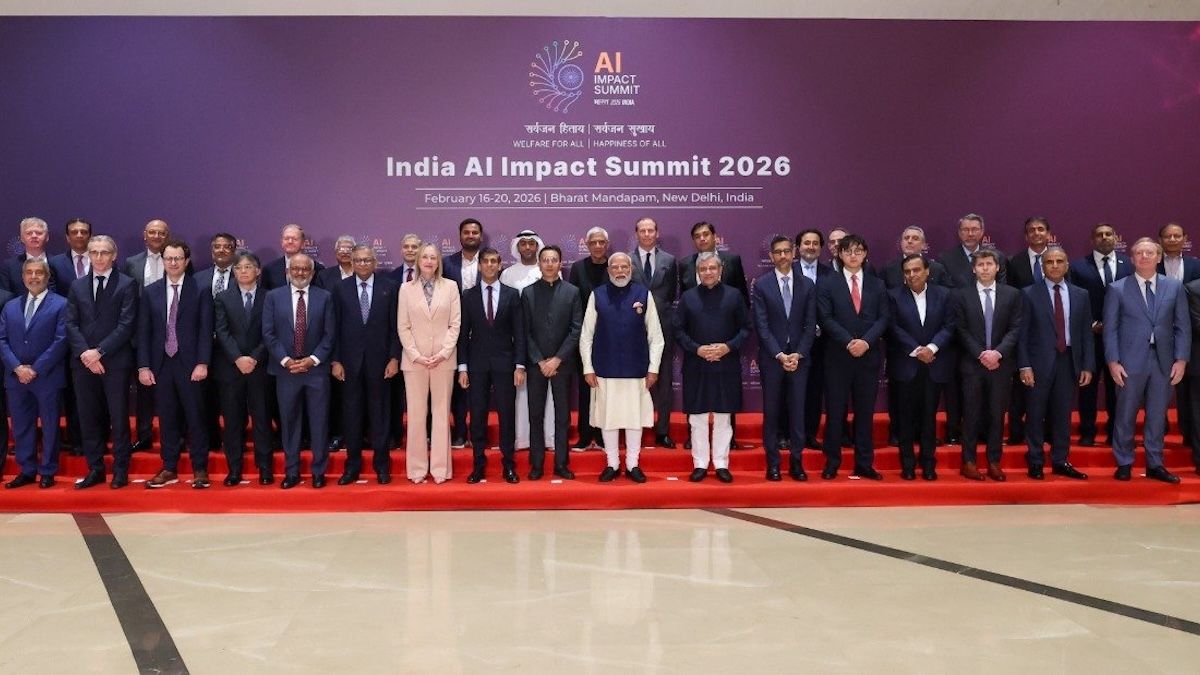
Attendees of the India AI Summit 2026, February 21, 2026 (IndiaAI)
Two working days before the much-anticipated 2026 AI Impact Summit got underway in New Delhi, IndiaAI Mission CEO Abhishek Singh proclaimed India’s ambition to create a “repository of use cases for AI in key sectors which can then be shared.” Branded as the “AI commons,” this repository would make AI applications “interoperable and available to the global community to ensure they are diffused widely and adopted at scale.” The Trusted “AI commons” was mentioned in the AI Impact Summit Declaration as a “non-binding and voluntary collaborative platform consolidating technical resources, tools, benchmarks and best practices that all can access and adapt to their contexts.”
The intended AI repository is not the only global platform that India has pushed for in recent years. A key outcome of India’s G20 Presidency was the offer to host a Global Digital Public Infrastructure Repository, intended as a knowledge hub showcasing digital public infrastructure use cases across the world. Similarly, the Indian delegation has been concerted in its push for a Global Cybersecurity Cooperation Portal that would enable countries to exchange information and best practices and cooperate more effectively on cyber stability at the United Nations First Committee discussions on cybersecurity norms. These repositories are not afterthoughts or collateral benefits but seem to be planned diplomatic milestones.
The outcomes (admittedly still a work-in-progress) of this “repository diplomacy” seem relatively modest. So why has India invested so much diplomatic capital in promoting these digital portals? In short, these initiatives allow New Delhi to burnish its credentials and status as a leader of the Global South without taking on any real ideological commitments that could jeopardize its relationship with any country, large or small.
India’s diplomatic stakes
India’s diplomacy and approaches to global governance resist simple categorization or pre-defined labels. The country faces a unique set of socio-economic and security challenges that demand a degree of diplomatic flexibility. Shyam Saran, India’s former foreign secretary-turned scholar, has described India as a “transitional” or “premature power,” a country with the scale and ambition of a major power but still confronting significant developmental constraints.
Policy trade-offs must reconcile the dual realities of a large and growing economy, and developing a capable military, with the persistent domestic challenges in healthcare, education and employment.
Brandishing India’s “superpower” potential may be feel-good rhetoric, but no Indian government can credibly stay in power if it ignores these economic and security constraints. To keep its developmental options open and strengthen its regional security position, India has cultivated issue-based partnerships with as many countries as possible.
To navigate this dichotomy, Indian diplomacy has centered the pursuit of strategic autonomy, understood most simply as the ability to make trade-offs on domestic or foreign policy without undue external influence. Strategic autonomy is rarely absolute. Nations seeking to build domestic capabilities may need to forge partnerships with external partners, which could lead to dependencies and constraints. Pursuing strategic autonomy, therefore, entails reducing external constraints to the extent possible given India’s developmental and security needs.
The constraints of ideology
Taking firm Ideological positions on cyber governance or digital economy issues could create obligations that Indian diplomacy does not want to bear. Today’s “post-liberal” cyber order is characterized by heavy ideological and geopolitical polarization. Russia and China advocate for a more state-centric model of internet governance shaped heavily by state controls, while the US and EU have traditionally supported a more open, multistakeholder approach,though the Trump administration has largely upset this status quo.
Amid this competition, many countries in the Global South are keen to preserve strategic autonomy, steering clear of the encumbrances, ideological or technological and other dependencies tied to any single bloc. Although the Trump Administration is ostensibly less keen to protect liberal values than its predecessors but remains equally invested in dominating global technology competition through the export of its firms and infrastructure. Statements or stances that unduly upset the President or his coterie personally come with diplomatic costs. Rising powers like India and South Africa have found this out the hard way, culminating in protracted diplomatic tussles with the White House in 2025. In this environment, weighing in on controversial issues risks pushback, given the uncertainty and unpredictability from Washington.
Ideological agnosticism drives India’s global posturing on the controversial fissures of global technology governance being debated by the US, EU, Russia and China. At the UN First Committee debating cybersecurity norms, India has voted for resolutions sponsored by both the US and Russia and acknowledged the validity of competing ideological positions without delving into the nuances. One such example is the applicability of international law to cyberspace. Russia and China have long sought a new binding treaty that would lead to greater and more centralized state control, as they believe that existing international law is outdated. The US and EU want more flexible non-binding norms that apply existing international law to cyberspace, an approach that would arguably keep the internet free and open.
India’s domestic approach to AI regulation is also flexible and still evolving. As analysts note “multiple, differing views within the establishment,” government ministries, industry and civil society actors are pushing a variety of positions on the nature and extent of domestic regulation. An AI governance plan published in November 2025 articulates broad principles but is thin on details. Propagating a so-called “third way” between US and Chinese approaches to AI governance internationally would need domestic policy certainty, which hasn’t come about yet. An ideological alternative that resonates with the Global South is a laudable goal, but such propositions necessitate certainty and clarity, which could lock in New Delhi’s domestic policy choices and avenues for external partnership.
The push for global repositories
Against this backdrop, India, therefore, doesn’t perceive any clear stakes in these grand but abstract debates. Weighing in could risk upsetting a potential partner while not furthering a specific pragmatic interest. Despite India’s pursuit of self-reliance, it presently needs to work with a range of partners across geopolitical divides to keep its technology stack running. Ideological postulation or bloc-based commitments could unduly constrain the multi-faceted or “multi-aligned” nature of India’s approach.
When delegations at the UN had questions about the Global Cybersecurity Cooperation Portal, the Indian delegation responded with a detailed presentation delivered by the Computer Emergency Response Team explaining how this portal would work and what its utility might be for other countries. The very fact that a UN “arms control” forum was getting into the weeds of a portal focused squarely on capacity-building was a useful shift from the perspectives of the developing world. The Global DPI Repository was launched during India’s G20 Presidency and is maintained by India’s Ministry of Electronics and Information Technology. Countries can voluntarily submit their use cases of Digital Public Infrastructure to this repository. One would imagine that the AI repository proposed last week by Mr. Singh might work similarly.
These repositories certainly have their use for developing countries. Participation is voluntary and comes with no strings-attached. A portal that enables easier and open-source access to information might be of relevance for policy-makers and researchers across the world. For Indian diplomats, this is a low-risk approach. It yields the benefits of cooperation with the developing world without being potentially exposed to the crossfire of leading power competition.
Yet, the repositories themselves should not be celebrated uncritically. Merely listing a best practice should not detract from global cooperation on the nuts and bolts of actually developing it. This includes factors such as the transfer of technology, equity in the construction of infrastructure and the availability of a fair set of funding channels to deploy the use cases adequately and develop new ones. Further, any portal or repository that highlights the “benefits and impact” of a certain use case must also explicitly and transparently highlight corresponding challenges and critiques. Exporting “best” practices through grand summits risks occluding the legitimate critics who question the state or industry’s view of what is “best”, as previous commentators have recently highlighted in Tech Policy Press (see here, here, and here).
Ideologically neutral repositories, even if well-intentioned, could thereby lead to the global adoption of supposedly welfare-augmenting technology that is not efficient or rights-respecting. Shoring up, accepting and responding to legitimate criticism of AI or DPI systems through these repositories does not signify weakness. Instead, it demonstrates reflexivity, maturity and openness, characteristics that have historically guided Indian diplomacy and continue to shape its contours today.
And speaking of Indian diplomacy, it’s finally worth asking the question: does this pragmatic pursuit of strategic autonomy risk shrinking India’s “moral vocabulary”? After all, Indian diplomacy has a rich and storied history of weighing in perspicuously on global issues such as apartheid, racism and the new international economic order in the early days of independence, when it had little material capabilities to boast of. As the history of today’s epochal moment of geopolitical flux and technological contest is written decades later, New Delhi might be tempted to consider a legacy that goes beyond global repositories.
Authors