Where State AI Legislation Stands Half Way Into 2026
Scott Babwah Brennen / Jul 6, 2026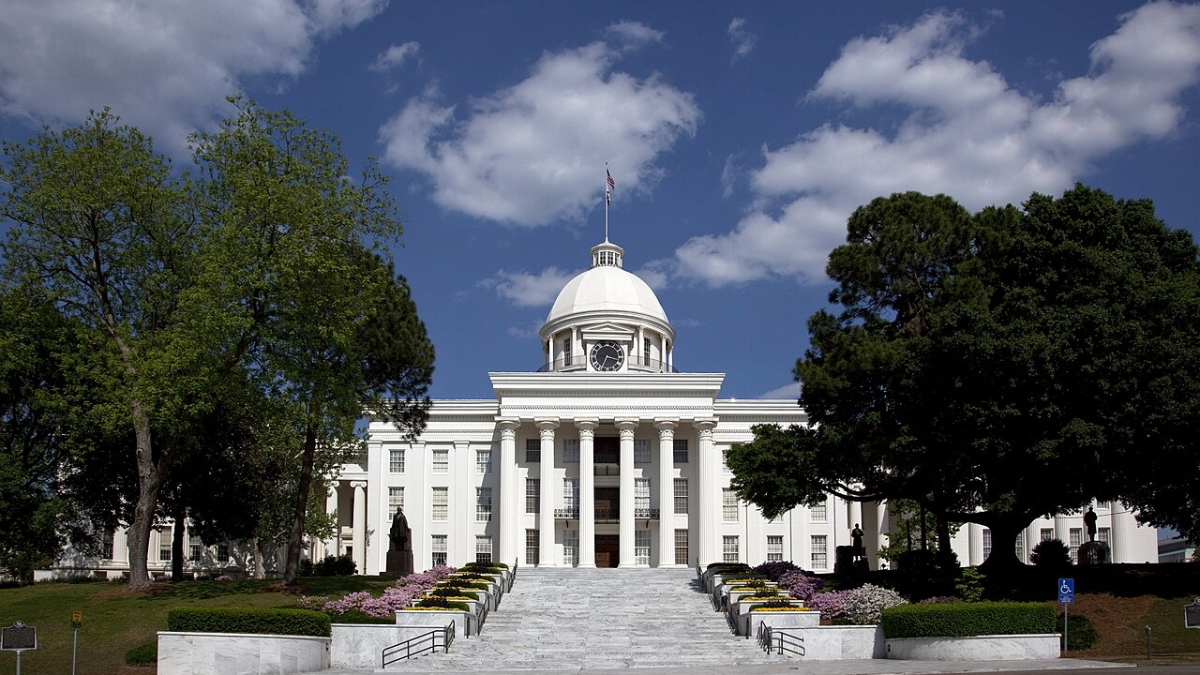
Capitol Building, Montgomery, Alabama. Photo from the Carol M. Highsmith Archive collection at the Library of Congress via Wikimedia Commons.
Amid efforts by the Trump administration and federal lawmakers to stop or limit states from enacting new AI legislation, as of July 1, more than half of US states have together enacted more than 100 new AI laws this term.
Every December, the Center on Technology Policy at NYU publishes a summary of what states did that year in AI and other areas of technology policy. But by July, most states have concluded their legislative sessions, allowing an initial look into the overall trajectory of the year. Below, I offer eight observations on the scope of state AI legislation so far in 2026.
1. States continue to actively pursue AI regulation across topics, despite continued efforts by the Trump Administration and federal lawmakers to limit state AI policymaking.
By our count, as of July 1, states have enacted 109 AI and 28 data center laws. This is slightly behind the pace of last year, when by the same date states had enacted 121 AI and 27 data center laws (by the end of 2025, states enacted 159 AI and 37 data center laws).
This activity has come despite a continued effort by federal officials to stop or limit state AI legislation. In 2025, a group of Republican senators proposed a moratorium on state AI laws as part of budget reconciliation. Although the Senate ultimately rejected that proposal, related preemption efforts continued to appear in other forms. In December, 2025, President Trump issued an executive order creating a new AI Litigation Task Force charged with challenging state AI laws that were not “minimally burdensome.” The order also directed the Department of Commerce to explore withholding federal broadband funding—known as BEAD—for states that enact "onerous" state AI laws.
2. Federal preemption efforts may have limited the number of states enacting AI regulation, even if they have not dramatically reduced the total number of enacted AI laws.
So far in 2026, 29 states have enacted AI legislation. Last year, 39 states had done so by this point in the year, and in total 46 enacted AI laws by the end of the year. Of the 21 that have not yet enacted AI laws this year, 10 still have ongoing legislative sessions. Some of these states, including California, are widely expected to enact AI laws before the end of the year. Even still, it appears fewer states are on track to enact AI laws in 2026.
That said, the states that have not yet enacted AI laws do not look obviously different from those that have. About 61% of states with Republican trifectas and 69% of those with Democrat trifectas have enacted AI legislation. As of July 1, the average state that has enacted AI laws has $742.2 million in BEAD funding, while the average state that hasn't has $920.9 million in BEAD funding. Once California enacts an AI law, as it is widely expected to do, those averages will be much closer: $873.7 million for states with AI laws and vs $779.6 million for states without them. While federal pressure may have affected the overall legislative environment, we can not yet see a simple partisan or BEAD-driven pattern as to which states are most impacted.
3. Federal preemption efforts may have influenced the substance of state AI laws.
The AI and data center laws enacted in 2026 look notably different than those enacted in 2025. While there is always some year-to-year variation, there is reason to believe that federal preemption efforts helped shape the types of laws states enacted in 2026.
Specifically, at least two distinct trends are emerging: more cross-partisan alignment on AI legislation, and a shift across states toward child safety, data centers, and consumer protection.
Trump’s December Executive Order identified several categories of state AI laws that the federal government should not preempt, including state regulation addressing child safety or “AI compute and data center infrastructure.” So far, there has been substantial state legislative activity in both areas. Both topics would have likely attracted significant attention regardless of the EO. But by signaling that these categories were less likely to be targeted by federal regulators, the EO may have moderated the chilling effect that the EO may have otherwise had.
4. Compared to last year, there is more cross-partisan alignment on AI regulation.
From 2025 to 2026, there was no meaningful difference in the share of AI laws with a bipartisan mix of sponsors. In 2025, 32% of enacted AI laws had sponsors from both parties; in 2026, it is 31%. (Those percentages drop to 11% and 7% respectively when looking only at primary sponsors.) But, while there has not been more bipartisan legislation, we do see lawmakers in both parties increasingly addressing a similar set of topics. In other words, while some AI issues remain largely Republican or Democrat-led, there is a growing set of topics attracting cross-party interest.
For example, in 2025, two Democrat-controlled states, California and New York, enacted companion chatbot bills. This year, six states with Democrat trifectas and eight states with Republican trifectas enacted companion-chatbot or similar laws. A similar pattern is appearing in laws addressing AI and mental health, professional licensing, and nonconsensual intimate imagery.
5. Companion chatbots regulation has become a major initiative for both Republicans and Democrats.
As our last annual state technology policy report predicted, AI companion chatbots were the most active area of state AI regulation in 2026. State legislators introduced more than 100 bills and enacted 14. There are notable differences across these new laws, but most build on the two laws enacted in California and New York in 2025. These laws require operators to include warnings that chatbots are not human and to address certain risks, including sexual content involving minors and self-harm.
Despite these commonalities, there are significant debates over several other provisions. Most notably, there has been a partisan split over age verification and parental supervision, with Republican-supported bills more likely to include stronger age verification and parental-oversight requirements.
One bill that remains under consideration in California would extend last year's companion chatbot law by requiring pre-deployment risk assessments. If enacted, it would represent a significant extension of the scope of companion chatbot legislation.
6. For the first time, both Republican and Democratic-led states enacted laws imposing more restrictions, oversight, or requirements on data centers.
For the last 15 years, state data center legislation has done little beyond granting data centers tax incentives. This began to change last year, with a handful of new laws that created new rate classes or instituted permitting preform. So far this year, state legislators have already enacted 28 laws, many of which grant states more control of data center development and operation. Broadly, these laws fall into four categories:
- Protecting ratepayers from energy cost increases. In addition to a handful of laws creating new rate classes for data centers or large load customers, several states enacted broader legislation to protect ratepayers from price increases. For example, Oklahoma legislators enacted the Data Center Customer Ratepayer Protection Act of 2026, which requires electric companies to create new large load tariffs designed to ensure that large-load customers reimburse utilities for any costs “fairly allocated to them,” including “costs incurred to directly serve the customer that may remain unrecovered if the customer departs the system or materially reduces load.”
- Establishing new oversight, audits, or disclosures. After several bills requiring new energy or water use audits failed last year, legislators enacted several new requirements this year. Notably, these are not limited to Democrat-led states. Alabama created a large load contract review process by the Public Service Commission. Legislators in Idaho limited the sources from which data centers could purchase water for cooling.
- Rolling back tax incentives. At least two states amended their tax laws to end or limit previously granted tax breaks for data centers. Washington legislators removed a tax exemption for data center replacement equipment. Maine legislators excluded data centers from a Business equipment tax exemption.
- Enacting moratoria. Dozens of cities across the country have now enacted temporary pauses in data center development; a handful have instituted full permanent bans. States lawmakers have begun considering similar moratoria. Legislators in two states passed moratorium bills: Maine's was vetoed, while New York’s is currently awaiting action Gov. Kathy Hochul.
7. Both Republican and Democratic-led states prioritized new AI-related consumer protection laws.
States have long overseen consumer protection. While legislators have shown consistent interest in AI related-consumer protections in the past several years, they redoubled those efforts in 2026. Over the last six months, both Republican and Democratic-led states have enacted new consumer protection laws, ranging from rules governing professional licensing, to restrictions on AI use by insurers, to new limits on dynamic pricing, to new consumer disclosure requirements.
For example, states enacted at least six new laws restricting the use of AI by health insurers, including both Republican lead states, such as Iowa, and Democratic led states, such as Washington. Similarly, several states enacted laws limiting or regulating AI-enabled dynamic pricing, including Democrat controlled Connecticut and Republican controlled Nebraska.
This year has seen the near total collapse of broad algorithmic discrimination protection. Most notably, after years of debate, Colorado legislators revised the broad algorithmic discrimination bills enacted in 2024, significantly scaling back its scope. But despite this, 2026 still saw the expansion of consumer protection provisions more generally.
8. Blue states are slowly advancing frontier model regulation.
The regulation of frontier models has been at the forefront of both state and federal policy debates for several years. While the Trump administration has consistently opposed state-level frontier regulation, it has recently restricted or delayed the release of cutting-edge models on national-security grounds.
In 2025, California and New York enacted laws requiring developers of frontier models to adopt safety frameworks, assess critical risks, and report critical safety incidents to regulators. A handful of states introduced similar bills in 2026. However, only one state is poised to enact a law. Illinois legislators recently passed a frontier model safety bill that adds a requirement that covered companies arrange yearly audits of frontier models by third-parties.
Connecticut legislators enacted one narrow provision from the New York/California model: whistleblower protections for employees of frontier model developers. Connecticut legislators did not, however, enact requirements that frontier developers conduct risk assessments, report critical incidents, or undergo third-party audits.
***
Although most states have already finished their legislative sessions and the midterms will pull attention away from policymaking, there remains much to watch. Massachusetts, California, and New Jersey legislators are all considering proposals that would represent significant developments in frontier or chatbot regulation. Successful federal legislation on child online safety or frontier models would strongly disrupt recent state regulation—especially if new laws include either strong preemption or broad moratoriums on state action. Trump’s Executive Order from last December has also injected uncertainty in how the federal government may respond to state AI legislation. How the administration chooses to respond will shape legislation in the back half of the year, and it may also shape state AI policymaking moving forward.
Authors