Freedom House Charts 'Seismic Shifts' on the Global Internet
Justin Hendrix / Nov 8, 2026Audio of this conversation is available via your favorite podcast service.
Each year, Tech Policy Press makes it a priority to cover the findings of the annual Freedom on the Net report from Freedom House, a nonprofit organization founded in 1941 to advance democracy and human rights.
This year, I was invited to moderate a panel discussion at an event to mark the launch of the report. This episode features audio from that Oct. 22 event, with experts including:
- Kian Vesteinsson, deputy director of research at Freedom House and Freedom on the Net author;
- Jennifer Brody, deputy director of policy and advocacy for Technology and Democracy at Freedom House;
- Callum Voge, director of governmental affairs and advocacy at the Internet Society;
- Mahsa Alimardani, digital rights researcher and advocate; and
- David Peterson, general manager of Proton VPN at Proton.
What follows is a lightly edited transcript.
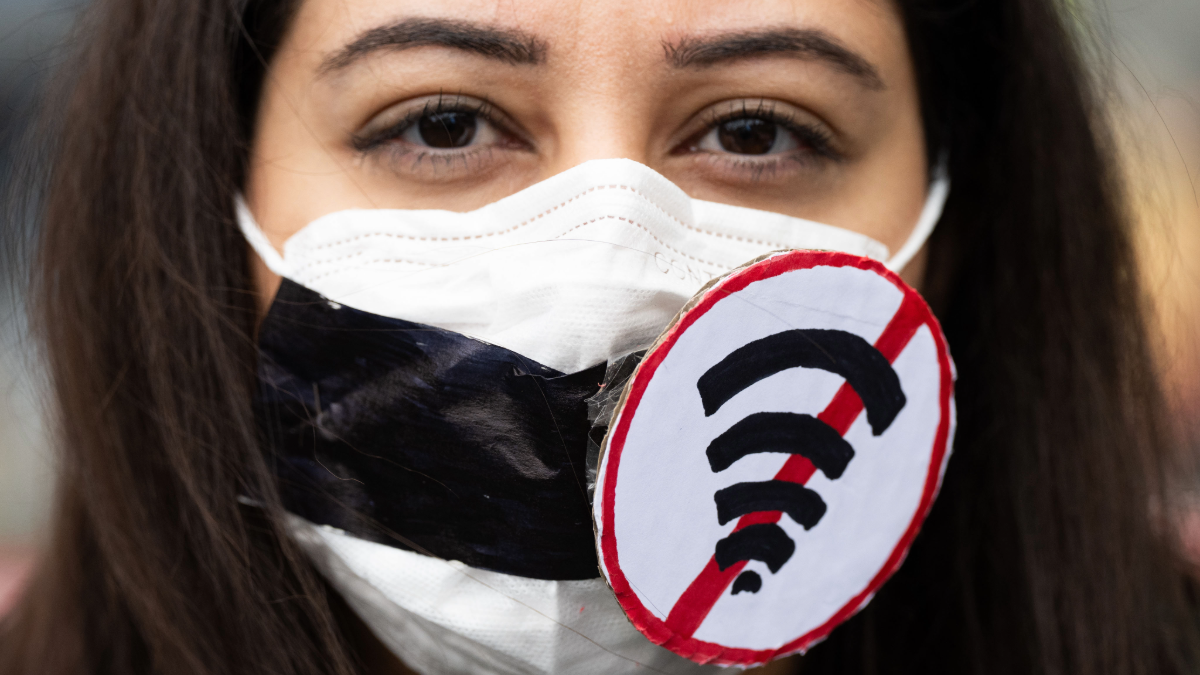
A woman wears a mask with a Wi-Fi symbol as a protest against internet censorship in Iran. Several hundred people demonstrated in Frankfurt, Germany on Rathenauplatz on May 16, 2026, demanding an end to the Islamic regime in Iran on placards and in chants. (Photo by Boris Roessler/picture-alliance/dpa/AP Images)
Justin Hendrix:
Good morning. I'm Justin Hendrix, editor of Tech Policy Press. We publish news analysis and perspectives on issues at the intersection of tech and democracy. Since we got started at Tech Policy Press, we've made it a priority every year to cover the findings of the annual Freedom on the Net Report from Freedom House. Freedom House is a nonprofit organization founded in 1941 to advance democracy and human rights. This year, I was invited to moderate a discussion at a virtual event timed with reports launch. Before the panel, Freedom House's Kian Vesteinsson, one of the key authors of Freedom on the Net, gave a presentation on how the research works and what it found.
Kian Vesteinsson:
This year, we analyzed internet freedom in 38 countries, which covers about 71% of the world's internet users. For each country, we assess how easily people can access the internet, whether the internet is censored, and how fundamental rights like free expression and privacy are restricted or protected. We are examining the real world experiences of people in a given country.
Justin Hendrix:
The coverage period for the report ran from June 2025 through May 2026. 16 years of decline is now the report's defining statistic, and this year the steepest fall was in Iran.
Kian Vesteinsson:
Iran's significant decline in this year's index was driven by brutal repression of the Iranian people and government restrictions on the internet. In February, Iranian authorities initiated a nationwide internet shutdown as the United States and Israel launched military strikes. For 88 days, the majority of Iran's population was prevented from accessing the internet even as missiles dropped across the country. Iran's blackout marked the longest nationwide internet shutdown in Freedom on the Net's history. As in Iran, many of these long-term restrictions were imposed during times of war or during brutal government crackdowns. Also, like in Iran, these shutdowns left people unable to access life-saving medical information to check on their families and to stay safe during crises.
Justin Hendrix:
In the report, Freedom House connects the situation in Iran to a broader phenomenon also seen in Russia. Both Tehran and Moscow spent the year building out domestic alternatives to the global internet and using shutdowns to push people onto them. In Russia, that meant a whitelist of state-backed sites that would stay online during an outage, including a new state-friendly messaging app called Max, which the report says is loaded with surveillance features. Both governments went after VPNs, which people use to get around the controls.
Kian Vesteinsson:
Policymakers in 10 of the 38 countries covered this year have proposed, passed or implemented age assurance laws for social media platforms or for other non-pornographic online content. I'll explain what this means in practice. Age assurance laws require companies to implement measures to estimate or verify a person's self-described age. A social media user might be asked to submit a scan of their face or a photo of a government issued ID card in order to confirm that they are above a certain age or a platform might analyze previously collected data for behavioral signals that indicate someone's age. The key thing here is that all of the techniques that are ready for market right now involve processing sensitive information or rely on previous mass data collection. That means that they carry privacy and security risks for all of the people who use them, both adults and kids.
Justin Hendrix:
There are two examples from the report. One is Australia's under-16 ban, which took effect in December, the first of its kind. As we've reported in Tech Policy Press, the early evidence of its efficacy is mixed. Officials say about 5 million accounts have been deleted, but surveys also suggest teenagers are getting around it at significant rates. And then there's Turkey.
Kian Vesteinsson:
Turkey's parliament passed an under-15 social media ban that required verification solely through a government-run digital identity system. This approach effectively ties all social media accounts to people's real names, presenting a real risk of abuse. Internet users in Turkey are routinely arrested and imprisoned over their online expression, particularly criticism of President Erdogan. The speedy adoption of age assurance social media bans represents the most significant live experiment in internet regulation in years.
Justin Hendrix:
The report isn't all bad news. The strongest improvement this year was Bangladesh, which saw its first year with no internet shutdown since 2016. Under the interim government that took power after a mass uprising ousted former Prime Minister Sheikh Hasina in August 2024. Freedom House also found that those same authorities sometimes reached for the former government's tactics going after real or perceived support for Hasina's Awami League. Kian noted that political transitions can produce short-term gains for internet freedom, but long-term change takes sustained and principled investment in a country's democratic institutions.
That's where his colleague Jennifer Brody picked up with what Freedom House thinks governments and companies should actually do.
Jennifer Brody:
There is a lot that can be done and it is critical that democracies, tech companies, and civil society come together to stand up for human rights in the digital age.
Justin Hendrix:
Drawing from the report, she recommended countering shutdowns through transparency from internet service providers and a willingness to challenge unlawful orders, expanding satellite internet so no government can impose a total blackout, funding the tools people use to get around censorship paired with digital security training, pushing back on surveillance, including mandates that would force VPN providers to log what their users do, protecting kids through platform design rather than identity checks, and by developing recommendation systems that don't push harmful content at them and putting internet freedom at the center of decisions about AI rather than bolting it on later. All of these recommendations and more are in the report at freedomonthenet.org. The panel discussion came next and I invited the panelists to both dig a little deeper into some of the findings and to offer their own perspectives on these issues. Let's get to it. So I'm joined by an excellent panel this morning.
I've got Mahsa Alimardani, a digital rights researcher and advocate, Callum Voge is director of government affairs and advocacy at the Internet Society, and David Peterson who is general manager of Proton, Proton VPN. And so I'm grateful to each of you for coming today. I kind of want to just start really with first reflections, the things that most stood out to each of you. Kian walked us through a year in what the report terms seismic shifts. If you were to kind of grasp onto one of those seismic shifts, which one would it be? What's the thing that stands out to you most? And I think perhaps Callum, I'll start with you on that question.
Callum Voge:
Yeah, sure. Thank you, Justin. Maybe first I want to thank Freedom House. Freedom House has been a long time partner of the Internet Society. We work very closely on internet measurement issues. So if you visit the Internet Society Pulse platform, you'll see that Freedom House's qualitative information data is combined with our quantitative data from the Internet Society. We also work very closely on policy on issues like encryption, surveillance, content blocking, VPN restrictions, and so on. So yeah, very appreciative to Freedom House. And as you were saying, Justin, this report really matters. It's very important for our field and is a bedrock of everything that we do. Very quickly for those maybe who don't know the Internet Society, we're a nonprofit established 1992 by the early internet pioneers. We led the technical development of the internet. We advocate for open, globally connected, secure and trustworthy internet.
And I think maybe something that makes us unique is our global community of over 180,000 volunteers around the world. But enough about us, you were asking what really stood out the most this year in the report. I think there were a lot of insightful findings. I noted the 16th consecutive year of decline of global internet freedom, the centralization of internet infrastructure and how that centralization has been applied for things like internet shutdowns, but also particularly interesting the pressure on otherwise established democracies such as the US, Australia, Hungary, and the dips that they've seen in their ranking. But I think the point that really spoke to me and something connected to the work that we're doing at the Internet Society is the introduction of mandated age checks in many different jurisdictions. The way that we're seeing it is that online safety really is the buzzword in most policy circles around the world right now.
This isn't about one particular legislative approach. It's quite broad and the debate kind of circles around the question of how do we build a safer, more secure, more trustworthy digital environment for everyone that will touch on topics such as consumer protection, platform governance, internal security, cybersecurity, law enforcement cooperation. And I think encryption really does remain at the heart of this debate. You have established democracies using the online safety framing and child protection as justifications for undermining encryption. You have the UK Online Safety Act that compels on-device scanning capabilities to circumvent end-to-end encryption. You have the EU child sexual abuse regulation, which many have nicknamed chat control, which similarly pushed for mandated scanning. It looks like it's not going in that direction in the end. That's only thanks to a huge pushback from civil society and the European public. But meanwhile in Canada, you still have the C-22 Lawful Access Act.
That's a live debate on encryption. And again, it circles back to lawful access for the authorities. But what we're seeing now, especially with this report, is that the debate has expanded. It's now talking about platform governance, it's talking about children's access, and we see that there are upcoming rules on how platforms can or cannot be designed. An example of this is the EU Digital Fairness Act that should be coming out next month or maybe the month after. We see the rollout of age assurance solutions, so companies offering products to check IDs, to check people's age, and you also have a cultural phenomenon. So there was the NYU professor, Jonathan Haidt, who had the 2024 bestselling book, The Anxious Generation, that book proposed under-16 age ban, and that has really been latched onto in the public imagination, but also by policymakers at this point. So the result is what we see, which is mentioned in the report, countries like Australia, Indonesia, or most recently the EU with the Kids Act looking at how age assurance can be implemented.
These are really big topics, big questions. How can government improve online safety without compromising the technologies that keep people, businesses, and public institutions secure? That's going to touch on cybersecurity, secure digital infrastructure resilience, open and global internet, and also an impact on fundamental rights. And of course, as the internet society, we do have some thoughts on that. Maybe to start with the problem, it is a real one, this action of age bans, it does resonate with parents and adults because they do see that children and people in general are tied to their devices more than ever before. So there is a kind of consensus that something should be done when it comes to online safety. The interesting detail is that in the public, we see at the implementation phase that actually most people favor safety by design or even education and digital literacy as better options than social media bans.
And so that kind of explains a really interesting phenomenon where you have about a third of the countries in the world are considering social media bans, but only seven countries so far have implemented it. We've even seen some countries ruling out social media bans and opposing it, Estonia, Mexico, and South Africa saying they won't do it. So this discrepancy between the number of countries talking about doing it and actually doing it, the reason for it is pretty simple. Age assurance is a political win, but it's a privacy danger and that's really hard for governments to navigate. There's kind of two reasons for that. I think one is the technical aspect, not effective. We heard in Australia, high percentage of children circumventing this ban. It's about VPNs. We'll maybe hear from our colleague David in a minute about VPNs as well, but it's discussed very often by policymakers as a circumvention of age assurance, yet we only see that about 7% of children in Australia are using VPNs, 5% of children in the UK.
There's easier ways to circumvent taking your parents' ID from the wallet or making an AI avatar that seems to also do the trick in the UK. There's also the issue of data breaches, 70,000 IDs leaked in the UK through a third party provider, but also with the EU's new age assurance app, a researcher found vulnerabilities within a few hours of the prototype being launched. So this is a data security aspect. And a final point I'll make, there's also of course legal aspects when it comes to children's rights, freedom of expression, privacy protections. Those ongoing lawsuits in Australia are pretty good evidence of the challenges that will come. So yeah, just to conclude the thoughts on this topic, social media bans probably very easy to explain and politically attractive as a policy tool, but the implementation is the difficult part and the controversial part. That's why we are slowly seeing this global trend towards more safety by design with governments trying to address the root problem more, which is focus on accountability and incentives for safer online platforms.
Justin Hendrix:
Callum, thank you for that tour of the ideas. I will come to David next since you referenced him in your remarks, but David, what did Callum leave untouched that you might like to point out?
David Peterson:
Callum was very, very comprehensive. I think one of the things that struck me the most in the report, and it aligns very much with what we are seeing ourselves, is the internet being squeezed from two directions at the same time. We have the authoritarian governments, the usual suspects moving from just blocking content to blocking access altogether, switching off the network, allow listing certain things, rolling out technologies that in some cases they've developed themselves, and in other cases they have leased or franchised from other countries to be blocking access to the internet and the people using it, particularly during times of political sensitivity. Meanwhile, from the other direction, we've got the more democratic countries that are putting ID checkpoints in front of ordinary platforms. I mean, it comes under the name of age verification, age assurance, protecting children online, but ultimately it's the adults who are being asked to provide ID, which then goes to places that people are uncertain about and what is being done with this.
Either way, it becomes internet access and access to these vital communication tools becomes a permission rather than and this is a problem we're seeing in what was previously unexpected places. One of the things that we track because Proton VPN offers a free service globally, we were able to see very quickly when there's a big spike in signups and activity. And one of the things we're seeing in 2025 and also in 2026, an emerging direction there as you reference in your report is that it's countries that weren't previously on the radar so much. We've got European countries, we've got Australia and so forth where we're seeing spikes in uptake around concerns about privacy. We're seeing pressure. We've had pressure in the past from authoritarian governments saying, "Oh, we need you to restrict access to VPNs. Oh, we want you to record people's details. We want you to log." We are now seeing some of those type of requests coming in from, or at least being discussed once again in these more democratic countries as well, something that we fiercely oppose and are totally aligned with Freedom House on this.
We're very much of a view that the best way from a security perspective, the best way to protect user information is simply not to collect it in the first place. It doesn't matter how many layers of protection you put on things. Inevitably, there is some sort of leak and where if you don't collect it in the first place, you don't need to worry about that sort of protection.
Justin Hendrix:
Thank you, David. And Mahsa, come to you for your general reactions, your first thoughts.
Mahsa Alimardani:
Yeah, thank you. And thank you to Freedom House for such a comprehensive report and to my fellow panelists who hit the nail on the head on so many of the points I guess that we in the community agreed to. Generally, the impression I had was in terms of a lot of the declines, it highlights how there are real harms that we face in terms of the threat of synthetic content really deteriorating our ability to know the truth, the threats and harm that exist for children online, but how quickly this can erode into policies that can be taken advantage of by authoritarian regimes and this real need to have an imagination and seek out ways to really try to reduce these types of harms without compromising our privacy, without giving a government the go ahead to create laws for synthetic media that end up being take down or censorship laws in essence.
So having this ability to come holistically with a lot of the great points my fellow panelists made about being privacy preserving and trying to seek out these sorts of remedies is really needed. But of course, the point that I also have been spending a lot of time thinking about, of course, has been this horrific decline that we've seen for the past 16 years that Freedom on the Net has been reporting in terms of things like internet shutdowns just becoming worse and we're having records being broken every year. And unfortunately, as Kian did a really great job of illustrating that we saw the record in Iran being broken by the longest nationwide internet shutdown that went on for 88 days in Iran. And of course, we had two rounds of internet shutdowns in Iran. And what this really calls, and I was so happy to see the recommendations that Jen was outlining of really trying to have, again, having an imagination about trying to tackle these problems and really trying to imagine after 16 years of many of us working in this field and talking about these same problems, really trying to seek out solutions where we can see a wholesale kind of change.
And of course, one of the things, and I guess one of the problems of seeing some of the worst case scenarios of what happens online on the internet in the situation of a context like Iran is, it can also help us see some of the possibilities. And of course, there've been a lot of us who are trying to see is there a way to imagine a new way of access through what we see emerging with the possibilities of satellite internet and thinking of ways of both working with the private sector, within governments, with governments to see if we can really shape and design a new emerging way of connectivity, whether it is through direct-to-cell, having this way of scaling access to satellite internet in which a state can't really control or shut down the internet. And so really, again, this is the overall theme that I see with the decline of freedoms online.
Can we really imagine ways of tackling these harms outside of the box, outside of the tools and things that we seem to be turning to over these years?
Justin Hendrix:
Thank you for that, Mahsa. I want to stick with you for just a moment and maybe just press a little more into Iran. You've been writing about that, including on Tech Policy Press, for which we're grateful. The report characterizes this year as including this further reconfiguration of the Iranian internet into this two-tiered system. What more can you tell us about what's happening in Iran, perhaps in response to the report or perhaps going beyond it?
Mahsa Alimardani:
Yeah, I mean, during the internet shutdown, those who were sharing state propaganda, we saw AI Lego videos kind of going viral, and this was kind of a state-affiliated media producer who was getting access to tiered internet to provide and further the state narrative during the war. The tiered access really was A, for the privilege associated with the regime. Of course, there's a lot of corruption in Iran. Those who could pay inordinate amount of fees to buy access to this were also getting. Of course, this is in the context of massive economic decline where you do speak to certain people in Iran who do choose to cut away from the budget of food and nutrition to get access to the internet. Creating the system of tiered access is really about making it much harder to access the free internet. And of course, a lot of arguments were made by those associated with the state in Iran that you had a lot of Iranians connecting to a national internet.
I just want to put forward my position, which is I believe the internet starts with a capital I. There's only one internet and it's the global internet and a national internet is not connecting to any sort of internet, it's connecting to a nationally controlled space.
I know this is all covered very comprehensively in the Freedom House report.
Justin Hendrix:
Thank you. I want to stick with the focus on satellites for a moment and ask David Callum if they have anything to add on that front, this idea of satellites being a lifeline. We also, of course, are seeing the geopolitics of low earth orbit play out in many ways, certainly in the Ukraine conflict and some of the recent events that we've seen there. But David Callum, this report also includes, I think for the first time, policy recommendations around satellite connectivity. Anything you'd want to add on that front?
Callum Voge:
Yeah, it's a really interesting topic. I think as was discussed, this is an additional option, creating redundancies, creating backups, that's all very positive. I have done some research in the past year of satellite internet in Kazakhstan, and that has a big question of actually internet censorship because when the satellite companies first entered the market, they were very attractive to users because they were access to the capital I internet as it was discussed. But through political pressure, a lot of those companies were forced to have ground stations in the country so that filtering and surveillance could be added to the satellite internet service. So I think yes, adding redundancies, but those types of governance issues can still exist. Justin, you also hinted towards the geopolitics of this. That's also the physical space of the satellites, how they're decommissioned. I would mention here that China has a very strong satellite internet strategy.
They see this as a place to be first movers and that there would be a first mover advantage. So yeah, we can expect, let's say, strong politicization of this technology.
Justin Hendrix:
Great. I think I'll maybe move the conversation to another big point that been brought up by you as well as David around age assurance. We've been tracking this at Tech Policy Press. I think on our global age restriction tracker, we're up to something like more than 60 countries that have entertained, implemented, passed, across the board, some form of age restriction, a lot of countries where it is in discussion at the policy level or in legislatures. Is there a path towards being able to do age restriction, age assurance in a privacy protecting way? I know we've addressed this a bit, but I just want to dig into it a little bit more. David, Callum, Mahsa, I don't know which of you would like to start off on that, but is there a path to being able to do this and what has to happen next?
David Peterson:
What we've seen has been, in a lot of cases, stuff done in a hurry because there's been a need for compliance and people grabbing, in some cases, the first available vendor who promises to satisfy that need. And in some cases, things look like they are, at least on their face, reasonably privacy respecting. There's, "Okay, take one look at this face, and I am probably over 18 and it's not going to ask me for ID." That might be less controversial than the ones who have gone back for the more strict age verification of, "Oh, we need to see a government ID for this." Where that has a big problem for an international platform, of course, is I don't know what an Iranian driver's license looks like. So how do I validate that? What do I check it against? And if I am checking against some central database, particularly in a more restrictive country, am I giving a heads-up to that regime of, oh, someone wants to register for a VPN or this person's registered for this social media account, is of course a grave concern.
So whatever it is needs to be able to assure age with reasonable confidence while not calling back to either unavailable, therefore excluding people altogether or politically sensitive databases and not recording things. A lot of what's going on behind the scenes is quite murky. Even when we've had companies claim, oh, we absolutely do not retain any of your data, a few months later, there it all is out of the internet.
These bodies need to be transparent, trusted, and once again, what I was pitching previously as a mantra that should be followed, the best way to protect user data is not to collect it in the first place. Should this be the responsibility of individual platforms doing it in an individual way or in the case of, I mean, if we're talking age verification that is perhaps more sensitive on mobile devices than on large format desktop computers, should that be perhaps more built into the platform where that information already exists? As the phone is set up, can we give parents better control and decision making? Parental control software has been around since I think 1995, 10 years longer than VPNs have. I mean, it is old technology, it's been around for a long time, but it is complicated and people have a tendency not to use it. So there needs to be something that is no more complex than a toaster if it is going to be used by not just tech enthusiasts, but by a typical member of a household who's setting it up for their kids and is worried about it.
Justin Hendrix:
Mahsa, Callum, anything quickly to add on this before we move on to the other topic of the day, AI, AI agents, AI-generated content?
Callum Voge:
I can chime in quickly. I think first the question is, do we need it? Do we want it? We're creating an infrastructure that could be abused for different purposes, the risk of scope creep. But putting that question aside for a moment, can it be done safely? There's the privacy security aspect. In the UK, we see it's outsourced to third parties. There's been a lot of scandals there with not good data practices. The EU approach may be a little bit more promising because the government is taking responsibility for creating an app. It should be open source. It should be vetted by researchers. It's then implemented by member states. We need more details how they're going to do this. They're talking about creating a token that's double blind, so services only know if you're under a threshold of age. Our question is, how are you creating that token in a privacy preserving way?
How are you making sure that tracking is not happening across platforms? So a lot of questions still to be answered, but at least the government is taking accountability for what they're producing. The accessibility issue that David raised, big question, what about people who don't have new technology? They have old tech people who are traveling across borders. Then finally, the competition, you're creating systems. What if it cements the dominance of certain players? Is that something that policymakers want? In many cases, their answer would be no, but they might accidentally create this market condition. So yeah, that's it for me.
Justin Hendrix:
Mahsa, I'll ask you to pick up on this question around AI. There's, I think, a mention of AI agents in the report, of course, and the ways that those are increasingly changing the internet. It feels like the story of the year, I'm sure it'll be a major focus in next year's report, but you've been working on various things to do with synthetic media and AI and its interaction with the information ecosystem for quite some time. Anything you want to dig into a little more there?
Mahsa Alimardani:
Well, I think what we see from the report is that there are some narrow AI rules emerging, and we've seen very similar theme to what we have been seeing with child safety, the kind of slippery slope that there is as you can veer into authoritarian creep or various different harms. And so what we really do need is having privacy preserving standards that can be internationally adopted. And of course, in my work leading some of the tech initiatives at the organization WITNESS, for example, we have been spending a lot of time trying to develop, for example, provenance standards that are both privacy preserving and trying to really break the dichotomy that you can't have privacy and transparency at the same time. And of course, with some of the legislation that we've seen emerge, like the Indian legislation, for example, a little bit kind of sloppily adopted, tacked onto existing information rules that they had, not really paying attention to these types of standards.
And of course, we have a lot of labeling rules and provenance rules. China has some of the most robust AI transparency legislation, and their provenance rules are not privacy preserving. They do attach identity and this ability to prosecute people for the type of content they're sharing. Very similar kind of, I would even say to some of the child safety legislation that we saw. For example, in Turkey, their child safety legislation essentially gives them a way to register people's identities in this effort to understand age. And attaching identity to social media accounts is basically a gift to any regime that wants to control and persecute expression. And of course, this is a very similar trend that we see with some of these efforts for AI transparency in the wrong hands. And then there was a really great example that this report laid out was we do also have a very real problem with AI of impersonation.
People's likeness being abused and some of the worst harms from AI comes from women's likeness being abused for AI generated nudes. This is one of the biggest harms along with child sexual abuse materials that we see online. And of course we saw in Mexico a law to stop this kind of impersonation used like the liar's dividend, the concept that we have within the AI disinformation field, which is when a bad actor wants to use the accusation of AI to put away inconvenient truths. And of course in Mexico, we saw this example of journalists being accused of doing AI impersonation of a politician to essentially be able to persecute journalists trying to do their jobs. And of course, again, that's the liar's dividend with handcuffs has the backing of legal infrastructure. So getting it right is quite difficult. It takes a lot of thoughtfulness and time and ensuring that we do have these international standards that can be upheld in all of these different contexts is very important.
And we do have different kind of instances where we're trying to see, for example, California has a very comprehensive AI transparency regulation that's slowly being implemented in different phases. Of course, you have the EU AI Act's AI transparency component, which came into force in August as well. Again, not fully robust, but some of the first kind of initiatives as well that are trying to get this right balance. And of course it's quite hard because you have company interests not really wanting these spaces to be fully regulated, not wanting to really invest a lot of resources, but I think it's an effort worth pursuing.
Justin Hendrix:
There is a question in the Q&A from a listener that asks about gendered risks on the net, technology facilitated gender-based violence, political violence targeting women, deepfake sexual imagery. You've just spoken to that a bit. I think this is something that we'll maybe point you to the report on. I'll also point you to some of the other work from Mahsa and her colleagues on this question. I will maybe just with a few minutes we have left, I just want to ask around AI agents in particular. Callum, on the agents question, I'm sure internet society is thinking about the ways that agents are changing the internet and challenging the architecture of the web and challenging information integrity. This is a recommendation in the report that we need to think about policy around AI agents from a human rights perspective. What else might you add on the AI agents front?
Callum Voge:
For the AI agents, I mean this is a very important topic, something the internet society's looking at very closely. Some of our early thoughts, like any technology, there needs to be a level of accountability when it comes to how this new technology is used. Our concern is if or how stakeholders actually have a voice in shaping standards and regulation when it comes to the use of these new technologies, we're not sure. There's this global feeling that the technology is moving so fast and not all concerns are being heard. So if that's the case, is user choice being respected? Do users have control over how their data is used, how they use the AI agents, and do they have transparency about its use? So I think for us, really key is making sure that this is a truly multi-stakeholder debate, that regulation is multi-stakeholder, that standards are multi-stakeholder.
We don't want it captured by any one actor. So that's always really core to our values.
Justin Hendrix:
We just have a few minutes left and I want to basically give each of you an opportunity to focus on some positive aspect of this report. And I don't mean to do so in a way that diminishes the degree of concern that everyone should have here about the top line trends and some of these very serious issues, but there are some points of light in it. There are some good stories, some things moving in the right direction. I'd like to give each of you an opportunity to maybe pick out one of those things or perhaps to introduce a new one into the conversation, something that gives you a bit of a hope that we can move things in the right direction here. But David, perhaps I'll start with you on that.
David Peterson:
Not really into specifics, but looking at trends, the 16 countries moving backwards and the number of years of year-on-year downturn paints a grim picture. But the ray of light that I saw was the eight countries that it improved. So not everyone is going on a downwards trajectory. Some are recovering. And I think those are examples that should be highlighted, brought forward as these are countries that are turning things around with regards to internet freedom because the internet freedom is not just an abstract concept, it is how people are communicating. Shutdowns and restrictions are impacting not just the way people communicate with each other, how ideas are shared, how the culture becomes richer, but it's also in many cases people's livelihood which is being disrupted. So these positive movements are certainly to be celebrated and hopefully held up as a better example than the countries that are moving in the opposite direction, many of whom would usually hold themselves up as an example that others should follow.
And perhaps this report paints a rather different story.
Justin Hendrix:
That might include the United States. I'll say that for you perhaps, but let me -
David Peterson:
I couldn't comment.
Justin Hendrix:
Point to Callum and then Mahsa, one minute each, something positive.
Callum Voge:
Yeah, I can go ahead. Yeah, I mean, as we discuss, the overall trend is very concerning. There's no sugarcoating. It's a hard year, another hard year for our field of work. But what I'm hopeful for is I think there's more solidarity than what I've seen in the past. There's potential for a really strong global community, a global movement to speak up and really be active on these issues. I think something that maybe five or 10 years ago we might've felt like the nerds in a very niche field. Now all of my friends and family want to talk about the same issues that we discussed today. So I think we do have the potential to really have a global movement with a lot of these topics and I'm hopeful for this.
Justin Hendrix:
And Mahsa?
Mahsa Alimardani:
I mean, I see a lot of hope despite the fact that it has been quite dark, that people are still continuing to connect. You see Iranians who did kind of mobilize and protest a very violent government. They're still coming online. You see Bangladeshis who got their first year without an internet shut down. And of course we see governments are getting much better at closing the net and making things much more dangerous online, but people are still being quite fast at finding gaps of how to make their ways online and make their ways online safely. And I think for those of us who work in this field, our job is to use that energy and help build the systems that make those gaps permanent. And I think there's so many different types of solutions that we talked about today that can help us really imagine better systems of connectivity.
Justin Hendrix:
Well, we end on notes of solidarity and creativity in the face of the authoritarian creep. I think that's a good place for me to once again thank Freedom House, to thank the panelists and to turn it back over to Kian.
Kian Vesteinsson:
Thank you, Justin, for moderating and thank you Callum, David, Mahsa for the really interesting discussion. Really so grateful to you all for making the time to digest the report's findings for all of us today. To the audience, thank you for joining us. Really pleased that you were able to listen in to talk about Internet Freedom and how we can reverse this global decline. We always like to joke that one year we'll be able to share that global internet freedom improved at a launch event like this. It didn't happen this year, but I appreciate the discussants, sharing some ideas about where we can look to make that change in the future. With that, we will close out. Thank you all, and please find more about our research and recommendations at freedomonthenet.org. Thank you.
Authors