The Silent World Cup Winners are the Companies Normalizing Surveillance
Tayrine dos Santos Dias, Leandro Ucciferri / Jul 19, 2026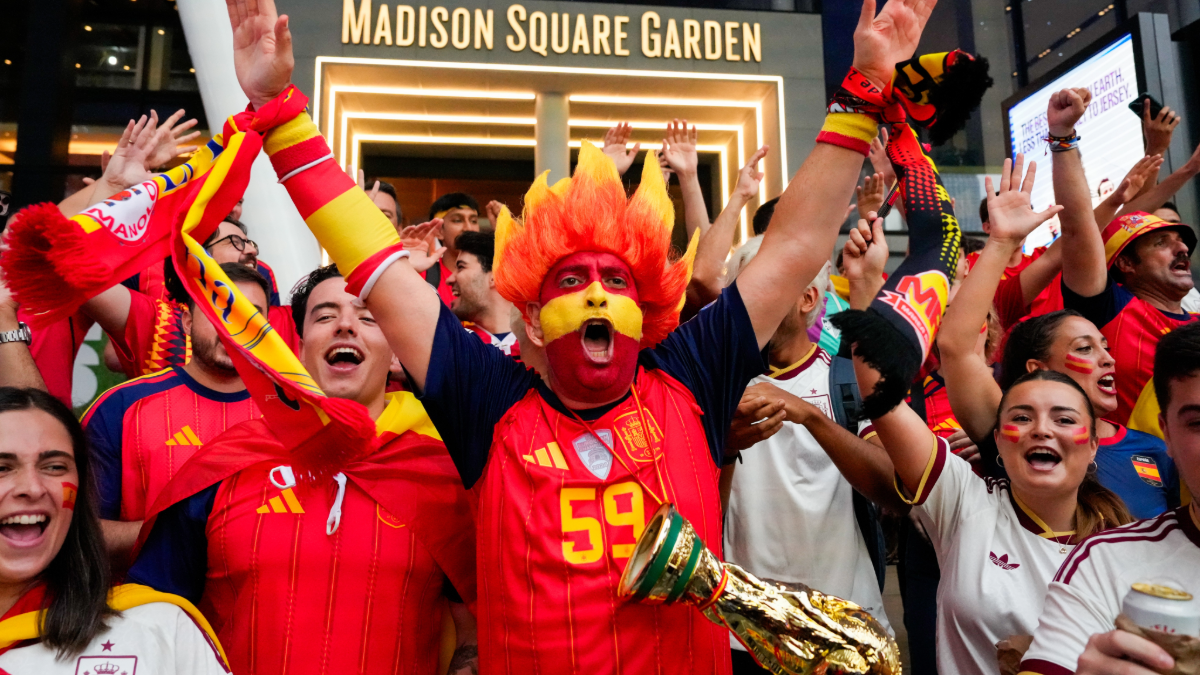
Spain fans gather for a rally on the eve of the World Cup final soccer match in New York's Times Square, Saturday, July 18, 2026 (AP Photo/Yuki Iwamura)
The 2026 World Cup ends this Sunday with a historic match between Argentina and Spain. Which team will secure its place in the history books remains to be seen. But after the stadium lights go out, a different kind of legacy will remain. The US, Mexico, and Canada have built up an ecosystem of surveillance technologies under the justification of ensuring the safety and security of the event. In doing so, they follow in the footsteps of past events like the Men’s World Cup in South Africa, Brazil and Qatar, and the Olympic and Paralympic games in Paris.
This week, Ranking Digital Rights (RDR) released an in-depth investigation into the companies supporting the expansion of surveillance tools and policing capabilities in the 16 host cities of the 2026 World Cup. We found that at least 21 companies helped build or enhance the surveillance structures used to monitor, track, and profile fans, visitors, and locals. These vendors provide products and services that we classify into a five-layer stack: data harvesting at scale, predictive policing, communications interception, data integration and command centers, and aerial surveillance.
What exactly is the “surveillance stack”? We use the framing proposed by New York University law professor Vincent M. Southerland: the surveillance stack is a set of technologies that are used to “surveil indiscriminately, and which are rarely governed by a warrant requirement or any of the traditional legal oversight mechanisms,” guiding decisions about “who to police, where to police, how to police, and when to police.” This definition encompasses AI-powered systems that process and analyze large amounts of data to monitor, track, and profile individuals and communities.
Surveillance and human rights in the 2026 World Cup
In July 2025, the US Department of Homeland Security introduced a new grant under the Federal Emergency Management Agency (FEMA), awarding $846 million to strengthen security operations and protect against drone threats in the eleven US host cities. Detailed breakdowns of how these funds were used and which companies benefited are elusive, but we know that Atlanta, Boston, and Dallas allocated part of their grants to expanding drone units, camera networks, and real-time police intelligence capabilities. Some of the companies that scored new contracts through these and other grants include longstanding government providers like weapons tech manufacturer Axon and technology consulting giant Booz Allen Hamilton.
In spite of this new influx of cash, the tournament’s host cities failed to establish strong due diligence processes, risk mitigation, and remedy mechanisms to consider the human rights impacts and harms associated with surveillance products and services. In 2026, for the first time in the history of the tournament, FIFA required that each host city develop its own human rights action plan. But by April of this year, only four of the 16 locations had published theirs. As RDR’s report shows, by the time the tournament started, three cities (Seattle, Mexico City, and Monterrey) had yet to make their plans public. (Monterrey published its human rights action plan on June 2, but it was only available as an Instagram Story.)
The majority of the action plans did not fully consider the human rights impacts that could arise from the extensive use of technology, especially surveillance and data protection risks. Only Boston, Toronto, and Vancouver had dedicated sections with considerations for the right to privacy. Vancouver was the only city that established a clear and explicit plan for when the technology used during the World Cup, namely the expanded CCTV infrastructure, would be dismantled.
The omissions in the host cities’ human rights action plans are the latest chapter in the history of opacity and lack of accountability over surveillance and policing, particularly in the US. Companies like Flock Safety, Clearview AI, and Palantir are already established providers of tech used by law enforcement agencies at various jurisdictional levels. But the municipal action plans display a complete lack of recognition for how existing surveillance infrastructure could impact the rights of locals and fans. For example, in Atlanta, one of the most surveilled cities in the US, law enforcement has used Flock Safety‘s license plate reader cameras to conduct immigration lookups on behalf of ICE. In Kansas City, the municipal Transportation Authority plans to install cameras with facial recognition in public buses after delaying their deployment during the tournament, prompting fears among civil rights advocates that the technology will continue to operate indefinitely.

A FIFA World Cup Trophy visual is displayed against the Manhattan skyline during the FIFA Drone show in New York/New Jersey at Liberty State Park on July 17, 2026 in Jersey City, New Jersey. (Photo by David Ramos/Getty Images)
From the stadiums to the streets and the borders
Our research found that at least 15 companies entered into new agreements or renewed existing partnerships with the 16 host cities to provide surveillance tools around the World Cup. But these vendors are part of a broader stack of corporate actors and monitoring tools that are already woven into the urban infrastructure.
Lenovo, FIFA’s official technology partner, had a prominent role in building the digital infrastructure for the venues. The company created an Intelligent Command Center and 3D Digital Twins—detailed virtual maps of all 16 stadiums— that ran crowd pattern identification and predictive analytics to facilitate safety and security interventions. Facial recognition technology continues to be deployed in stadiums, used for access control and purchases in food stalls. At least two venues in this World Cup made use of this technology: Boston's Gillette Stadium, which partnered with NWN, and Atlanta's Mercedes-Benz Stadium, which partnered with Wicket. These stadiums add to a growing list of entertainment sites that are deploying and normalizing the use of facial recognition in public spaces. World Cup surveillance also extends to the skies through companies like Fortem Technologies and Ondas Inc., which received contracts to deploy drone and counter-drone systems across multiple cities.
Once fans exit the stadiums, they encounter the increasingly pervasive tech in the streets.
Companies like Flock Safety and Motorola are behind the massive surge of automated license plate readers (ALPRs), with volunteer mapping project DeFlock logging more than 650 devices in Atlanta, Los Angeles, Houston, and New Jersey. Nexera’s KeepZone AI provided a threat detection system to Mexican authorities. Peregrine’s integrated public safety platforms were in place across all 11 host cities in the US. Seguritech, one of the major government contractors in Mexico, advertised its role in the 2026 World Cup in its social media profiles, claiming to implement a security operation that ranges from CCTV, analytics, drones, and cybersecurity services, all coordinated into a critical mission tech system.
The technologies described above compound human rights impacts, from the right to privacy, to freedom of expression and peaceful assembly. Data harvesting and identification tools, as well as data systems like the ones Clearview AI and Axon Enterprise deploy, exacerbate over-policing bias towards minorities and incur high error rates. Their use in public spaces also creates an environment of fear that stifles political freedom and has already been linked with numerous wrongful arrests. Likewise, predictive policing systems are trained with historically biased datasets and risk increasing the targeting of marginalized communities. Data integration and command centers like Palantir’s Gotham platform create extensive capacity for mass profiling thanks to the consolidation of multiple data flows into a single source of information. Aerial surveillance with drone and counter-drone systems, like those of Robin Radar Systems and Fortem Technologies, support indiscriminate surveillance and carry exposure risks, potentially sweeping mobile data via radio frequency monitoring.
Reclaiming the game—and our neighborhoods
As video surveillance, facial recognition technology, and behavioral analytics continue to proliferate, tech-facilitated hyper-surveillance quietly becomes the norm at mega-events and remains in place long after they end. The spread of surveillance technologies is known to lead to chilling effects, introducing behavioral changes in people who know, or even just have a suspicion that they are being watched. Ultimately, this can erode speech and push behavior toward social conformity, restricting expression that is deemed unacceptable. But the technology and its direct effects belie the far broader problem of deep societal distrust toward law enforcement institutions and the systematic impunity they enjoy after committing egregious human rights violations. Companies and governments must respect people’s rights and freedoms, and due diligence mechanisms must be in place to protect them.
Together, activists and civil society are pushing back against the widespread use and abuse of surveillance at mega-events around the world. In doing so, they are also taking a stand against the failures of the global socioeconomic order that produced this reality, from labor abuse to housing exploitation. Local, national, and international coalitions are taking a stand. But other clusters of resistance are highly decentralized: individual, anonymous hackers and digital rights organizations are increasingly sharing creative ways for people to circumvent everyday surveillance.
The links between powerful tech companies and the FIFA World Cup’s global sociopolitical influence deserve far more scrutiny than they have received. In the face of this power, the momentum built by those resisting AI-powered surveillance will not end with the final whistle. Looking forward to the 2028 Olympic and Paralympic Games, communities are coming together and learning from previous Olympic Games to build campaigns calling on companies, governments and other stakeholders to invest in people instead of a permaculture of surveillance.
This article was updated on July 21 to remove a reference to a system deployed in Houston by MoboTrex (Derq), which says its technology is "built for roadway safety intelligence, not personal surveillance or enforcement" and that “it does not use facial recognition or license-plate recognition, and it is not designed to identify individual drivers, pedestrians, cyclists, or vehicles by name, face, license plate, or personal identity.”
Authors