Untethering South America from US Cables After Rubio Pressures Chile in Trans-Pacific
Jorge Heine, Juan Ortiz Freuler / Mar 13, 2026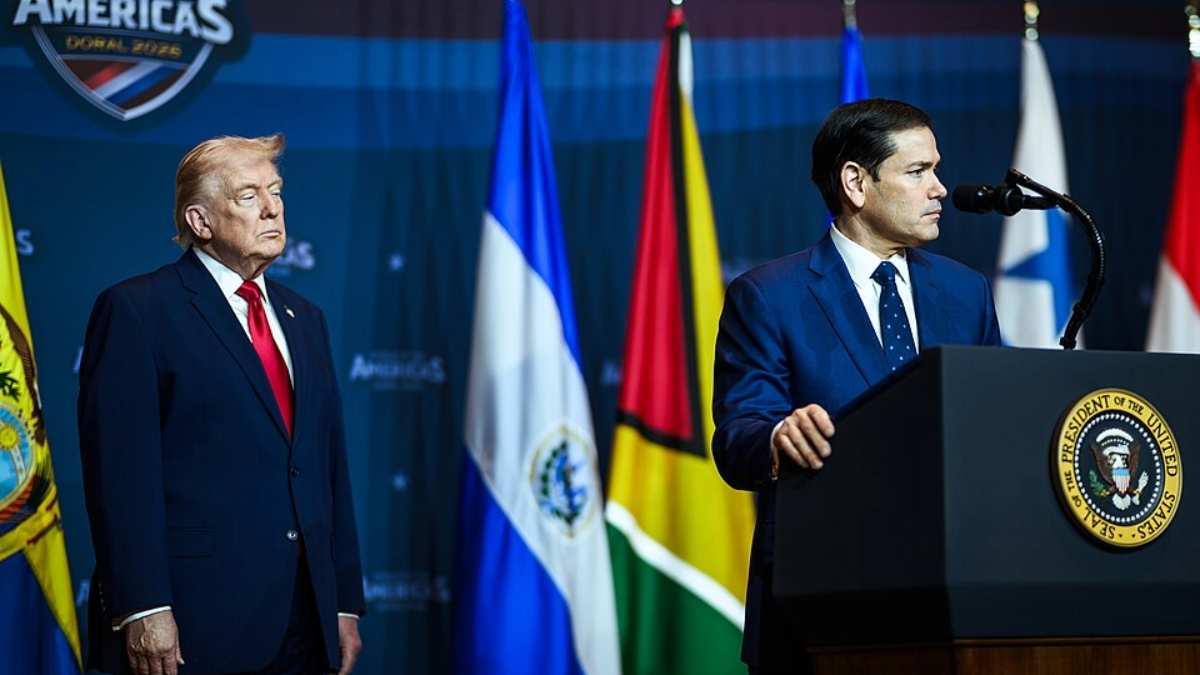
Secretary of State Marco Rubio delivers remarks during the Shield of the Americas summit in Miami on March 7. (Official White House Photo by Daniel Torok)
As the global order ruptures, internet infrastructure is offering us a glimpse into how different countries are managing these shifting tides. The United States’ decision to use sticks instead of carrots in South America should be read as yet another sign of its coercive turn.
On February 20, the US State Department revoked the visas of three Chilean government officials who were in the process of authorizing a $500 million project by a Chinese company, China Mobile, to link Valparaiso and Hong Kong by fiber optic cable. This would have been the first cable to directly link South America to China (and to Asia), an extraordinary situation given that China is South America’s top trading partner. While there are dozens of fiber optic cables linking Asia with North America, there are none directly linking Asia with South America. Meanwhile, every coastal South American country is already connected to the US, which also accounts for most of its international traffic.
Without publicly naming these individuals or the cable itself, the State Department claimed they had “knowingly directed, authorized, funded, provided significant support to, and/or carried out activities that compromised critical telecommunications infrastructure and undermined regional security in our hemisphere.” As it turns out, these sanctions were applied to the Minister of Transport Juan Carlos Muñoz, to the deputy minister of telecommunications and to the latter´s chief of staff, as well as their families.
What makes these sanctions noteworthy is that they were seemingly applied not for the application of a particular policy, but for merely considering the authorization of a foreign investment project, something Chilean government authorities are effectively forced to do by law. This radically expands the rationale for the application of sanctions.
Chile is the country with the highest internet penetration in Latin America. It is ranked among the top ten in digital governance by the Organisation for Economic Co-operation and Development (OECD), as is its average broadband internet speed. Chile is thus ideally placed to be the digital bridge linking Asia to South America.
Washington, however, strongly objects. It is not the first time the US has pressured Chile over its digital connectivity with China. In 2019, then-Secretary of State Mike Pompeo pressured Chile to shut down a similar project designed to lay a cable that would link Chile to Shanghai.
South America is at a geopolitical fault line, torn between a historical political bond with the US and a growing commercial bond pulling it towards China. In 2025, China surpassed the US as the region’s most important trading partner. Meanwhile, the US has come to expect the region is within its sphere of influence, and government officials recurrently refer to Latin America as their “backyard.” This hegemonic view has been described as the Monroe Doctrine, which asserts that the US considers foreign influence in the hemisphere as a threat to its national security. The Trump administration’s National Security Strategy released in November lays out the “Donroe Doctrine” as an expansion of the previous doctrine, now aimed at actively seeking “to purge unchecked economic … interference and to stamp out malign influence from extra-hemispheric powers.”
The global internet infrastructure, which expanded as the material underbelly of globalization during the unipolar world order of the 1990s and early 2000s, embodies the technological and economic order now under pressure. As a result of both the politics and the economics of it, the network of undersea cables currently exhibits a hub-and-spoke shape, with South American countries interacting through a central-US node.
In information networks, occupying these central positions allows these actors to shape information flows by pulling data circulating through the network (such as through surveillance, as revealed by Edward Snowden), pushing data into territories trying to restrict it (like propaganda in its traditional sense, a concern raised by US officials regarding the Chinese ownership of TikTok) or cutting information flows as a way to pressure parties dependent on these flows (such as via digital lockouts, like the US levied on the International Criminal Court (ICC) prosecutor, which led him to lose access to his email).
Given the ways in which the US has abused its central position in this global information network, it makes sense for the region to try to diversify its digital linkages and seek direct connections with more countries, including China. This diversification is crucial given that Trump's second term has brought about an acceleration of US unilateralism, best portrayed by the increase in sanctions by over 933% between 2000 and 2021.
That is, the US is willing to exploit its central position in the international network of trade to weaponize the emerging interdependence against its challengers. It would be a historical misstep if the US were allowed to gatekeep the ability of South America to communicate with Asia, a region which is currently contributing over 60 percent of global growth, and which includes China, the region’s main trading partner.
The Humboldt cable, currently being laid by Google to connect Chile to Australia, and onwards to Asia, does not solve this strategic vulnerability. It is managed by a US company (Google), which is subject to US law and could be required by the Treasury Department to cut off access to the region, as it has done to the ICC prosecutor. Furthermore, the plan is to route traffic to Asia through an intermediate landing point in Australia, a country that is a member of the US’s Five Eyes intelligence sharing alliance. As Edward Snowden revealed, this creates a risk that the US intelligence agencies would be pulling data from these cables.
As one cable manager recently stated: "Today, Chile is totally dependent on the United States; the only submarine fiber optic cables we have to connect to the world depend on the United States."
This creates the reasonable concern that the US might weaponize this dependence on Chile and the broader region, leveraging this dependence to coerce its leaders into making deals it would otherwise not. A direct cable connection with China is badly needed to lower risk from the US.
The region’s leaders should refuse to take sides in the US-China competition. In recent years, Latin American leaders such as Brazil’s Luiz Inacio Lula da Silva have taken this approach to cope with the US pressure in the region. Some scholars have come to refer to this strategy as Active Non-Alignment. This emerging strategic doctrine takes a page from the Non-Aligned Movement of yesteryear, which sought to ensure peripheral countries could retain their autonomy from the US and the Soviet Union, but adapts it to acknowledge that there are new challenges posed by China’s distinct prowess in managing global trade. In this specific scenario regarding cables, such a doctrine would call for diversifying digital connections to increase the resilience of the country’s digital network and ensuring it can talk freely with all parties.
These shared regional goals could be financed by a consortium of Chinese and South American backbone operators, public companies and governments. It could build upon the experience gained by Brazil, which after the Snowden revelations coordinated with the European Union towards laying down the EllaLink cable which connects South America directly to the EU. This was specifically to circumvent the landing points on US territory that the National Security Agency had used to spy on conversations between then-Brazilian President Dilma Rousseff and German Prime Minister Angela Merkel.
While South America’s current political fragmentation challenges any such collective project in the near future, interest in such a trans-Pacific cable project will not wane any time soon. Thus, working towards developing a project that can diffuse US pressure, ensuring it does not fall on a single South American country or company is the key to ensure the success of a variation of the past two failed projects.
South America is on a tense geopolitical fault line, with a technological stack tightly tethered to the US, while its overall trade relations increasingly reel the region towards China. In such a setting, the region needs to ensure it can engage freely and directly with both powers.
Authors