Why Brazil's Elections Offer Hope in the Fight Against Big Tech
Natalia Viana / Nov 24, 2026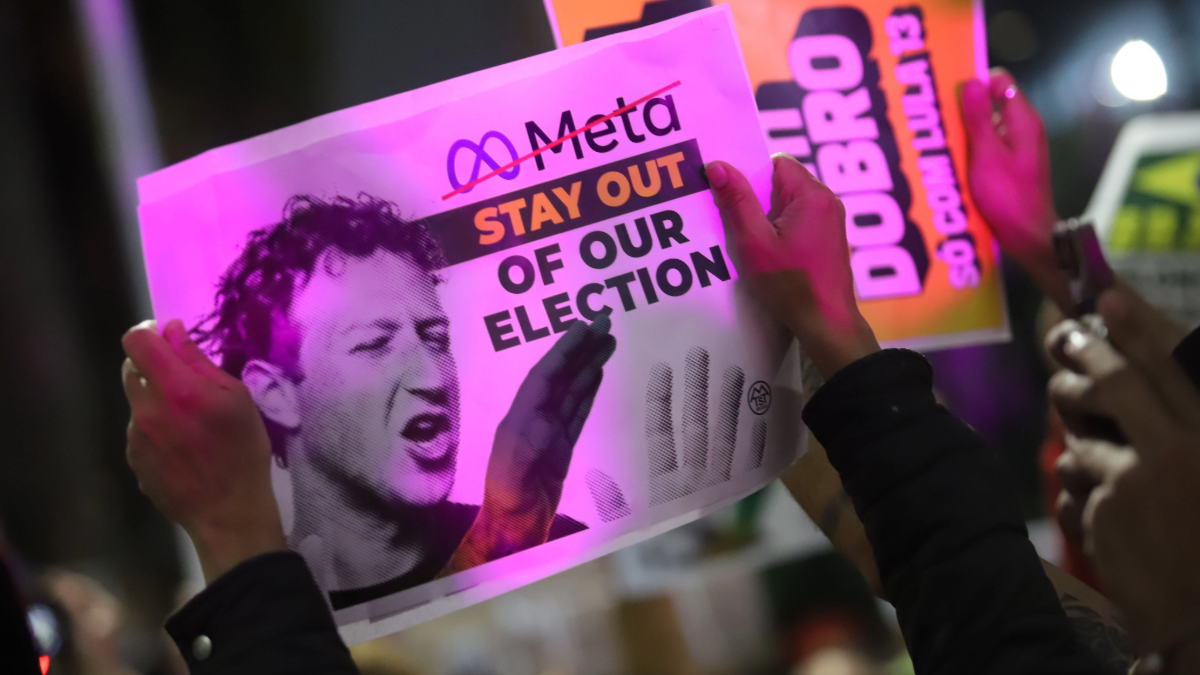
Civil society organizations and social movements held a demonstration in front of Meta's headquarters in São Paulo on Oct. 19 to protest against the company's alleged interference in the Brazilian electoral process. (Photo: Rodilei Morais/Fotoarena/Sipa via AP Images)
In an era when corporations in Silicon Valley have shown no restraint in allying themselves (and blatantly funding) anti-democratic forces, there is hope that societies can fight back — and the recent elections in the US and Brazil offer exactly that.
While in the US people’s resistance against data center implementation became a hot issue in many races, leading to several “anti-datacenter” results, what unfolded in Brazil's elections was historic — an example not only for the country but for the world.
The story of why and how begins and ends with Big Tech.
Brazil is among the countries that have felt most acutely what it means to face a disinformation campaign that weaponizes technological tools to destroy democracy. The attempted coup of January 8, 2023 was, as in the US two years earlier, an effort to destroy through disinformation a democracy that is still teetering — a young one, barely 40 years old.
In the months and years that followed, for the first time in its history, Brazil managed to gather evidence, prosecute and punish those who attempted the coup d'état. Today, dozens of military personnel involved in the coup led by former president Jair Bolsonaro are in prison. He himself is under house arrest, impeded from running for office.
At bottom, the recent election hinged on three themes. The first was a choice between two projects: the project embraced by the current president, Luiz Inácio Lula da Silva, which sought to continue confronting those who attempted a coup just three years ago; and the one defended by Flávio Bolsonaro, son of the former president, who promised amnesty for all of those involved in the insurrection – including his father – as his first act of government.
Flávio had the clear support of President Donald Trump and his administration for his project.
Perhaps such support was key for Trump because Brazil took a different route from the US in how it chose to handle its coup attempt. Instead of letting it go, Brazil created a detailed map of how disinformation-fueled coup d’état attempts are made in this era, and how a society can confront them. To that end, Washington adopted a series of pressure measures: the designation of the Brazilian drug cartels PCC and CV as terrorist organizations on June 5, announced just 10 days after Flávio Bolsonaro met with Trump and Secretary of State Marco Rubio in Washington so that he could claim the decision as a campaign achievement; and Rubio personally blaming Lula for the 25% tariffs the US government imposed on Brazilian exports, saying he “put his own ego ahead of making a deal for the welfare of the Brazilian people.” “President Lula and his government have not negotiated with the US in good faith. His economic policies are bad for Americans and bad for Brazilians,” Rubio wrote on X. There was also an attempt to send two State Department officials to question Brazil's electronic voting machines under the theme of "freedom of expression," and a meeting by the US consulate in São Paulo with right wing influencers to reinforce the "censorship" narrative.
The third theme was the role of Big Tech — connected to these same issues I mentioned before. Silicon Valley’s leaders will not admit to this, but the sheer reality is that tech giants were facilitators of the 2023 attempted coup. Not only did they fail to act to curb coup rhetoric, but they profited, selling ads to the very people who spread disinformation and threats.
In response, Brazilian society, the Lula government and politicians from different parties sought to pass regulation holding the companies accountable for illegal and harmful content freely replicated on their platforms. The response was brutal. The aggressive lobbying campaign included nearly 700 meetings in Congress, as well as propaganda and astroturfing — the creation of movements that appear to be spontaneous mobilizations but are funded and driven by the tech companies.
The law was never passed, which meant a new trauma for a society that came face to face with the very tangible prospect of returning to a dictatorship barely four decades after emerging from one.
This is fundamental to understanding what happened in the October elections this year.
Beyond the weight of the nightmare, the trauma, the memories of torture, corruption, violence and repression — what drove people to turn out massively for Lula in the second round of the election, with an extra 10 million votes comparing to the first round, was a mobilization against Big Tech and its apparent alliance with the US government against Brazil.
After defeating the regulation in Congress, as Agência Pública reported, Big Tech suffered blows in the Supreme Court, which suspended a law that allowed the companies to publish nearly anything without ever being held accountable, and in the Chamber of Deputies, where a law on digital protection for children was passed and signed into law by Lula in September 2025. The courts kept ordering the suspension of accounts accused of spreading hate speech and disinformation.
The reaction was brutal. Elon Musk’s X said it would no longer accept Brazil's orders and closed its office. Musk’s company lobbied alongside others from Silicon Valley for the Trump administration to act and punish Brazil. They secured a 25% tariff against Brazilian exports to the US, along with bans on companies doing business with a Supreme Court judge (under the Magnitsky Act) and the suspension of visas for nine of members of the judiciary.
All of it bears the hand of the tech companies. Their greatest allies, besides Trump, are the Bolsonaros, who promise to prevent any regulation of hate speech, attacks on constitutions and human rights violations.
The backdrop of this battle is a debate about freedom of expression and how our societies want to protect it for the good of citizens. The tech companies argue they are being censored in Brazil.
We Brazilians demand the right to regulate them and to order our information environment in a manner consistent with the democratic values we believe in. This is a battle of an entire country against the most powerful companies in the history of capitalism.
The last chapter took place in the second round of the presidential elections. In an election where the project of the techno-oligarchies allied with the Trump administration exerted enormous pressure on Brazil, it became very clear that Meta’s moderation decisions — the owner of the most widely used tools in Brazil, WhatsApp (170 million users), Facebook (110 million users) and Instagram (130 million users) — harmed President Lula's campaign. There were dozens of failures, account suspensions and episodes of shadow banning that affected mainly a single campaign. The company acknowledged technical issues, such as the suspension of the Lula campaign's ads account and that it permitted the creation of pro-Flavio AI content while impeding the same for Lula, but denied it ever acted to influence the election. It is important to say that the Electoral Court found no evidence that Meta was consciously damaging one campaign against the other, but still fined the company around $1.3 million due to delays in presenting evidence, incomplete information and data that was difficult to verify.
Other data reveal that the platforms did what they always do, and are rarely punished for: they disregarded the electoral law. The corporate accountability organization Ekō ran a test and found that 13 out of 15 fake AI-generated ads were approved by Meta to run on their platforms. The same organization mapped accounts posting information about the Brazilian election run from Guatemala, Colombia and Peru, and our own investigation at Agencia Pública found over 1,000 ads paid for in dollars, despite the national ban on foreign-financed campaign propaganda. The ads ran without labels and drew more than 82 million impressions before Meta removed them.
The response to these events came from a virtual coordination: the Army of Lula, a WhatsApp group that brought together more than 10 million Brazilians — 5% of the country, which equates to one in six of Lula's voters — who in a coordinated and massive way pushed true information and engagement on posts throughout social media, subverting the logic of the platforms.
Through comments, likes and shares, they got truthful messages and images to reach the citizenry, convincing the old and the young to vote against an authoritarian project.
In all of this, journalism — and independent journalism in particular — played a fundamental role. We watched the citizenry take each new revelation about corruption, coup plotting and international interference into their hands and, with the Army of Lula, work to spread them. Our revelations were widely republished, formed the basis of episodes of a viral YouTube series, and became influencer posts and memes.
We learned that the new phase of democracy in the digital era requires constant citizen mobilization. It also demands that people manage to confront and defeat Big Tech.
On the heels of a historic mobilization in my country, I can guarantee that humanity's future at this crossroads of capitalism and technology will only be bright if the citizenry takes into its hands the protection of the majority's rights.
Authors