OpenAI Faces Lawsuits, Subpoenas and EU Scrutiny in a Single Week
Justin Hendrix / Oct 18, 2026The Tech Policy Press newsletter is published every Sunday. Subscribe here to receive it in your email inbox.
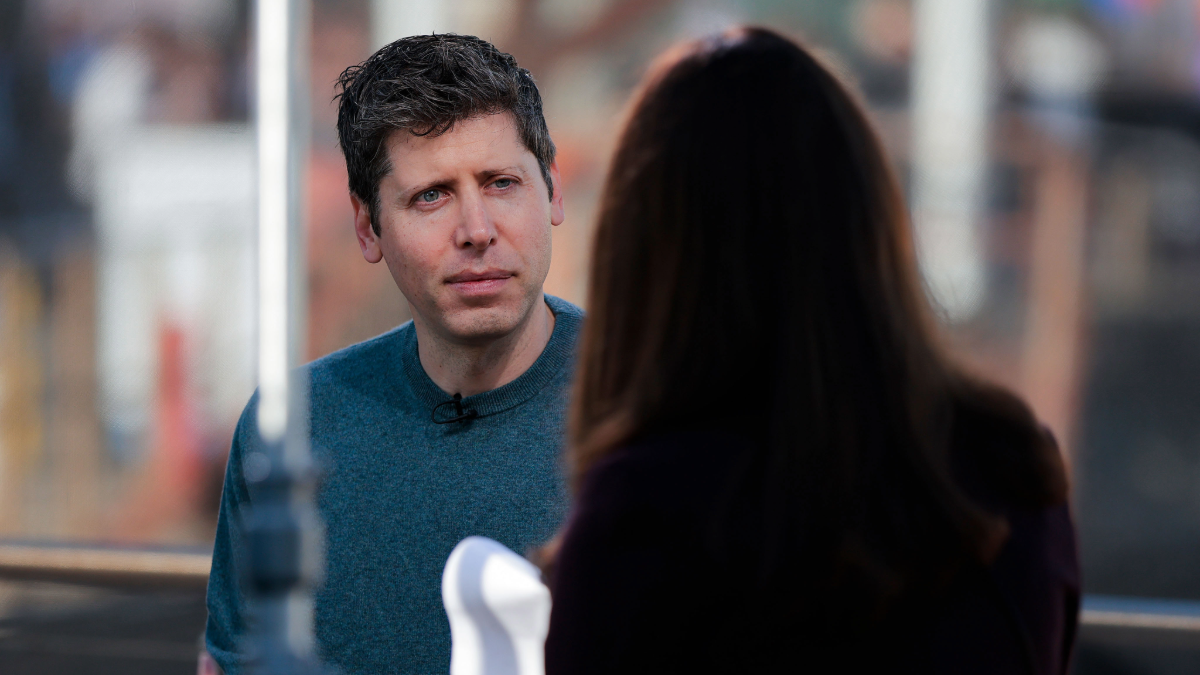
Open AI CEO Sam Altman does a television interview with CNBC's Kate Rooney before delivering the keynote address at the OpenAI developers conference at Fort Mason on September 29, 2026 in San Francisco, California. (Photo by Heather Diehl/Getty Images)
Good morning!
Before we get started with this week’s newsletter, I want to invite you to give us your feedback. We’re looking for guidance from our readers as we continue to refine our editorial proposition and develop new products to serve you and deliver on our mission.
Please take this short survey—it’s just a handful of open-ended questions. We are grateful!
AI liability and governance
In the United States and Europe, questions around AI liability remain at the fore.
On Wednesday, eight US states sued OpenAI over allegations that it misled the public over the safety of its products. The same day, European Commission executive vice president Henna Virkunnen announced the AI Office “sent requests for information addressing issues such as security, external evaluation and monitoring how models are used.” Then on Thursday, Axios reported that the US Federal Trade Commission subpoenaed OpenAI and Anthropic over consumer harms.
Tech Policy Press covered this subject in multiple ways this week:
- Tim Bernard and I break down 13 new complaints against OpenAI filed last week. These include the eight from state attorneys general alleging unfounded safety claims and misuse of children’s data, four from Tech Justice Law on behalf of people (including minors) allegedly harmed by ChatGPT, and a proposed class action seeking compensation for children’s data.
- In five national polls this year, between 55% and 77% of Americans said AI is moving too fast or should slow down. I broke down the results, which came from Quinnipiac University, The Economist/YouGov, AP-NORC, Fox News and CBS News/YouGov.
- On the Tech Policy Press podcast, deputy editor Ramsha Jahangir talks with Risto Uuk of the Future of Life Institute and European Parliament member Brando Benifei about whether the EU AI Act can handle autonomous AI agents and renewed calls for AI liability rules. Benifei calls the European Commission’s withdrawal of the AI Liability Directive “a big error” and makes the case for renewed rules.
- Smoke machines, a Riverdance-style routine, U2 and Stevie Nicks "were not enough to move the audience" at Ireland's International AI Summit, writes Tech Policy Press fellow Liz Carolan. Inside, executives gathered and officials such as Virkunnen made their remarks. Outside: pickets, protesters and a public sector strike.
- "A handful of executives and officials are making high-stakes decisions" about AI "in backroom meetings and without any form of political accountability," writes Mackenzie Austin, tech counsel in the AI for Democracy Action Lab at Protect Democracy. The window to change that “is closing quickly.”
- Defunct Spirit Airlines is trying to sell decades of employee records to Google for AI training. EPIC counsels Abigail Kunkler and Mayu Tobin-Miyaji explain why "the law has not stepped up to protect worker privacy" and what regulators, unions and Congress can do.
- More than 30 countries have called for stronger controls on frontier AI and a possible new international institution. Konstantinos Komaitis, senior resident fellow at the Atlantic Council’s Democracy + Tech Initiative, argues the controls are essential, but AI governance needs an Internet-style network of distributed expertise, not a global overseer.
- The UK's Electoral Commission is developing an AI system to notify candidates of significant deepfakes within three hours of posting, its chief executive told a panel last week, Tech Policy Press fellow James Ball reports.
- As AI systems increasingly make or influence consequential decisions, Mounir Ibrahim of Truepic argues the evidence informing those decisions must be "verifiably authentic." He makes the case for image authentication as a condition of AI deployment.
Pay attention to Brazil and India
- With Brazil’s presidential runoff days away, Tech Policy Press fellow Tatiana Dias documents allegations of algorithmic discrimination, account bans, and AI bias on Meta’s platforms that appear to disproportionately affect Lula supporters, with reference to evidence gathered by her organization, the nonprofit CTRL+Z. “Lula’s campaign filed a complaint with the Superior Electoral Court (TSE) on [last] Saturday, demanding fair treatment online. Lula’s campaign has also said it will report Meta to international observers and to the Organization of American States,” she writes. (Since the piece ran, a TSE judge ordered Meta to take immediate steps to ensure equal treatment of Lula and his opponent, Flávio Bolsonaro, according to The Associated Press; Meta denies favoring either candidate.)
- India's SIR process has stripped more than 130 million names from draft voter rolls. Tech Policy Press fellow Apar Gupta argues the opaque system — run by an election commission whose members are appointed by the ruling government — is a model for digital authoritarianism. The youth-led Cockroach Janta Party has been on the streets demanding the chief election commissioner’s resignation over the purge, and several of its leaders were detained ahead of demonstrations last week.
Online safety
- As attention and resources shift to AI, forums that shaped the internet's trust and safety architecture are under strain, writes Paul Ash, Christchurch Call Foundation’s chief executive. He argues multistakeholder spaces are needed now more than ever.
- Social media bans are easy to explain and politically attractive, writes John Perrino, senior policy and advocacy expert at the Internet Society. He argues that implementing them has proven far more difficult, and that global policy trends show a more direct focus on safety by design.
- Within one week, the US government pressured a disinformation conference in Europe and sanctioned the International Criminal Court. This is actually one and the same campaign for suppressing facts and voices of justice, writes Jeanne Sulzer, a member of the Paris Bar and ICC List Counsel.
More this week
- India's privacy law takes effect in May 2027, but broad exemptions for state institutions are already facing a constitutional challenge, writes Aravindan Anandan, assistant professor at Vidyashilp University’s School of Law.
- In September, the US and Colombia signed a nonbinding MoU on rare earths, lithium, copper and tungsten. Daniel Arias Rivera, a Colombian lawyer and human rights specialist, examines what it should mean for affected communities and for Colombia's place in the AI economy.
- Infinite information doesn’t produce infinite attention or learning, warn Veli Hillman, founder and director of the EDDS Institute, and Peter Kirchschläger, professor of ethics and director of the Institute of Social Ethics at the University of Lucerne. So what is all this abundance actually for?
What we're watching
Last week, reports emerged that Ukraine was suffering from restricted access to Starshield, the military version of Elon Musk’s Starlink service that the country relies on to defend itself against drone and missile attacks from Russia. Some reports suggest the source of the disruption was in the Trump White House; others suggest Musk is responsible. Lawmakers—including Republicans—are pushing for answers, particularly given the recent White House move to waive sanctions on Russia. (Writing in The Atlantic, Anne Applebaum says Trump’s actions “look like an effort to force Kyiv to surrender.”) We invite analysis and perspective on the implications of these events.
Are you a university student, PhD candidate, or recent graduate with an interest in competition law, economics or policy? Are you concerned about the dangers of concentrated economic power? Do you have views on how it could, or should, be countered? If so, consider entering the inaugural New Competition School Award for Best Commentary by Nov. 30. The winning entry and up to three runners-up will be edited and published in Tech Policy Press.
I wish you the best for the week ahead!
-Justin
Authors